




Find the range of c which the line \[y = mx + c\] touches the parabola \[{y^2} = 8\left( {x + 2} \right)\].
Answer
 Verified
594.6k+ views
Hint: Use both the given equation to eliminate ‘y’ and form an quadratic equation in term of ‘x’ and then equating discriminant of quadratic equation equal to zero as line is given tangent to parabola and then solving ‘c’ for discriminant greater than zero to find its range.
Complete step-by-step answer:
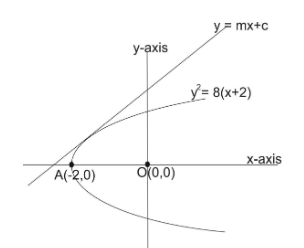
From the statement we have line $ y = mx + c $ touches the parabola $ {y^2} = 8(x + 2) $ .
Using, value of y from line in equation of parabola we have,
$ {(mx + c)^2} = 8x + 16 $
$ \Rightarrow {m^2}{x^2} + {c^2} + 2mxc = 8x + 16 $
Shifting terms to the left hand side. We have,
$ \Rightarrow {m^2}{x^2} + {c^2} + 2mcx - 8x - 16 = 0 $
Forming quadratic in terms of ‘x’.
$ \Rightarrow {m^2}{x^2} + (2mc - 8)x + ({c^2} - 16) = 0 $
Since, the given line touches the parabola. Hence, there will be only one root possible.
$ \therefore D = 0 $ , where D is discriminant of the above formed quadratic equation.
$ {b^2} - 4ac = 0\,\,\,\,\,\,\, $
From quadratic equation we have $ a = {m^2}{x^2},\,\,b = 2mc - 8,c = {c^2} - 16 $
Substituting values of ‘a’, ‘b’ and ‘c’ in above formula. We have,
\[{(2mc - 8)^2} - 4 \times {m^2} \times ({c^2} - 16) = 0\]
$ \Rightarrow {(2mc)^2} + {(8)^2} - 2 \times (2mc) \times 8 - 4{m^2}({c^2} - 16) = 0 $
$ \Rightarrow 4{m^2}{c^2} + 64 - 32mc - 4{m^2}{c^2} + 64{m^2} = 0 $
$ \Rightarrow 64{m^2} - 32mc + 64 = 0 $
$ \Rightarrow 32(2{m^2} - mc + 2) = 0 $
$ \Rightarrow 2{m^2} - cm + 2 = 0 $ , as $ m \in R(range) $
So, $ D \geqslant 0 $ , here $ a = 2,b = - c,c = 2 $
$ {b^2} - 4ac \geqslant 0\,\,\,\,\,\,\,\,\,\,\,\,\,\,\,\,\,\,\,\left\{ {\because D = {b^2} - 4ac} \right\} $
$ \Rightarrow {(c)^2} - 4 \times 2 \times 2 \geqslant 0 $
$ \Rightarrow {c^2} - 16 \geqslant 0 $
\[ \Rightarrow {c^2} \geqslant 0 + 16\]
\[ \Rightarrow {c^2} \geqslant 16\]
$ \Rightarrow |c| \geqslant 4 $
$\Rightarrow c \geqslant 4\,\,\,and\,\,\,c \leqslant - 4\,\,\,\,\,\,\,\,\,\,\,\,\,\,\,\,\,\,\,\,\,\,\,\,\,\,\left\{ {|x|\,\, \geqslant a \Rightarrow x > a\,\,and\,\,x \leqslant - a} \right\} $
$ \Rightarrow c \in ( - \infty , - 4] \cup [4,\infty ) $
Hence, from above we see that required range of ‘c’ is $ ( - \infty , - 4] \cup [4,\infty ) $
Note: We know that not even for parabola but for all curves like circle, ellipse, hyperbola etc. Whenever a given line touches the given curve (parabola, ellipse, hyperbola…) then always solve for discriminant equal to zero of quadratic equation formed by eliminating ‘y’ from parabola using given equation of a line and then solve the equation so formed from equating discriminant equal to zero to get required solution of the given problem.
Complete step-by-step answer:
From the statement we have line $ y = mx + c $ touches the parabola $ {y^2} = 8(x + 2) $ .
Using, value of y from line in equation of parabola we have,
$ {(mx + c)^2} = 8x + 16 $
$ \Rightarrow {m^2}{x^2} + {c^2} + 2mxc = 8x + 16 $
Shifting terms to the left hand side. We have,
$ \Rightarrow {m^2}{x^2} + {c^2} + 2mcx - 8x - 16 = 0 $
Forming quadratic in terms of ‘x’.
$ \Rightarrow {m^2}{x^2} + (2mc - 8)x + ({c^2} - 16) = 0 $
Since, the given line touches the parabola. Hence, there will be only one root possible.
$ \therefore D = 0 $ , where D is discriminant of the above formed quadratic equation.
$ {b^2} - 4ac = 0\,\,\,\,\,\,\, $
From quadratic equation we have $ a = {m^2}{x^2},\,\,b = 2mc - 8,c = {c^2} - 16 $
Substituting values of ‘a’, ‘b’ and ‘c’ in above formula. We have,
\[{(2mc - 8)^2} - 4 \times {m^2} \times ({c^2} - 16) = 0\]
$ \Rightarrow {(2mc)^2} + {(8)^2} - 2 \times (2mc) \times 8 - 4{m^2}({c^2} - 16) = 0 $
$ \Rightarrow 4{m^2}{c^2} + 64 - 32mc - 4{m^2}{c^2} + 64{m^2} = 0 $
$ \Rightarrow 64{m^2} - 32mc + 64 = 0 $
$ \Rightarrow 32(2{m^2} - mc + 2) = 0 $
$ \Rightarrow 2{m^2} - cm + 2 = 0 $ , as $ m \in R(range) $
So, $ D \geqslant 0 $ , here $ a = 2,b = - c,c = 2 $
$ {b^2} - 4ac \geqslant 0\,\,\,\,\,\,\,\,\,\,\,\,\,\,\,\,\,\,\,\left\{ {\because D = {b^2} - 4ac} \right\} $
$ \Rightarrow {(c)^2} - 4 \times 2 \times 2 \geqslant 0 $
$ \Rightarrow {c^2} - 16 \geqslant 0 $
\[ \Rightarrow {c^2} \geqslant 0 + 16\]
\[ \Rightarrow {c^2} \geqslant 16\]
$ \Rightarrow |c| \geqslant 4 $
$\Rightarrow c \geqslant 4\,\,\,and\,\,\,c \leqslant - 4\,\,\,\,\,\,\,\,\,\,\,\,\,\,\,\,\,\,\,\,\,\,\,\,\,\,\left\{ {|x|\,\, \geqslant a \Rightarrow x > a\,\,and\,\,x \leqslant - a} \right\} $
$ \Rightarrow c \in ( - \infty , - 4] \cup [4,\infty ) $
Hence, from above we see that required range of ‘c’ is $ ( - \infty , - 4] \cup [4,\infty ) $
Note: We know that not even for parabola but for all curves like circle, ellipse, hyperbola etc. Whenever a given line touches the given curve (parabola, ellipse, hyperbola…) then always solve for discriminant equal to zero of quadratic equation formed by eliminating ‘y’ from parabola using given equation of a line and then solve the equation so formed from equating discriminant equal to zero to get required solution of the given problem.
Recently Updated Pages
Master Class 11 Social Science: Engaging Questions & Answers for Success

Master Class 11 Physics: Engaging Questions & Answers for Success
Master Class 11 Maths: Engaging Questions & Answers for Success
Master Class 11 Economics: Engaging Questions & Answers for Success
Master Class 11 Computer Science: Engaging Questions & Answers for Success
Master Class 11 Chemistry: Engaging Questions & Answers for Success
Trending doubts
One Metric ton is equal to kg A 10000 B 1000 C 100 class 11 physics CBSE
There are 720 permutations of the digits 1 2 3 4 5 class 11 maths CBSE
1 Quintal is equal to a 110 kg b 10 kg c 100kg d 1000 class 11 physics CBSE
State and prove Bernoullis theorem class 11 physics CBSE
Difference Between Prokaryotic Cells and Eukaryotic Cells
Which among the following are examples of coming together class 11 social science CBSE