




Find the quadrant or axis in/on which the following point lies \[\left( { - 5,7} \right)\]?
A. I
B. II
C. III
D. None of these
Answer
 Verified
479.1k+ views
Hint: Here, we are given a point and we need to find out in which quadrant it lies. Also, one should note that the x coordinate is always written first and the y coordinate is written next. And so, starting from the top right corner is Quadrant I and then, in a counter clockwise direction you will see Quadrants II, III and IV. Thus, we will notice the sign of the coordinates in each point and then compare them with the standard form of the quadrants to get the final output.
Complete step by step answer:
Given, one point \[\left( { - 5,7} \right)\]
We know that, when we draw a horizontal line and then a vertical line, both intersect and that intersection point is called the origin. Then, from the reference of origin and those two lines we define quadrants, the horizontal line is called x-axis and the vertical line is called y-axis and so we get 4 quadrants in all.
For this, we will first understand the type of points every quadrant has and then compare them with the given point to find the required quadrant in which the given point lies.
So, we have drawn the figure below:
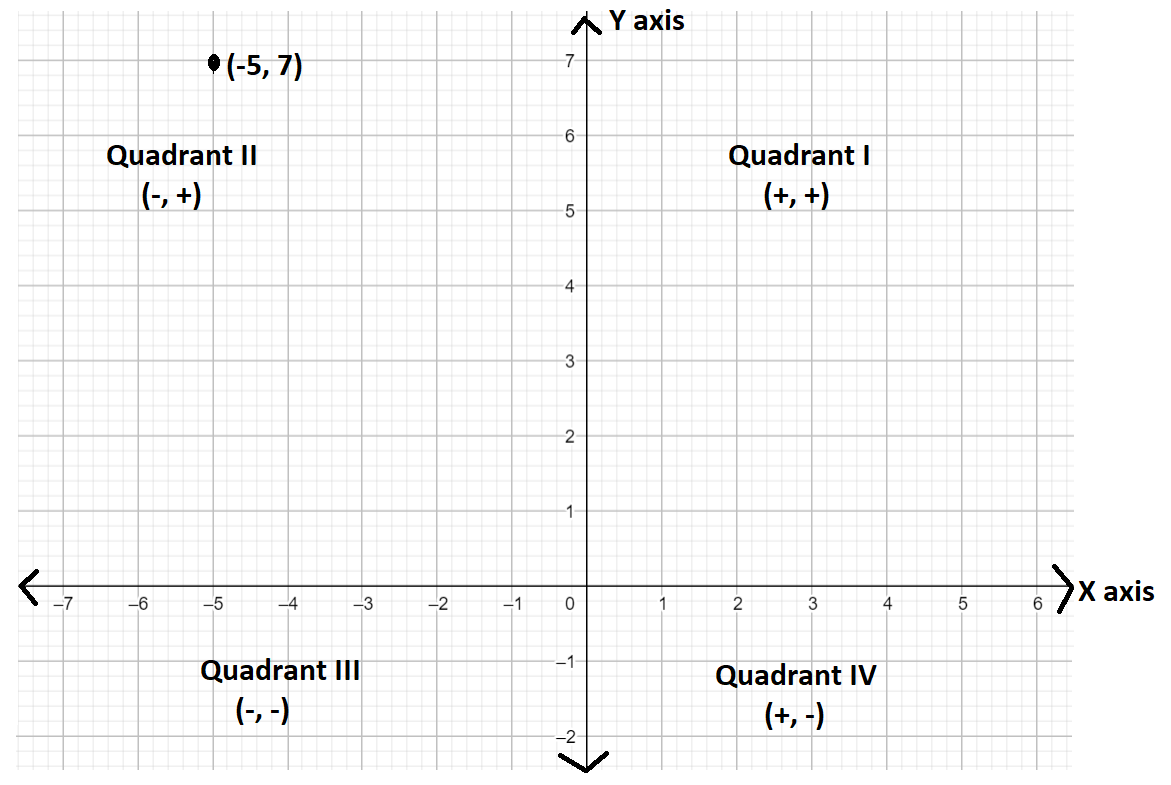
According to the figure, both the coordinates are there in all the 4 quadrants as shown below:
1) 1st quadrant: x is positive and y is positive
2) 2nd quadrant: x is negative and y is positive
3) 3rd quadrant: x is negative and y is negative
4) 4th quadrant: x is positive and y is negative.
We are given a point \[\left( { - 5,7} \right)\] and in this, x is negative and y is positive.
So, from the figure, we can say that this point is in the 2nd quadrant.
Hence, the point \[\left( { - 5,7} \right)\] lies in quadrant II.
Note:
A quadrant is the area contained by the x and y axis. To explain this, the two dimensional Cartesian plane is divided by the x and y axis into four quadrants. Students often make mistakes in naming quadrants in the Cartesian plane. Also remember, the quadrant starts from the top right corner and moves in an anticlockwise direction.
Complete step by step answer:
Given, one point \[\left( { - 5,7} \right)\]
We know that, when we draw a horizontal line and then a vertical line, both intersect and that intersection point is called the origin. Then, from the reference of origin and those two lines we define quadrants, the horizontal line is called x-axis and the vertical line is called y-axis and so we get 4 quadrants in all.
For this, we will first understand the type of points every quadrant has and then compare them with the given point to find the required quadrant in which the given point lies.
So, we have drawn the figure below:
According to the figure, both the coordinates are there in all the 4 quadrants as shown below:
1) 1st quadrant: x is positive and y is positive
2) 2nd quadrant: x is negative and y is positive
3) 3rd quadrant: x is negative and y is negative
4) 4th quadrant: x is positive and y is negative.
We are given a point \[\left( { - 5,7} \right)\] and in this, x is negative and y is positive.
So, from the figure, we can say that this point is in the 2nd quadrant.
Hence, the point \[\left( { - 5,7} \right)\] lies in quadrant II.
Note:
A quadrant is the area contained by the x and y axis. To explain this, the two dimensional Cartesian plane is divided by the x and y axis into four quadrants. Students often make mistakes in naming quadrants in the Cartesian plane. Also remember, the quadrant starts from the top right corner and moves in an anticlockwise direction.
Recently Updated Pages
Master Class 11 Computer Science: Engaging Questions & Answers for Success

Master Class 11 Business Studies: Engaging Questions & Answers for Success
Master Class 11 Economics: Engaging Questions & Answers for Success
Master Class 11 English: Engaging Questions & Answers for Success
Master Class 11 Maths: Engaging Questions & Answers for Success
Master Class 11 Biology: Engaging Questions & Answers for Success
Trending doubts
One Metric ton is equal to kg A 10000 B 1000 C 100 class 11 physics CBSE
There are 720 permutations of the digits 1 2 3 4 5 class 11 maths CBSE
Discuss the various forms of bacteria class 11 biology CBSE
Draw a diagram of a plant cell and label at least eight class 11 biology CBSE
State the laws of reflection of light
Explain zero factorial class 11 maths CBSE