




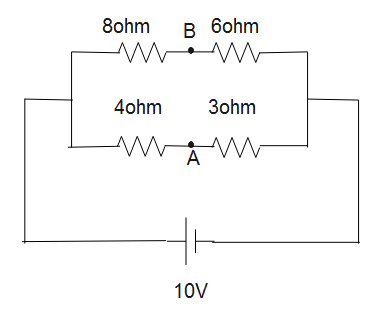
Find the potential difference between A and B:
Answer
 Verified
594k+ views
Hint: In this question, we will use the basic relation between voltage, current and resistance, which is given by Ohm’s law. We will use this formula to calculate voltage for each resistance and finally get the required result by applying Kirchhoff’s law. Further, we will study the basics of series and parallel circuit, for our better understanding.
Formula used:
$V = IR$
Complete step by step solution:
We know that, potential difference across 8 ohm resistor is $8{i_1}$
Similarly potential difference across 6 ohm resistor is $6{i_1}$
$\eqalign{& 10V = 8{i_1} + 6{i_1} \cr
& \Rightarrow {i_1} = \dfrac{{10}}{{14}} = \dfrac{5}{7}A \cr} $
Now, potential difference across 4 ohm resistor is $4{i_2}$
Similarly, potential difference across 3 ohm resistor is $3{i_2}$
$\eqalign{
& 10V = 4{i_2} + 3{i_2} \cr
& \Rightarrow {i_2} = \dfrac{{10}}{7}A \cr} $
Now, from Kirchhoff’s law, we can write:
${V_A} - {V_B} = - 4{i_2} + 8{i_1}$
Here, we substitute the values of current in the above equation:
${V_A} - {V_B} = - 4\left( {\dfrac{{10}}{7}} \right) + 8\left( {\dfrac{5}{7}} \right)$
$\therefore {V_A} - {V_B} = 0$
Therefore, we get the required result i.e., the potential difference between A and B in the given circuit is zero.
Additional information:
We should know that in a series circuit, the output current of the first resistor flows into the input of the second resistor; so, the current is the same in each resistor whereas In a parallel circuit, all of the resistor are on connected together on one side and all the leads on the other side are connected together.
In a circuit if the resistance is constant over a range of voltage, then I = V/R, can be used to predict the behavior of the material. This involves DC current and voltage, it is the same for the resistors. Further, a material obeys Ohm's law or does not obey; the resistance of the material can be described in terms of its bulk.
The resistivity, and the resistance both, is temperature dependent. Over certain ranges of temperature, this temperature dependence can be predicted from resistance.
Note:
In series connection the resistances are directly added whereas in parallel connection resistance is added inversely. Internal resistance of a circuit refers to the opposition to the flow of current offered by the cells and batteries themselves thereby, resulting in the generation of heat. Internal resistance and resistance both are measured in Ohms.
Formula used:
$V = IR$
Complete step by step solution:
We know that, potential difference across 8 ohm resistor is $8{i_1}$
Similarly potential difference across 6 ohm resistor is $6{i_1}$
$\eqalign{& 10V = 8{i_1} + 6{i_1} \cr
& \Rightarrow {i_1} = \dfrac{{10}}{{14}} = \dfrac{5}{7}A \cr} $
Now, potential difference across 4 ohm resistor is $4{i_2}$
Similarly, potential difference across 3 ohm resistor is $3{i_2}$
$\eqalign{
& 10V = 4{i_2} + 3{i_2} \cr
& \Rightarrow {i_2} = \dfrac{{10}}{7}A \cr} $
Now, from Kirchhoff’s law, we can write:
${V_A} - {V_B} = - 4{i_2} + 8{i_1}$
Here, we substitute the values of current in the above equation:
${V_A} - {V_B} = - 4\left( {\dfrac{{10}}{7}} \right) + 8\left( {\dfrac{5}{7}} \right)$
$\therefore {V_A} - {V_B} = 0$
Therefore, we get the required result i.e., the potential difference between A and B in the given circuit is zero.
Additional information:
We should know that in a series circuit, the output current of the first resistor flows into the input of the second resistor; so, the current is the same in each resistor whereas In a parallel circuit, all of the resistor are on connected together on one side and all the leads on the other side are connected together.
In a circuit if the resistance is constant over a range of voltage, then I = V/R, can be used to predict the behavior of the material. This involves DC current and voltage, it is the same for the resistors. Further, a material obeys Ohm's law or does not obey; the resistance of the material can be described in terms of its bulk.
The resistivity, and the resistance both, is temperature dependent. Over certain ranges of temperature, this temperature dependence can be predicted from resistance.
Note:
In series connection the resistances are directly added whereas in parallel connection resistance is added inversely. Internal resistance of a circuit refers to the opposition to the flow of current offered by the cells and batteries themselves thereby, resulting in the generation of heat. Internal resistance and resistance both are measured in Ohms.
Recently Updated Pages
Master Class 12 Business Studies: Engaging Questions & Answers for Success

Master Class 12 Chemistry: Engaging Questions & Answers for Success
Master Class 12 Biology: Engaging Questions & Answers for Success
Class 12 Question and Answer - Your Ultimate Solutions Guide
Master Class 9 General Knowledge: Engaging Questions & Answers for Success
Master Class 9 Maths: Engaging Questions & Answers for Success
Trending doubts
Which are the Top 10 Largest Countries of the World?
Draw a labelled sketch of the human eye class 12 physics CBSE
Name the crygenes that control cotton bollworm and class 12 biology CBSE
Differentiate between homogeneous and heterogeneous class 12 chemistry CBSE
In a transcription unit the promoter is said to be class 12 biology CBSE
Sulphuric acid is known as the king of acids State class 12 chemistry CBSE