




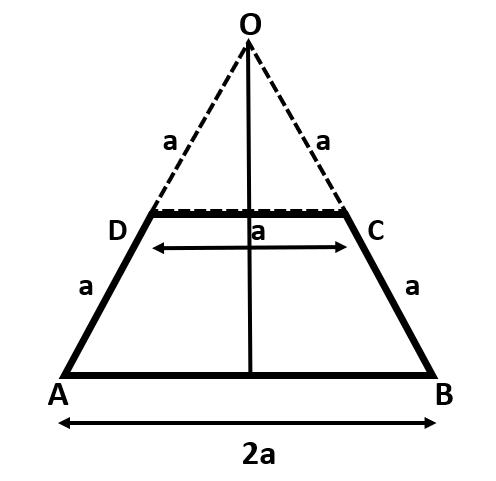
Find the position of COM of uniform lamina ABCD (as shown in figure) from O.
A).$\dfrac{a}{2\sqrt{3}}$
B).$\dfrac{7a}{3\sqrt{3}}$
C).$\dfrac{2a}{2\sqrt{3}}$
D). None of these
Answer
 Verified
545.4k+ views
Hint: In order to find the COM of the lamina ABCD, we will consider the triangle OAB to be fully made of the same material as that of lamina ABCD. Then, we can subtract the COM of smaller triangle OCD from the COM of larger triangle OAB, both calculated from O, to get the COM of the lamina ABCD.
Complete step-by-step solution:
First of all we will find what type of triangle is formed by triangle OAB and triangle OCD.
We can see that all the sides of triangle OAB are equal and the length of each side is ‘2a’. Also, in the smaller triangle OCD, the length of all the sides are equal, that is, ‘a’. Thus, both the triangles are equilateral triangles.
Now, from the property of equilateral triangle, we have the COM of an equilateral triangle lies at its centroid which is at a distance of $\left( \dfrac{2h}{3} \right)$ from any of its vertex,
where ‘h’ is the length of the base.
We can understand this with the help of the following diagram:
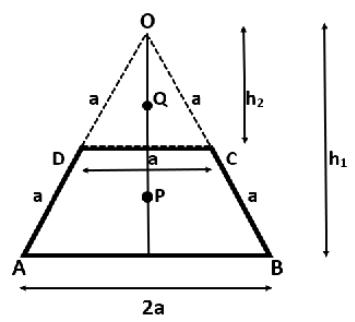
Now, in triangle OAB, we have:
$\begin{align}
& \Rightarrow {{h}_{1}}=2a\cos {{30}^{0}} \\
& \therefore {{h}_{1}}=\sqrt{3}a \\
\end{align}$
Therefore, its COM from O (say P) is equal to:
$\begin{align}
& \Rightarrow P=\dfrac{2{{h}_{1}}}{3} \\
& \Rightarrow P=\dfrac{2\sqrt{3}a}{3} \\
\end{align}$
Now, in triangle OCD, we have:
$\begin{align}
& \Rightarrow {{h}_{2}}=a\cos {{30}^{0}} \\
& \therefore {{h}_{2}}=\dfrac{\sqrt{3}a}{2} \\
\end{align}$
Therefore, its COM from O (say Q) is equal to:
$\begin{align}
& \Rightarrow Q=\dfrac{2{{h}_{2}}}{3} \\
& \Rightarrow Q=\dfrac{2\dfrac{\sqrt{3}a}{2}}{3} \\
& \Rightarrow Q=\dfrac{\sqrt{3}a}{3} \\
\end{align}$
Now, the mass of triangle OAB is equal to (assuming surface mass density as d):
$\begin{align}
& \Rightarrow {{M}_{OAB}}=d\times \left( \dfrac{1}{2}\times 2a\times \sqrt{3}a \right) \\
& \Rightarrow {{M}_{OAB}}=\sqrt{3}{{a}^{2}}d \\
\end{align}$
And, the mass of triangle OCD is equal to:
$\begin{align}
& \Rightarrow {{M}_{OCD}}=d\times \left( \dfrac{1}{2}\times a\times \dfrac{\sqrt{3}a}{2} \right) \\
& \Rightarrow {{M}_{OCD}}=\dfrac{\sqrt{3}{{a}^{2}}d}{4} \\
\end{align}$
Therefore, the COM of lamina ABCD (say X) could be written as:
$\Rightarrow X=\dfrac{{{M}_{OAB}}P-{{M}_{OCD}}Q}{{{M}_{OAB}}-{{M}_{OCD}}}$
Putting the values of all the terms in the above equation, we get:
$\Rightarrow X=\dfrac{\sqrt{3}{{a}^{2}}d\times \dfrac{2\sqrt{3}a}{3}-\dfrac{\sqrt{3}{{a}^{2}}d}{4}\times \dfrac{\sqrt{3}a}{3}}{\sqrt{3}{{a}^{2}}d-\dfrac{\sqrt{3}{{a}^{2}}d}{4}}$
On simplifying the above equation, we get:
$\begin{align}
& \Rightarrow X=\dfrac{\left( 2a-\dfrac{a}{4} \right)}{\left( \sqrt{3}-\dfrac{\sqrt{3}}{4} \right)} \\
& \therefore X=\dfrac{7a}{3\sqrt{3}} \\
\end{align}$
Hence, the distance of COM of lamina ABCD from the point O comes out to be $\dfrac{7a}{3\sqrt{3}}$.
Hence, option (B) is the correct option.
Note: To calculate the COM of lamina only would have been quite tough if we tried to solve it by breaking the lamina into two triangles and one rectangle as it would have taken a lot more calculation and time. In problems like these, we need to find the best possible solution, that is, the one with least amount of time required and least amount of calculation needed.
Complete step-by-step solution:
First of all we will find what type of triangle is formed by triangle OAB and triangle OCD.
We can see that all the sides of triangle OAB are equal and the length of each side is ‘2a’. Also, in the smaller triangle OCD, the length of all the sides are equal, that is, ‘a’. Thus, both the triangles are equilateral triangles.
Now, from the property of equilateral triangle, we have the COM of an equilateral triangle lies at its centroid which is at a distance of $\left( \dfrac{2h}{3} \right)$ from any of its vertex,
where ‘h’ is the length of the base.
We can understand this with the help of the following diagram:
Now, in triangle OAB, we have:
$\begin{align}
& \Rightarrow {{h}_{1}}=2a\cos {{30}^{0}} \\
& \therefore {{h}_{1}}=\sqrt{3}a \\
\end{align}$
Therefore, its COM from O (say P) is equal to:
$\begin{align}
& \Rightarrow P=\dfrac{2{{h}_{1}}}{3} \\
& \Rightarrow P=\dfrac{2\sqrt{3}a}{3} \\
\end{align}$
Now, in triangle OCD, we have:
$\begin{align}
& \Rightarrow {{h}_{2}}=a\cos {{30}^{0}} \\
& \therefore {{h}_{2}}=\dfrac{\sqrt{3}a}{2} \\
\end{align}$
Therefore, its COM from O (say Q) is equal to:
$\begin{align}
& \Rightarrow Q=\dfrac{2{{h}_{2}}}{3} \\
& \Rightarrow Q=\dfrac{2\dfrac{\sqrt{3}a}{2}}{3} \\
& \Rightarrow Q=\dfrac{\sqrt{3}a}{3} \\
\end{align}$
Now, the mass of triangle OAB is equal to (assuming surface mass density as d):
$\begin{align}
& \Rightarrow {{M}_{OAB}}=d\times \left( \dfrac{1}{2}\times 2a\times \sqrt{3}a \right) \\
& \Rightarrow {{M}_{OAB}}=\sqrt{3}{{a}^{2}}d \\
\end{align}$
And, the mass of triangle OCD is equal to:
$\begin{align}
& \Rightarrow {{M}_{OCD}}=d\times \left( \dfrac{1}{2}\times a\times \dfrac{\sqrt{3}a}{2} \right) \\
& \Rightarrow {{M}_{OCD}}=\dfrac{\sqrt{3}{{a}^{2}}d}{4} \\
\end{align}$
Therefore, the COM of lamina ABCD (say X) could be written as:
$\Rightarrow X=\dfrac{{{M}_{OAB}}P-{{M}_{OCD}}Q}{{{M}_{OAB}}-{{M}_{OCD}}}$
Putting the values of all the terms in the above equation, we get:
$\Rightarrow X=\dfrac{\sqrt{3}{{a}^{2}}d\times \dfrac{2\sqrt{3}a}{3}-\dfrac{\sqrt{3}{{a}^{2}}d}{4}\times \dfrac{\sqrt{3}a}{3}}{\sqrt{3}{{a}^{2}}d-\dfrac{\sqrt{3}{{a}^{2}}d}{4}}$
On simplifying the above equation, we get:
$\begin{align}
& \Rightarrow X=\dfrac{\left( 2a-\dfrac{a}{4} \right)}{\left( \sqrt{3}-\dfrac{\sqrt{3}}{4} \right)} \\
& \therefore X=\dfrac{7a}{3\sqrt{3}} \\
\end{align}$
Hence, the distance of COM of lamina ABCD from the point O comes out to be $\dfrac{7a}{3\sqrt{3}}$.
Hence, option (B) is the correct option.
Note: To calculate the COM of lamina only would have been quite tough if we tried to solve it by breaking the lamina into two triangles and one rectangle as it would have taken a lot more calculation and time. In problems like these, we need to find the best possible solution, that is, the one with least amount of time required and least amount of calculation needed.
Recently Updated Pages
Master Class 11 Social Science: Engaging Questions & Answers for Success

Master Class 11 Physics: Engaging Questions & Answers for Success
Master Class 11 Maths: Engaging Questions & Answers for Success
Master Class 11 Economics: Engaging Questions & Answers for Success
Master Class 11 Computer Science: Engaging Questions & Answers for Success
Master Class 11 Chemistry: Engaging Questions & Answers for Success
Trending doubts
One Metric ton is equal to kg A 10000 B 1000 C 100 class 11 physics CBSE
There are 720 permutations of the digits 1 2 3 4 5 class 11 maths CBSE
1 Quintal is equal to a 110 kg b 10 kg c 100kg d 1000 class 11 physics CBSE
State and prove Bernoullis theorem class 11 physics CBSE
Difference Between Prokaryotic Cells and Eukaryotic Cells
Discuss the various forms of bacteria class 11 biology CBSE