




How do you find the period of $y=\cot \left( 2\dfrac{x}{3} \right)$?
Answer
 Verified
581.7k+ views
Hint: Firstly we need to consider the graph of the function $y=\cot x$ and determine its period. Then by scaling the graph of $y=\cot x$, we will obtain the graph of the given function, that is, $y=\cot \left( 2\dfrac{x}{3} \right)$. From that graph, the required period can be easily determined.
Complete step by step solution:
The function given in the above question is
$\Rightarrow y=\cot \left( 2\dfrac{x}{3} \right)$
We see that the above function is similar to the function $y=\cot x$. The graph of the function $y=\cot x$ is given as
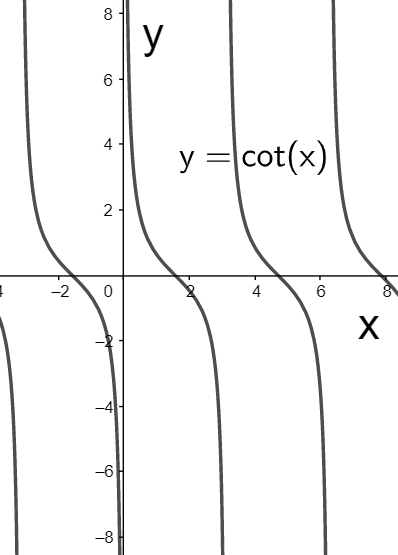
The graph cuts the x-axis at the points $\left( -\dfrac{\pi }{2},0 \right);\left( \dfrac{\pi }{2},0 \right);\left( \dfrac{3\pi }{2},0 \right).......$. Therefore, its period can be given by
$\begin{align}
& \Rightarrow T=\dfrac{\pi }{2}-\left( -\dfrac{\pi }{2} \right) \\
& \Rightarrow T=\dfrac{\pi }{2}+\dfrac{\pi }{2} \\
& \Rightarrow T=\pi .......(i) \\
\end{align}$
So the period of $y=\cot x$ is $\pi $.
Now, the equation $y=\cot \left( 2\dfrac{x}{3} \right)$ can also be written as
$\Rightarrow y=\cot \left( \dfrac{x}{\dfrac{3}{2}} \right)$
Comparing $y=\cot x$, we see that the only change is that the independent variable $x$ is divided by $\dfrac{3}{2}$. So the graph of $y=\cot \left( 2\dfrac{x}{3} \right)$ can be obtained by expanding the graph of $y=\cot x$ in the horizontal direction by $\dfrac{3}{2}$ units as shown below.
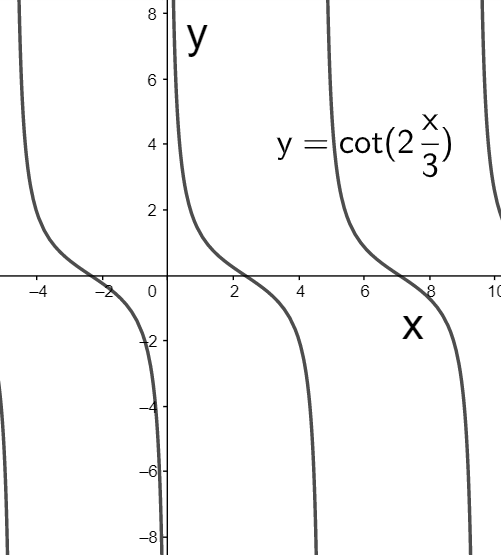
Since the graph of $y=\cot x$ is expanded by $\dfrac{3}{2}$ units, so its period must also be expanded by the same amount, that is, if the period of $y=\cot \left( 2\dfrac{x}{3} \right)$ is $T'$, then it can be given by
$\Rightarrow T'=\dfrac{3}{2}T$
Substituting (i) in the above equation, we get
$\begin{align}
& \Rightarrow T'=\dfrac{3}{2}\pi \\
& \Rightarrow T'=\dfrac{3\pi }{2} \\
\end{align}$
Hence, the period of $y=\cot \left( 2\dfrac{x}{3} \right)$ is equal to $\dfrac{3\pi }{2}$.
Note:
For solving these types of questions, we don’t necessarily need the help of the graphs. The graphs only make our work easier. But if we can’t remember them, then we must remember the period of the trigonometric functions. The period of the sine and the cosine functions is equal to $2\pi $, while that of the tangent and the cotangent functions is equal to $\pi $. Then doing the required scaling on the period, we can obtain the period of any trigonometric function.
Complete step by step solution:
The function given in the above question is
$\Rightarrow y=\cot \left( 2\dfrac{x}{3} \right)$
We see that the above function is similar to the function $y=\cot x$. The graph of the function $y=\cot x$ is given as
The graph cuts the x-axis at the points $\left( -\dfrac{\pi }{2},0 \right);\left( \dfrac{\pi }{2},0 \right);\left( \dfrac{3\pi }{2},0 \right).......$. Therefore, its period can be given by
$\begin{align}
& \Rightarrow T=\dfrac{\pi }{2}-\left( -\dfrac{\pi }{2} \right) \\
& \Rightarrow T=\dfrac{\pi }{2}+\dfrac{\pi }{2} \\
& \Rightarrow T=\pi .......(i) \\
\end{align}$
So the period of $y=\cot x$ is $\pi $.
Now, the equation $y=\cot \left( 2\dfrac{x}{3} \right)$ can also be written as
$\Rightarrow y=\cot \left( \dfrac{x}{\dfrac{3}{2}} \right)$
Comparing $y=\cot x$, we see that the only change is that the independent variable $x$ is divided by $\dfrac{3}{2}$. So the graph of $y=\cot \left( 2\dfrac{x}{3} \right)$ can be obtained by expanding the graph of $y=\cot x$ in the horizontal direction by $\dfrac{3}{2}$ units as shown below.
Since the graph of $y=\cot x$ is expanded by $\dfrac{3}{2}$ units, so its period must also be expanded by the same amount, that is, if the period of $y=\cot \left( 2\dfrac{x}{3} \right)$ is $T'$, then it can be given by
$\Rightarrow T'=\dfrac{3}{2}T$
Substituting (i) in the above equation, we get
$\begin{align}
& \Rightarrow T'=\dfrac{3}{2}\pi \\
& \Rightarrow T'=\dfrac{3\pi }{2} \\
\end{align}$
Hence, the period of $y=\cot \left( 2\dfrac{x}{3} \right)$ is equal to $\dfrac{3\pi }{2}$.
Note:
For solving these types of questions, we don’t necessarily need the help of the graphs. The graphs only make our work easier. But if we can’t remember them, then we must remember the period of the trigonometric functions. The period of the sine and the cosine functions is equal to $2\pi $, while that of the tangent and the cotangent functions is equal to $\pi $. Then doing the required scaling on the period, we can obtain the period of any trigonometric function.
Recently Updated Pages
Master Class 11 Social Science: Engaging Questions & Answers for Success

Master Class 11 Chemistry: Engaging Questions & Answers for Success
Master Class 9 General Knowledge: Engaging Questions & Answers for Success
Master Class 9 Maths: Engaging Questions & Answers for Success
Master Class 9 Science: Engaging Questions & Answers for Success
Master Class 9 English: Engaging Questions & Answers for Success
Trending doubts
One Metric ton is equal to kg A 10000 B 1000 C 100 class 11 physics CBSE
Difference Between Prokaryotic Cells and Eukaryotic Cells
Two of the body parts which do not appear in MRI are class 11 biology CBSE
1 ton equals to A 100 kg B 1000 kg C 10 kg D 10000 class 11 physics CBSE
10 examples of friction in our daily life
Name the Largest and the Smallest Cell in the Human Body ?