




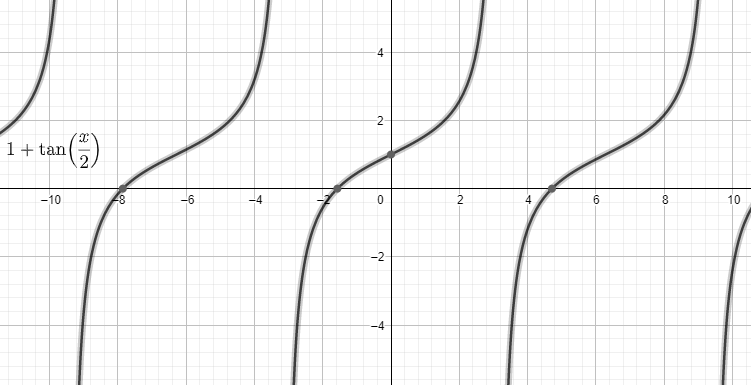
How do you find the period of $y=1+\tan \left( \dfrac{x}{2} \right)$?
Answer
 Verified
559.5k+ views
Hint: We explain the main function of the given equation $y=1+\tan \left( \dfrac{x}{2} \right)$. We take the general equation and explain the period. Then we equate the given function $y=1+\tan \left( \dfrac{x}{2} \right)$ with the general one and find the solution. The general equation for $y=\tan x$ will be $y=A\tan \left[ B\left( x+C \right) \right]+D$. We find the new period as $\dfrac{\pi }{\left| B \right|}$.
Complete step by step answer:
We need to find the period for $y=1+\tan \left( \dfrac{x}{2} \right)$.
The main function of the given equation is $\tan x$. The period of $\cos x$ is $\pi $.
We define the general formula to explain the period for $\tan x$.
If the $y=\tan x$ changes to $y=A\tan \left[ B\left( x+C \right) \right]+D$, the period becomes $\dfrac{\pi }{\left| B \right|}$.
Now we explain the things for the given $y=1+\tan \left( \dfrac{x}{2} \right)$.
$y=1+\tan \left( \dfrac{x}{2} \right)=1\times \tan \left( \dfrac{1}{2}x \right)+0$
We equate with $A\tan \left[ B\left( x+C \right) \right]+D$.
The values will be \[\left| B \right|=\dfrac{1}{2}\]. The period is $\dfrac{\pi }{{}^{1}/{}_{2}}=\dfrac{2\times \pi }{1}=2\pi $.
Therefore, the period for $y=1+\tan \left( \dfrac{x}{2} \right)$ is $2\pi $ respectively.
We can also find the shift for the new equation $y=1+\tan \left( \dfrac{x}{2} \right)$.
The shift has two parts. One being phase shifting of the graph and other one being vertical shift. Phase shifting is C (positive sign means going left) and vertical shift is D.
There is no vertical or phase shifting at all.
Note: Amplitude is the vertical distance from the X-axis to the highest (or lowest) point on a sin or cosine curve. Period of each generalized sine or cosine curve is the length of one complete cycle. Phase shift is the amount that the curve is shifted right or left. Amplitude and period are always a positive number. Phase shift can be of both signs.
Complete step by step answer:
We need to find the period for $y=1+\tan \left( \dfrac{x}{2} \right)$.
The main function of the given equation is $\tan x$. The period of $\cos x$ is $\pi $.
We define the general formula to explain the period for $\tan x$.
If the $y=\tan x$ changes to $y=A\tan \left[ B\left( x+C \right) \right]+D$, the period becomes $\dfrac{\pi }{\left| B \right|}$.
Now we explain the things for the given $y=1+\tan \left( \dfrac{x}{2} \right)$.
$y=1+\tan \left( \dfrac{x}{2} \right)=1\times \tan \left( \dfrac{1}{2}x \right)+0$
We equate with $A\tan \left[ B\left( x+C \right) \right]+D$.
The values will be \[\left| B \right|=\dfrac{1}{2}\]. The period is $\dfrac{\pi }{{}^{1}/{}_{2}}=\dfrac{2\times \pi }{1}=2\pi $.
Therefore, the period for $y=1+\tan \left( \dfrac{x}{2} \right)$ is $2\pi $ respectively.
We can also find the shift for the new equation $y=1+\tan \left( \dfrac{x}{2} \right)$.
The shift has two parts. One being phase shifting of the graph and other one being vertical shift. Phase shifting is C (positive sign means going left) and vertical shift is D.
There is no vertical or phase shifting at all.
Note: Amplitude is the vertical distance from the X-axis to the highest (or lowest) point on a sin or cosine curve. Period of each generalized sine or cosine curve is the length of one complete cycle. Phase shift is the amount that the curve is shifted right or left. Amplitude and period are always a positive number. Phase shift can be of both signs.
Recently Updated Pages
Master Class 11 Computer Science: Engaging Questions & Answers for Success

Master Class 11 Business Studies: Engaging Questions & Answers for Success
Master Class 11 Economics: Engaging Questions & Answers for Success
Master Class 11 English: Engaging Questions & Answers for Success
Master Class 11 Maths: Engaging Questions & Answers for Success
Master Class 11 Biology: Engaging Questions & Answers for Success
Trending doubts
One Metric ton is equal to kg A 10000 B 1000 C 100 class 11 physics CBSE
There are 720 permutations of the digits 1 2 3 4 5 class 11 maths CBSE
Discuss the various forms of bacteria class 11 biology CBSE
Draw a diagram of a plant cell and label at least eight class 11 biology CBSE
State the laws of reflection of light
Explain zero factorial class 11 maths CBSE