




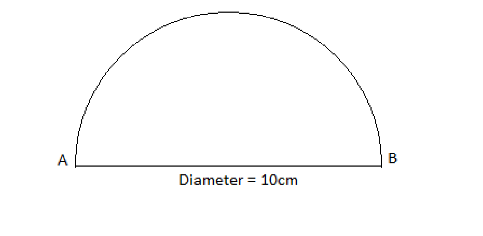
Find the perimeter of the adjoined figure, which is semicircle, includes its diameter :
Answer
 Verified
596.1k+ views
Hint: To find the perimeter of the figure we use the formula of the perimeter of semi-circle which is given as:
Perimeter of the semi-circle is: \[\left( \pi +2 \right)\dfrac{D}{2}\].
where D is the diameter of the figure.
Complete step by step solution:
Let us find the perimeter of the semi-circle and to find the perimeter of the semi-circle we use the formula of the semi-circle as:
Perimeter of the semi-circle is: \[\left( \pi +2 \right)\dfrac{D}{2}\]
According to the question given, the value of the diameter D is given as \[10\text{ }cm\]. Now placing the value of the diameter in the above formula as:
\[\Rightarrow \left( \pi +2 \right)\dfrac{10}{2}\]cm
Removing the bracket and multiplying the values of \[\dfrac{10}{2}\]to both \[\pi ,2\] we get the equation as:
\[\Rightarrow \left( \pi +2 \right)5\] cm
\[\Rightarrow 5\pi +10\] cm
Converting the value of the \[\pi \] into \[3.14\] and placing it in the above equation, we get the value of the perimeter is given as:
\[\Rightarrow 5\times 3.14+10\] cm
\[\Rightarrow 25.71\] cm
Therefore, the value of the perimeter of the semi-circle is given as \[25.71\] cm.
Note: The perimeter of the circle is given as \[\pi D\] and the perimeter of the semi-circle is actually divided into two parts with one part of the semicircle is the diameter line and the second part of the circle is the arc. Hence, the perimeter of the semicircle is equal to the sum of the perimeter of the arc and diameter of the semi-circle. Perimeter of the semi-circle = Perimeter of the arc + Perimeter of the diameter line.
\[\left( \pi +2 \right)r=\pi r+2r\]
Perimeter of the semi-circle is: \[\left( \pi +2 \right)\dfrac{D}{2}\].
where D is the diameter of the figure.
Complete step by step solution:
Let us find the perimeter of the semi-circle and to find the perimeter of the semi-circle we use the formula of the semi-circle as:
Perimeter of the semi-circle is: \[\left( \pi +2 \right)\dfrac{D}{2}\]
According to the question given, the value of the diameter D is given as \[10\text{ }cm\]. Now placing the value of the diameter in the above formula as:
\[\Rightarrow \left( \pi +2 \right)\dfrac{10}{2}\]cm
Removing the bracket and multiplying the values of \[\dfrac{10}{2}\]to both \[\pi ,2\] we get the equation as:
\[\Rightarrow \left( \pi +2 \right)5\] cm
\[\Rightarrow 5\pi +10\] cm
Converting the value of the \[\pi \] into \[3.14\] and placing it in the above equation, we get the value of the perimeter is given as:
\[\Rightarrow 5\times 3.14+10\] cm
\[\Rightarrow 25.71\] cm
Therefore, the value of the perimeter of the semi-circle is given as \[25.71\] cm.
Note: The perimeter of the circle is given as \[\pi D\] and the perimeter of the semi-circle is actually divided into two parts with one part of the semicircle is the diameter line and the second part of the circle is the arc. Hence, the perimeter of the semicircle is equal to the sum of the perimeter of the arc and diameter of the semi-circle. Perimeter of the semi-circle = Perimeter of the arc + Perimeter of the diameter line.
\[\left( \pi +2 \right)r=\pi r+2r\]
Recently Updated Pages
Master Class 5 English: Engaging Questions & Answers for Success

Master Class 5 Maths: Engaging Questions & Answers for Success
Master Class 5 Social Science: Engaging Questions & Answers for Success
Master Class 5 Science: Engaging Questions & Answers for Success
Class 5 Question and Answer - Your Ultimate Solutions Guide
Master Class 9 General Knowledge: Engaging Questions & Answers for Success
Trending doubts
One Metric ton is equal to kg A 10000 B 1000 C 100 class 11 physics CBSE
What is cell theory Who formulated it class 11 biology CBSE
Phyllotaxy is the arrangement of ALeaflets BLeaves class 11 biology CBSE
Difference Between Prokaryotic Cells and Eukaryotic Cells
The symbiotic association of fungi and algae is called class 11 biology CBSE
Cell theory was formulated by A Schleiden and Schwann class 11 biology CBSE