




Find the perimeter of a rhombus with diagonals $30cm$ and $40cm$ long.
A) 210cm
B) 200cm
C) 100cm
D) 50cm
Answer
 Verified
533.7k+ views
Hint: This is the question for mensuration. We need to know the properties of the rhombus to find the perimeter of the figure. We will use Pythagoras theorem to solve the question which is applied in a right-angled triangle. Perimeter of the figure refers to the total length of the sides of 2-D shape. Perimeter of the rhombus is $4\left( \text{length of one side} \right)$.
Complete step by step solution:
The question asks us to find the perimeter of the rhombus which has the diagonal $30cm$ and $40cm$. The main characteristic used here is that the diagonals in the rhombus meet at ${{90}^{\circ }}$. To solve this question we will apply Pythagoras theorem which I applied in right-angled triangle, which state that
$Hypotenus{{e}^{2}}=Bas{{e}^{2}}+Heigh{{t}^{2}}$
As we can see in the below figure the diagonal $AC$ and $BD$ are intersecting at ${{90}^{\circ }}$ at $E$. The diagonal even bisect each other. So $AE=15cm$, $BE=20cm$ ,$CE=15cm$ and $DE=20cm$.
To find the side of the rhombus we will use Pythagoras theorem. We will consider $\vartriangle BEC$ where $\angle BEC={{90}^{\circ }}$ to find the length $BC$.
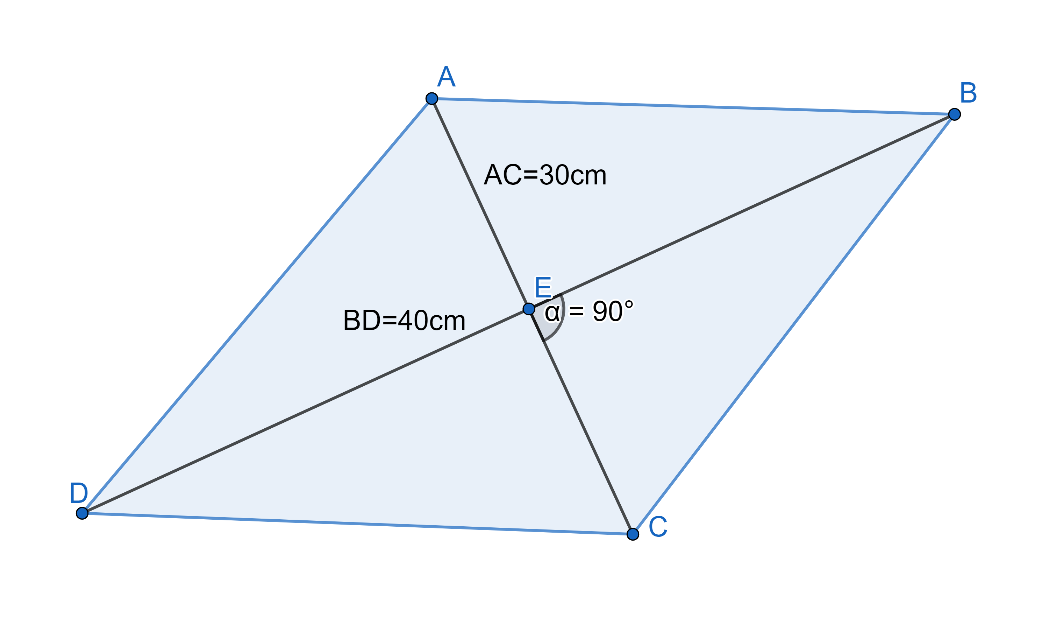
In this triangle $height=BE,base=EC$ and $ hypotenuse=BC$, on solving we get:
$Hypotenus{{e}^{2}}=Bas{{e}^{2}}+Heigh{{t}^{2}}$
$B{{C}^{2}}=E{{C}^{2}}+B{{E}^{2}}$
Since the diagonals bisect each other, so the sides could be written as:
$\Rightarrow B{{C}^{2}}={{\left( \dfrac{CD}{2} \right)}^{2}}+{{\left( \dfrac{BD}{2} \right)}^{2}}$
$\Rightarrow BC=\sqrt{{{\left( \dfrac{CD}{2} \right)}^{2}}+{{\left( \dfrac{BD}{2} \right)}^{2}}}$
On putting the values we get:
$\Rightarrow BC=\sqrt{{{\left( \dfrac{30}{2} \right)}^{2}}+{{\left( \dfrac{40}{2} \right)}^{2}}}$
$\Rightarrow BC=\sqrt{{{\left( 15 \right)}^{2}}+{{\left( 20 \right)}^{2}}}$
On squaring both the numbers we get the following:
$\Rightarrow BC=\sqrt{225+400}$
$\Rightarrow BC=\sqrt{665}$
The square root of the number is found:
$\Rightarrow BC=25$
So the length of the side of the rhombus is $25$.
We know that all the sides of the rhombus are equal which is $25$ . Perimeter of the rhombus $ABCD$ is the total length of the figure, which would be denoted by:
$Perimeter=AB+BC+CD+DA$
Since all sides are equal so it could be written as:
$\Rightarrow Perimeter=4\left( BC \right)$
Putting the value of $BC$ as $25cm$, the perimeter we get is:
$\Rightarrow Perimeter=4\times 25$
$\Rightarrow Perimeter=100cm$
So, the correct answer is “Option C”.
Note: For solving this question we can take any triangle which was formed by the intersection of two diagonals. Properties of the rhombus should be known to us as the question is solved using these properties. The diagonal of the rhombus meets at ${{90}^{\circ }}$and bisects each other. Sides of the rhombus are equal, so finding a perimeter becomes easy.
Complete step by step solution:
The question asks us to find the perimeter of the rhombus which has the diagonal $30cm$ and $40cm$. The main characteristic used here is that the diagonals in the rhombus meet at ${{90}^{\circ }}$. To solve this question we will apply Pythagoras theorem which I applied in right-angled triangle, which state that
$Hypotenus{{e}^{2}}=Bas{{e}^{2}}+Heigh{{t}^{2}}$
As we can see in the below figure the diagonal $AC$ and $BD$ are intersecting at ${{90}^{\circ }}$ at $E$. The diagonal even bisect each other. So $AE=15cm$, $BE=20cm$ ,$CE=15cm$ and $DE=20cm$.
To find the side of the rhombus we will use Pythagoras theorem. We will consider $\vartriangle BEC$ where $\angle BEC={{90}^{\circ }}$ to find the length $BC$.
In this triangle $height=BE,base=EC$ and $ hypotenuse=BC$, on solving we get:
$Hypotenus{{e}^{2}}=Bas{{e}^{2}}+Heigh{{t}^{2}}$
$B{{C}^{2}}=E{{C}^{2}}+B{{E}^{2}}$
Since the diagonals bisect each other, so the sides could be written as:
$\Rightarrow B{{C}^{2}}={{\left( \dfrac{CD}{2} \right)}^{2}}+{{\left( \dfrac{BD}{2} \right)}^{2}}$
$\Rightarrow BC=\sqrt{{{\left( \dfrac{CD}{2} \right)}^{2}}+{{\left( \dfrac{BD}{2} \right)}^{2}}}$
On putting the values we get:
$\Rightarrow BC=\sqrt{{{\left( \dfrac{30}{2} \right)}^{2}}+{{\left( \dfrac{40}{2} \right)}^{2}}}$
$\Rightarrow BC=\sqrt{{{\left( 15 \right)}^{2}}+{{\left( 20 \right)}^{2}}}$
On squaring both the numbers we get the following:
$\Rightarrow BC=\sqrt{225+400}$
$\Rightarrow BC=\sqrt{665}$
The square root of the number is found:
$\Rightarrow BC=25$
So the length of the side of the rhombus is $25$.
We know that all the sides of the rhombus are equal which is $25$ . Perimeter of the rhombus $ABCD$ is the total length of the figure, which would be denoted by:
$Perimeter=AB+BC+CD+DA$
Since all sides are equal so it could be written as:
$\Rightarrow Perimeter=4\left( BC \right)$
Putting the value of $BC$ as $25cm$, the perimeter we get is:
$\Rightarrow Perimeter=4\times 25$
$\Rightarrow Perimeter=100cm$
So, the correct answer is “Option C”.
Note: For solving this question we can take any triangle which was formed by the intersection of two diagonals. Properties of the rhombus should be known to us as the question is solved using these properties. The diagonal of the rhombus meets at ${{90}^{\circ }}$and bisects each other. Sides of the rhombus are equal, so finding a perimeter becomes easy.
Recently Updated Pages
Master Class 10 Computer Science: Engaging Questions & Answers for Success

Master Class 10 General Knowledge: Engaging Questions & Answers for Success
Master Class 10 English: Engaging Questions & Answers for Success
Master Class 10 Social Science: Engaging Questions & Answers for Success
Master Class 10 Maths: Engaging Questions & Answers for Success
Master Class 10 Science: Engaging Questions & Answers for Success
Trending doubts
What is the median of the first 10 natural numbers class 10 maths CBSE
Which women's tennis player has 24 Grand Slam singles titles?
Who is the Brand Ambassador of Incredible India?
Why is there a time difference of about 5 hours between class 10 social science CBSE
Write a letter to the principal requesting him to grant class 10 english CBSE
A moving boat is observed from the top of a 150 m high class 10 maths CBSE