




Find the perimeter of a parallelogram with sides 9 cm and 5 cm.
Answer
 Verified
580.5k+ views
Hint: Assume 9 cm as the length of parallelogram and denote it with ‘l’ and 5 cm as the breadth of the parallelogram and denote it with ‘b’. Use the formula: - perimeter of a parallelogram = 2(l + b) and substitute the given values to simplify and get the answer.
Complete step by step answer:
Here we have been provided with the sides of a parallelogram as 9 cm and 5 cm. We are asked to find the perimeter of the triangle.
Now, we know that the opposite sides of a parallelogram are equal and we are provided with sides with two different measurements that means measures of adjacent sides of the parallelogram are given. Let us draw a rough diagram of the given situation.
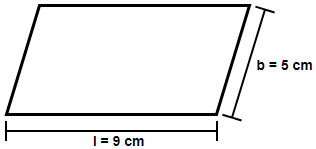
Considering 9 cm as the length of the parallelogram denoted as ‘l’ and 5 cm as the breadth of the parallelogram denoted as ‘b’ we have two sides measuring ‘l’ and two sides measuring ‘b’, so the perimeter will be the sum of measure of all these four sides. Therefore we get,
$\Rightarrow $ Perimeter of the parallelogram = 2l + 2b
$\Rightarrow $ Perimeter of the parallelogram = 2(l + b)
Substituting the values of ‘l’ and ‘b’ in the above relation we get,
$\Rightarrow $ Perimeter of the parallelogram = 2(9 + 5)
$\therefore $ Perimeter of the parallelogram = 28 cm
Hence, the perimeter of the parallelogram is 28 cm.
Note: One may note that here we have assumed length of the parallelogram greater than its breadth. You may assume its breadth greater than the length as this will not alter our answer but only the numerical value of the measure of the sides will get interchanged. Do not use the relation of the area of the parallelogram because we have been provided with the information regarding its perimeter.
Complete step by step answer:
Here we have been provided with the sides of a parallelogram as 9 cm and 5 cm. We are asked to find the perimeter of the triangle.
Now, we know that the opposite sides of a parallelogram are equal and we are provided with sides with two different measurements that means measures of adjacent sides of the parallelogram are given. Let us draw a rough diagram of the given situation.
Considering 9 cm as the length of the parallelogram denoted as ‘l’ and 5 cm as the breadth of the parallelogram denoted as ‘b’ we have two sides measuring ‘l’ and two sides measuring ‘b’, so the perimeter will be the sum of measure of all these four sides. Therefore we get,
$\Rightarrow $ Perimeter of the parallelogram = 2l + 2b
$\Rightarrow $ Perimeter of the parallelogram = 2(l + b)
Substituting the values of ‘l’ and ‘b’ in the above relation we get,
$\Rightarrow $ Perimeter of the parallelogram = 2(9 + 5)
$\therefore $ Perimeter of the parallelogram = 28 cm
Hence, the perimeter of the parallelogram is 28 cm.
Note: One may note that here we have assumed length of the parallelogram greater than its breadth. You may assume its breadth greater than the length as this will not alter our answer but only the numerical value of the measure of the sides will get interchanged. Do not use the relation of the area of the parallelogram because we have been provided with the information regarding its perimeter.
Recently Updated Pages
Class 10 Question and Answer - Your Ultimate Solutions Guide

Master Class 10 Computer Science: Engaging Questions & Answers for Success
Master Class 10 General Knowledge: Engaging Questions & Answers for Success
Master Class 12 Economics: Engaging Questions & Answers for Success
Master Class 12 Social Science: Engaging Questions & Answers for Success
Master Class 12 English: Engaging Questions & Answers for Success
Trending doubts
Explain the Treaty of Vienna of 1815 class 10 social science CBSE
The slogan Jai Hind was given by A Lal Bahadur Shastri class 10 social science CBSE
10 examples of evaporation in daily life with explanations
What is the full form of POSCO class 10 social science CBSE
Identify the feminine form of noun nephew a shenephew class 10 english CBSE
CSIR full form?