




How do I find the orthogonal projection of two vectors?
Answer
 Verified
590.7k+ views
Hint: Orthogonal projection between two vectors states that the angle between these two vectors is \[{90^ \circ }\].
We will put this value into the general formula to find the value of projection.
Formula used: If two vectors \[\overrightarrow a \], \[\overrightarrow b \] are there in a \[2D - plane\], and they make an angle of \[\theta \], then we can write the following equation:
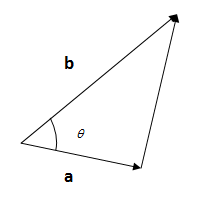
So, The vector projection of \[b\] onto \[a\]: we said that the length of the projection is \[\left| b \right|\cos \theta \].
So, \[\left| a \right|\left| b \right|\cos \theta = ab\].
So, it is written as \[pro{j_a}b\].
We can divide both the sides by \[\left| a \right|\] to get the value of \[\left| b \right|\cos \theta \].
Complete step-by-step solution:
Let's say, we want to find the projection of \[\overrightarrow x \] on another \[\overrightarrow y \] in the same vector space.
Also, consider that the projection is denoted by \[\overrightarrow p \].
Then we can set the dot product of these two vectors using the above formula:
\[\left| {\overrightarrow x } \right|\left| {\overrightarrow {(y - p)} } \right|\cos \theta = \overrightarrow x \overrightarrow {(y - p)} \].
But these two vectors are orthogonal, the angle between them should be equal to \[{90^ \circ }\].
So, we can rewrite the above equation in following way:
$\Rightarrow$\[\left| {\overrightarrow x } \right|\left| {\overrightarrow {(y - p)} } \right|\cos {90^ \circ } = \overrightarrow x \overrightarrow {(y - p)} \].
We know that the value of \[\cos {90^ \circ } = 0\], putting it to the above equation, we get:
$\Rightarrow$\[\overrightarrow x \overrightarrow {(y - p)} = 0\].
Now, using the property of dot product, we get the following equation:
$\Rightarrow$\[\overrightarrow x \overrightarrow y - \overrightarrow x \overrightarrow p = 0..........(1)\].
Now, as the projection of these two vectors is along the side to \[\overrightarrow x \], or $\Rightarrow$\[\overrightarrow p \]is along\[\overrightarrow x \], \[\overrightarrow p \] would be some multiple of \[\overrightarrow x \].
Let say, \[\overrightarrow p = m\overrightarrow x \]
So, we can rewrite the equation \[(1)\] as following:
$\Rightarrow$\[\overrightarrow x \overrightarrow y - \overrightarrow x m\overrightarrow x = 0\]
After applying the rules of dot products, we get:
$\Rightarrow$\[\overrightarrow x \overrightarrow y - \overrightarrow x m\overrightarrow x = 0\]
So, the require projection vector \[\overrightarrow p \] would be \[\dfrac{{\overrightarrow x \overrightarrow y }}{{\left| x \right|\left| x \right|}}\overrightarrow x \].
Note: Vector projection is the vector produced when one vector is resolved into two component vectors.
One vector is perpendicular to the second vector and the other one is parallel to the second vector.
The parallel one is called a projection vector.
We will put this value into the general formula to find the value of projection.
Formula used: If two vectors \[\overrightarrow a \], \[\overrightarrow b \] are there in a \[2D - plane\], and they make an angle of \[\theta \], then we can write the following equation:
So, The vector projection of \[b\] onto \[a\]: we said that the length of the projection is \[\left| b \right|\cos \theta \].
So, \[\left| a \right|\left| b \right|\cos \theta = ab\].
So, it is written as \[pro{j_a}b\].
We can divide both the sides by \[\left| a \right|\] to get the value of \[\left| b \right|\cos \theta \].
Complete step-by-step solution:
Let's say, we want to find the projection of \[\overrightarrow x \] on another \[\overrightarrow y \] in the same vector space.
Also, consider that the projection is denoted by \[\overrightarrow p \].
Then we can set the dot product of these two vectors using the above formula:
\[\left| {\overrightarrow x } \right|\left| {\overrightarrow {(y - p)} } \right|\cos \theta = \overrightarrow x \overrightarrow {(y - p)} \].
But these two vectors are orthogonal, the angle between them should be equal to \[{90^ \circ }\].
So, we can rewrite the above equation in following way:
$\Rightarrow$\[\left| {\overrightarrow x } \right|\left| {\overrightarrow {(y - p)} } \right|\cos {90^ \circ } = \overrightarrow x \overrightarrow {(y - p)} \].
We know that the value of \[\cos {90^ \circ } = 0\], putting it to the above equation, we get:
$\Rightarrow$\[\overrightarrow x \overrightarrow {(y - p)} = 0\].
Now, using the property of dot product, we get the following equation:
$\Rightarrow$\[\overrightarrow x \overrightarrow y - \overrightarrow x \overrightarrow p = 0..........(1)\].
Now, as the projection of these two vectors is along the side to \[\overrightarrow x \], or $\Rightarrow$\[\overrightarrow p \]is along\[\overrightarrow x \], \[\overrightarrow p \] would be some multiple of \[\overrightarrow x \].
Let say, \[\overrightarrow p = m\overrightarrow x \]
So, we can rewrite the equation \[(1)\] as following:
$\Rightarrow$\[\overrightarrow x \overrightarrow y - \overrightarrow x m\overrightarrow x = 0\]
After applying the rules of dot products, we get:
$\Rightarrow$\[\overrightarrow x \overrightarrow y - \overrightarrow x m\overrightarrow x = 0\]
So, the require projection vector \[\overrightarrow p \] would be \[\dfrac{{\overrightarrow x \overrightarrow y }}{{\left| x \right|\left| x \right|}}\overrightarrow x \].
Note: Vector projection is the vector produced when one vector is resolved into two component vectors.
One vector is perpendicular to the second vector and the other one is parallel to the second vector.
The parallel one is called a projection vector.
Recently Updated Pages
Master Class 12 Economics: Engaging Questions & Answers for Success

Master Class 12 English: Engaging Questions & Answers for Success
Master Class 12 Social Science: Engaging Questions & Answers for Success
Master Class 12 Maths: Engaging Questions & Answers for Success
Master Class 12 Physics: Engaging Questions & Answers for Success
Master Class 11 Social Science: Engaging Questions & Answers for Success
Trending doubts
Find the value of the expression given below sin 30circ class 11 maths CBSE
Draw a diagram of nephron and explain its structur class 11 biology CBSE
What organs are located on the left side of your body class 11 biology CBSE
Difference between physical and chemical change class 11 chemistry CBSE
Which of the following is the hottest month AMay BJune class 11 social science CBSE
What is the percentage of photosynthetically active class 11 biology CBSE