




How do I find the original projection of a vector?
Answer
 Verified
572.1k+ views
Hint: In this question, we need to find a formula for orthogonal projection of vector $\overrightarrow{a}$ on the vector $\overrightarrow{b}$. For this we will first understand the orthogonal projection with the help of diagrams. Then we will use trigonometric relations in the triangle formed to find the length of projection. After that, we will simply find the length and the formula required. We will use $\overrightarrow{a}\cdot \overrightarrow{b}=\left| \overrightarrow{a} \right|\left| \overrightarrow{b} \right|\cos \theta $.
Complete step by step answer:
Here we need to find the formula of orthogonal projection of a vector $\overrightarrow{a}$ on to the vector $\overrightarrow{b}$.
Suppose the two vectors are inclined at an angle $\theta $. So diagram looks like,
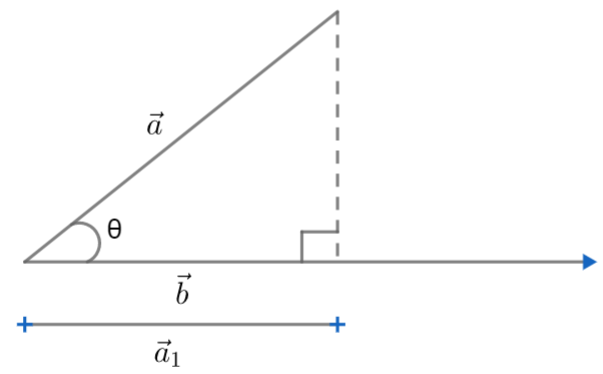
The projection of $\overrightarrow{a}$ onto $\overrightarrow{b}$ is the vector $\overrightarrow{{{a}_{1}}}$ which is formed when $\overrightarrow{a}$ forms a projection on $\overrightarrow{b}$. As we can see from the triangle formed $\overrightarrow{{{a}_{1}}}$ will be equal to $\left| \overrightarrow{a} \right|\cos \theta $.
So projection of $\overrightarrow{a}$ on $\overrightarrow{b}$ will be $\left| \overrightarrow{a} \right|\cos \theta $.
To simplify it in terms of $\overrightarrow{b}$ multiplying $\left| \overrightarrow{b} \right|$ on numerator and denominator we get,
\[\text{Scalar Projection}=\dfrac{\left| \overrightarrow{a} \right|\left| \overrightarrow{b} \right|\cos \theta }{\left| \overrightarrow{b} \right|}\].
We know that $\left| \overrightarrow{a} \right|\left| \overrightarrow{b} \right|\cos \theta $ represents the dot product between two vectors. So, we can write .... as $\overrightarrow{a}\cdot \overrightarrow{b}$.
So scalar projection becomes \[\dfrac{\overrightarrow{a}\cdot \overrightarrow{b}}{\left| \overrightarrow{b} \right|}\] where $\left| \overrightarrow{b} \right|$ represent the magnitude of $\overrightarrow{b}$.
In terms of vector notation, we can say $\text{Projection}=\dfrac{\left( \overrightarrow{a}\cdot \overrightarrow{b} \right)}{\overrightarrow{b}\cdot \overrightarrow{b}}\overrightarrow{b}$.
$\text{Vector Projection}=\left( \overrightarrow{a}\cdot \overrightarrow{b} \right)\dfrac{\overrightarrow{b}}{{{\left| \overrightarrow{b} \right|}^{2}}}$.
Note:
Students should keep in mind the formulas of vectors to solve this sum. Note that there is difference in terms, projection of $\overrightarrow{a}$ onto $\overrightarrow{b}$ and projection of $\overrightarrow{b}$ onto $\overrightarrow{a}$. Projection of $\overrightarrow{a}$ on $\overrightarrow{b}$ can be described as the shadow of $\overrightarrow{a}$ on $\overrightarrow{b}$.
Complete step by step answer:
Here we need to find the formula of orthogonal projection of a vector $\overrightarrow{a}$ on to the vector $\overrightarrow{b}$.
Suppose the two vectors are inclined at an angle $\theta $. So diagram looks like,
The projection of $\overrightarrow{a}$ onto $\overrightarrow{b}$ is the vector $\overrightarrow{{{a}_{1}}}$ which is formed when $\overrightarrow{a}$ forms a projection on $\overrightarrow{b}$. As we can see from the triangle formed $\overrightarrow{{{a}_{1}}}$ will be equal to $\left| \overrightarrow{a} \right|\cos \theta $.
So projection of $\overrightarrow{a}$ on $\overrightarrow{b}$ will be $\left| \overrightarrow{a} \right|\cos \theta $.
To simplify it in terms of $\overrightarrow{b}$ multiplying $\left| \overrightarrow{b} \right|$ on numerator and denominator we get,
\[\text{Scalar Projection}=\dfrac{\left| \overrightarrow{a} \right|\left| \overrightarrow{b} \right|\cos \theta }{\left| \overrightarrow{b} \right|}\].
We know that $\left| \overrightarrow{a} \right|\left| \overrightarrow{b} \right|\cos \theta $ represents the dot product between two vectors. So, we can write .... as $\overrightarrow{a}\cdot \overrightarrow{b}$.
So scalar projection becomes \[\dfrac{\overrightarrow{a}\cdot \overrightarrow{b}}{\left| \overrightarrow{b} \right|}\] where $\left| \overrightarrow{b} \right|$ represent the magnitude of $\overrightarrow{b}$.
In terms of vector notation, we can say $\text{Projection}=\dfrac{\left( \overrightarrow{a}\cdot \overrightarrow{b} \right)}{\overrightarrow{b}\cdot \overrightarrow{b}}\overrightarrow{b}$.
$\text{Vector Projection}=\left( \overrightarrow{a}\cdot \overrightarrow{b} \right)\dfrac{\overrightarrow{b}}{{{\left| \overrightarrow{b} \right|}^{2}}}$.
Note:
Students should keep in mind the formulas of vectors to solve this sum. Note that there is difference in terms, projection of $\overrightarrow{a}$ onto $\overrightarrow{b}$ and projection of $\overrightarrow{b}$ onto $\overrightarrow{a}$. Projection of $\overrightarrow{a}$ on $\overrightarrow{b}$ can be described as the shadow of $\overrightarrow{a}$ on $\overrightarrow{b}$.
Recently Updated Pages
Basicity of sulphurous acid and sulphuric acid are

Master Class 11 Business Studies: Engaging Questions & Answers for Success
Master Class 11 Computer Science: Engaging Questions & Answers for Success
Master Class 11 Economics: Engaging Questions & Answers for Success
Master Class 11 Social Science: Engaging Questions & Answers for Success
Master Class 11 English: Engaging Questions & Answers for Success
Trending doubts
One Metric ton is equal to kg A 10000 B 1000 C 100 class 11 physics CBSE
The largest wind power cluster is located in the state class 11 social science CBSE
Explain zero factorial class 11 maths CBSE
State and prove Bernoullis theorem class 11 physics CBSE
Which among the following are examples of coming together class 11 social science CBSE
Can anyone list 10 advantages and disadvantages of friction