



How do you find the numeric value of angle $A$ and $B$ for triangle $ABC$ with $C$ being the right angle, given $A = x$ and $B = {x^2}$?
Answer
 Verified
563.1k+ views
Hint: Here we are given a right angled triangle and asked to find the other two angles of the triangle. To find the unknown angles, let us use the angle sum property of a triangle. According to this property sum of all the three interior angles of a triangle is equal to ${180^\circ }$. Since we know that the one of the angles is ${90^ \circ }$, by using the sum property we obtain the other two angles.
Complete step by step solution:
Given a right angled triangle $ABC$ with the angle $\angle C = {90^ \circ }$.
Given that $A = x$ and $B = {x^2}$.
We are asked to find the value of the other two angles, $\angle A$ and $\angle B$.
i.e. we need to find the value of the variable x to determine the angles.
Consider the right angled triangle $ABC$ given below in the diagram.
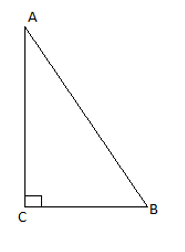
To find the angles $\angle A$ and $\angle B$, we make use of the angle sum property of a triangle.
According to the angle sum property of a triangle, the sum of all the three interior angles of a triangle is equal to ${180^\circ }$.
i.e. $\angle A + \angle B + \angle C = {180^ \circ }$ (1)
We have $\angle A = x$and $\angle B = {x^2}$ and $\angle C = {90^ \circ }$.
Substituting these values in the equation (1), we get,
$x + {x^2} + {90^ \circ } = {180^ \circ }$
Taking ${90^ \circ }$ to the other side we get,
$ \Rightarrow x + {x^2} = {180^ \circ } - {90^ \circ }$
$ \Rightarrow x + {x^2} = {90^ \circ }$
$ \Rightarrow {x^2} + x - {90^ \circ } = 0$
Now we solve the quadratic equation ${x^2} + x - 90 = 0$
We solve this using the factoring method to find the value of the variable x.
Now rearranging the terms and taking 90 to the L.H.S. we get,
$ \Rightarrow {x^2} + x - 90 = 0$
$ \Rightarrow {x^2} + 10x - 9x - 90 = 0$
Factor out the common terms we get,
$ \Rightarrow x(x + 10) - 9(x + 10) = 0$
Now factor out the common factors we get,
$ \Rightarrow (x + 10)(x - 9) = 0$
So either $x + 10 = 0$ or $x - 9 = 0$.
If $x + 10 = 0$, then we have $x = - 10$.
If $x - 9 = 0$, then we have $x = 9$.
Note that angle cannot be negative. Hence $x = - 10$ is not possible.
Hence, the required value of x is $x = 9$.
Therefore, we get $\angle A = x$
$ \Rightarrow \angle A = {9^ \circ }$
Also $\angle B = {x^2}$, so we get,
$ \Rightarrow \angle B = {9^2}$
$ \Rightarrow \angle B = {81^ \circ }$
Hence the required value of the angles in the right angled triangle $ABC$ are $\angle A = {9^ \circ }$ and $\angle B = {81^ \circ }$
Note: Students must have the knowledge about basic properties of a triangle. So it makes us find the solution easier. Here one must know the angle sum property of a triangle which is nothing but the sum of all the three angles of a triangle is ${180^ \circ }$. So by knowing this property we can find the other two angles of a triangle when one of its angles is given.
Remember that the angle of a triangle cannot have negative value.
Complete step by step solution:
Given a right angled triangle $ABC$ with the angle $\angle C = {90^ \circ }$.
Given that $A = x$ and $B = {x^2}$.
We are asked to find the value of the other two angles, $\angle A$ and $\angle B$.
i.e. we need to find the value of the variable x to determine the angles.
Consider the right angled triangle $ABC$ given below in the diagram.
To find the angles $\angle A$ and $\angle B$, we make use of the angle sum property of a triangle.
According to the angle sum property of a triangle, the sum of all the three interior angles of a triangle is equal to ${180^\circ }$.
i.e. $\angle A + \angle B + \angle C = {180^ \circ }$ (1)
We have $\angle A = x$and $\angle B = {x^2}$ and $\angle C = {90^ \circ }$.
Substituting these values in the equation (1), we get,
$x + {x^2} + {90^ \circ } = {180^ \circ }$
Taking ${90^ \circ }$ to the other side we get,
$ \Rightarrow x + {x^2} = {180^ \circ } - {90^ \circ }$
$ \Rightarrow x + {x^2} = {90^ \circ }$
$ \Rightarrow {x^2} + x - {90^ \circ } = 0$
Now we solve the quadratic equation ${x^2} + x - 90 = 0$
We solve this using the factoring method to find the value of the variable x.
Now rearranging the terms and taking 90 to the L.H.S. we get,
$ \Rightarrow {x^2} + x - 90 = 0$
$ \Rightarrow {x^2} + 10x - 9x - 90 = 0$
Factor out the common terms we get,
$ \Rightarrow x(x + 10) - 9(x + 10) = 0$
Now factor out the common factors we get,
$ \Rightarrow (x + 10)(x - 9) = 0$
So either $x + 10 = 0$ or $x - 9 = 0$.
If $x + 10 = 0$, then we have $x = - 10$.
If $x - 9 = 0$, then we have $x = 9$.
Note that angle cannot be negative. Hence $x = - 10$ is not possible.
Hence, the required value of x is $x = 9$.
Therefore, we get $\angle A = x$
$ \Rightarrow \angle A = {9^ \circ }$
Also $\angle B = {x^2}$, so we get,
$ \Rightarrow \angle B = {9^2}$
$ \Rightarrow \angle B = {81^ \circ }$
Hence the required value of the angles in the right angled triangle $ABC$ are $\angle A = {9^ \circ }$ and $\angle B = {81^ \circ }$
Note: Students must have the knowledge about basic properties of a triangle. So it makes us find the solution easier. Here one must know the angle sum property of a triangle which is nothing but the sum of all the three angles of a triangle is ${180^ \circ }$. So by knowing this property we can find the other two angles of a triangle when one of its angles is given.
Remember that the angle of a triangle cannot have negative value.

Recently Updated Pages
Master Class 9 Social Science: Engaging Questions & Answers for Success

Master Class 9 Science: Engaging Questions & Answers for Success
Master Class 9 Maths: Engaging Questions & Answers for Success
Master Class 9 General Knowledge: Engaging Questions & Answers for Success
Class 9 Question and Answer - Your Ultimate Solutions Guide
Master Class 8 Social Science: Engaging Questions & Answers for Success
Trending doubts
Find the sum of series 1 + 2 + 3 + 4 + 5 + + 100 class 9 maths CBSE
What is the Full Form of ISI and RAW
Fill the blanks with the suitable prepositions 1 The class 9 english CBSE
Difference Between Plant Cell and Animal Cell
Who is eligible for RTE class 9 social science CBSE
What is pollution? How many types of pollution? Define it