




Find the number of images.
Answer
 Verified
589.5k+ views
Hint: Multiple images are formed when two mirrors are kept inclined to each other. The number of images depends on the angle between them. Since the image formed by a plane mirror is virtual, it is formed at the back of the mirror and is at the same distance from the mirror as the object.
Formula used:
\[\text{n = }\dfrac{{{360}^{\text{o}}}}{\text{A}}\text{ - 1}\] (When \[\dfrac{{{360}^{\text{o}}}}{\text{A}}\] is even) - (1)
\[\text{n = }\dfrac{\text{36}{{\text{0}}^{\text{o}}}}{\text{A}}\] (When \[\dfrac{{{360}^{\text{o}}}}{\text{A}}\]is odd) - (2)
\[\text{n = }\dfrac{{{360}^{\text{o}}}}{\text{A}}\text{ - 1}\](When object is kept symmetrically) - (3)
\[\text{n = }\dfrac{\text{36}{{\text{0}}^{\text{o}}}}{\text{A}}\](When object is kept asymmetrically) -(4)
Complete step-by-step answer:
A plane mirror forms a single, virtual and erect image of the same size as the object. The image is laterally inverted. But when two mirrors are kept together inclined at an angle, more than two images are formed depending on the angle between them. This happens because the rays coming from each mirror get reflected multiple times between both mirrors and new images of the old images are created.
No of images formed, \[\text{n}\]when two mirrors are inclined at angle \[\text{A}\]is given by-
\[\text{n = }\dfrac{{{360}^{\text{o}}}}{\text{A}}\text{ - 1}\] (When \[\dfrac{{{360}^{\text{o}}}}{\text{A}}\] is even) - (1)
\[\text{n = }\dfrac{\text{36}{{\text{0}}^{\text{o}}}}{\text{A}}\] (When \[\dfrac{{{360}^{\text{o}}}}{\text{A}}\]is odd) - (2)
\[\text{n = }\dfrac{{{360}^{\text{o}}}}{\text{A}}\text{ - 1}\](When object is kept symmetrically) - (3)
\[\text{n = }\dfrac{\text{36}{{\text{0}}^{\text{o}}}}{\text{A}}\](When object is kept asymmetrically) -(4)
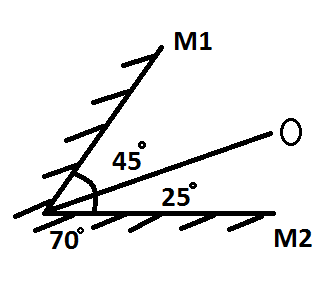
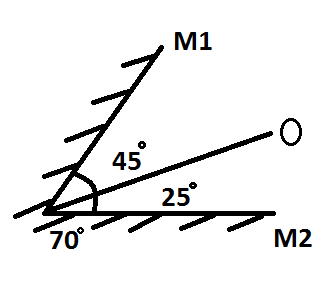
The in the given figure, the object is more inclined towards \[\text{M2}\]which means that it is kept asymmetrically between the mirrors, so using eq (4) to calculate the number of images formed by both mirrors, we get,
\[\begin{align}
& \text{n = }\dfrac{360}{70} \\
& \Rightarrow \text{ n = 4}\text{.14 } \\
\end{align}\]
The integral part of \[\text{n}\] is the total number of images formed which is 4.
Hence, 4 images of the object were formed by both mirrors.
Note: The rays falling on the mirror from the object are parallel to each other. They come from infinity and reflect back to infinity. It follows the laws of reflection which states that the angle of incidence is equal to the angle of reflection,\[\text{i = r}\]and incident ray, normal ray and the reflected ray lie in the same plane.
Formula used:
\[\text{n = }\dfrac{{{360}^{\text{o}}}}{\text{A}}\text{ - 1}\] (When \[\dfrac{{{360}^{\text{o}}}}{\text{A}}\] is even) - (1)
\[\text{n = }\dfrac{\text{36}{{\text{0}}^{\text{o}}}}{\text{A}}\] (When \[\dfrac{{{360}^{\text{o}}}}{\text{A}}\]is odd) - (2)
\[\text{n = }\dfrac{{{360}^{\text{o}}}}{\text{A}}\text{ - 1}\](When object is kept symmetrically) - (3)
\[\text{n = }\dfrac{\text{36}{{\text{0}}^{\text{o}}}}{\text{A}}\](When object is kept asymmetrically) -(4)
Complete step-by-step answer:
A plane mirror forms a single, virtual and erect image of the same size as the object. The image is laterally inverted. But when two mirrors are kept together inclined at an angle, more than two images are formed depending on the angle between them. This happens because the rays coming from each mirror get reflected multiple times between both mirrors and new images of the old images are created.
No of images formed, \[\text{n}\]when two mirrors are inclined at angle \[\text{A}\]is given by-
\[\text{n = }\dfrac{{{360}^{\text{o}}}}{\text{A}}\text{ - 1}\] (When \[\dfrac{{{360}^{\text{o}}}}{\text{A}}\] is even) - (1)
\[\text{n = }\dfrac{\text{36}{{\text{0}}^{\text{o}}}}{\text{A}}\] (When \[\dfrac{{{360}^{\text{o}}}}{\text{A}}\]is odd) - (2)
\[\text{n = }\dfrac{{{360}^{\text{o}}}}{\text{A}}\text{ - 1}\](When object is kept symmetrically) - (3)
\[\text{n = }\dfrac{\text{36}{{\text{0}}^{\text{o}}}}{\text{A}}\](When object is kept asymmetrically) -(4)
The in the given figure, the object is more inclined towards \[\text{M2}\]which means that it is kept asymmetrically between the mirrors, so using eq (4) to calculate the number of images formed by both mirrors, we get,
\[\begin{align}
& \text{n = }\dfrac{360}{70} \\
& \Rightarrow \text{ n = 4}\text{.14 } \\
\end{align}\]
The integral part of \[\text{n}\] is the total number of images formed which is 4.
Hence, 4 images of the object were formed by both mirrors.
Note: The rays falling on the mirror from the object are parallel to each other. They come from infinity and reflect back to infinity. It follows the laws of reflection which states that the angle of incidence is equal to the angle of reflection,\[\text{i = r}\]and incident ray, normal ray and the reflected ray lie in the same plane.
Recently Updated Pages
Master Class 12 Social Science: Engaging Questions & Answers for Success

Master Class 12 Physics: Engaging Questions & Answers for Success
Master Class 12 Maths: Engaging Questions & Answers for Success
Master Class 12 Economics: Engaging Questions & Answers for Success
Master Class 12 Chemistry: Engaging Questions & Answers for Success
Master Class 12 Business Studies: Engaging Questions & Answers for Success
Trending doubts
Which are the Top 10 Largest Countries of the World?
Draw a labelled sketch of the human eye class 12 physics CBSE
Explain the structure of megasporangium class 12 biology CBSE
What are the major means of transport Explain each class 12 social science CBSE
How many chromosomes are found in human ovum a 46 b class 12 biology CBSE
The diagram of the section of a maize grain is given class 12 biology CBSE