




Find the number of all the integral of the inequality \[\dfrac{{({x^2} + 2)(\sqrt {{x^2} - 16} )}}{{({x^4} + 2)({x^2} - 9)}} \leqslant 0\].
Answer
 Verified
594k+ views
Hint: Consider only those terms which affect the inequality sign less than equal to. First we change the denominator sign on the right side and then we will solve the equation.
Complete step by step answer:
(1) Given inequality is \[\dfrac{{({x^2} + 2)\sqrt {{x^2} - 16} }}{{({x^4} + 2)({x^2} - 9)}} \leqslant 0\]
Since, LHS of inequality is negative but terms \[\left( {{x^2} + 2} \right){\text{ }}and{\text{ }}\left( {{x^4} + 2} \right)\] are always positive for all value of $x$.
(2) On taking \[\left( {{x^2} + 2} \right){\text{ }}and{\text{ }}\left( {{x^4} + 2} \right)\] on RHS, we have
\[\dfrac{{\sqrt {{x^2} - 16} }}{{({x^2} - 9)}} \leqslant 0\]
(3) But \[\sqrt {{x^2} - 16} \geqslant 0\]always
\[\therefore for\dfrac{{\sqrt {{x^2} - 16} }}{{{x^2} - 9}}\] to be negative
\[\sqrt {{x^2} - 16} \geqslant 0,\,\,{x^2} - 9 \leqslant 0\]
Implies that \[{x^2}-9 \leqslant 0\]
(4) Hence from above we got two inequalities
\[\sqrt {{x^2} - 16} \geqslant 0,\,\,{x^2} - 9 \leqslant 0\]
Solving separately by these two terms,
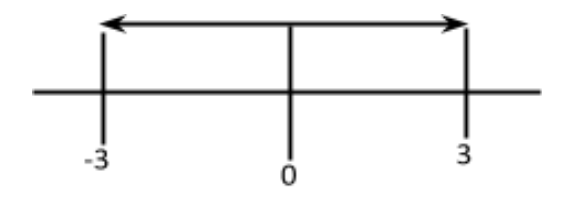
(5)\[{x^2} - 9 \leqslant 0\]
\[{x^2} \leqslant 9\]
$x \leqslant 3$
\[ - 3 < x < 3\]
\[x \in ( - 3,3)\]
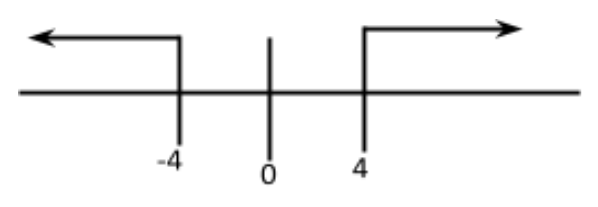
(6) Also,
\[\sqrt {{x^2} - 16} \geqslant 0\]
\[
{x^2} \geqslant 16 \\
x \geqslant 4 \\
x < - 4,\,\,x > 4 \\
\]
(7) On combining two solutions in number line
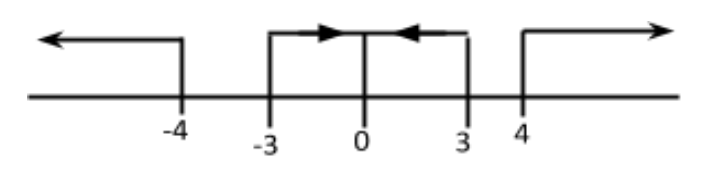
(8) There is no common region hence integral value of solution for given inequality is zero \[(\phi ).\]
Note: If $f\left( x \right) \leqslant \,\,g(x)$on the interval \[\left[ {a,b} \right],\] then the integral of \[f\left( x \right)\] is less than or equal to the integral of \[g\left( x \right)\]on the interval \[\left[ {a,b} \right]\]. As a special case, if $m \leqslant f(x) \leqslant M$ on [a,b], then the integral of \[f\left( x \right)\] is between \[m\left( {b - a} \right){\text{ }}and{\text{ }}M\left( {b - a} \right).\]
Complete step by step answer:
(1) Given inequality is \[\dfrac{{({x^2} + 2)\sqrt {{x^2} - 16} }}{{({x^4} + 2)({x^2} - 9)}} \leqslant 0\]
Since, LHS of inequality is negative but terms \[\left( {{x^2} + 2} \right){\text{ }}and{\text{ }}\left( {{x^4} + 2} \right)\] are always positive for all value of $x$.
(2) On taking \[\left( {{x^2} + 2} \right){\text{ }}and{\text{ }}\left( {{x^4} + 2} \right)\] on RHS, we have
\[\dfrac{{\sqrt {{x^2} - 16} }}{{({x^2} - 9)}} \leqslant 0\]
(3) But \[\sqrt {{x^2} - 16} \geqslant 0\]always
\[\therefore for\dfrac{{\sqrt {{x^2} - 16} }}{{{x^2} - 9}}\] to be negative
\[\sqrt {{x^2} - 16} \geqslant 0,\,\,{x^2} - 9 \leqslant 0\]
Implies that \[{x^2}-9 \leqslant 0\]
(4) Hence from above we got two inequalities
\[\sqrt {{x^2} - 16} \geqslant 0,\,\,{x^2} - 9 \leqslant 0\]
Solving separately by these two terms,
(5)\[{x^2} - 9 \leqslant 0\]
\[{x^2} \leqslant 9\]
$x \leqslant 3$
\[ - 3 < x < 3\]
\[x \in ( - 3,3)\]
(6) Also,
\[\sqrt {{x^2} - 16} \geqslant 0\]
\[
{x^2} \geqslant 16 \\
x \geqslant 4 \\
x < - 4,\,\,x > 4 \\
\]
(7) On combining two solutions in number line
(8) There is no common region hence integral value of solution for given inequality is zero \[(\phi ).\]
Note: If $f\left( x \right) \leqslant \,\,g(x)$on the interval \[\left[ {a,b} \right],\] then the integral of \[f\left( x \right)\] is less than or equal to the integral of \[g\left( x \right)\]on the interval \[\left[ {a,b} \right]\]. As a special case, if $m \leqslant f(x) \leqslant M$ on [a,b], then the integral of \[f\left( x \right)\] is between \[m\left( {b - a} \right){\text{ }}and{\text{ }}M\left( {b - a} \right).\]
Recently Updated Pages
Master Class 11 Computer Science: Engaging Questions & Answers for Success

Master Class 11 Business Studies: Engaging Questions & Answers for Success
Master Class 11 Economics: Engaging Questions & Answers for Success
Master Class 11 English: Engaging Questions & Answers for Success
Master Class 11 Maths: Engaging Questions & Answers for Success
Master Class 11 Biology: Engaging Questions & Answers for Success
Trending doubts
One Metric ton is equal to kg A 10000 B 1000 C 100 class 11 physics CBSE
There are 720 permutations of the digits 1 2 3 4 5 class 11 maths CBSE
Discuss the various forms of bacteria class 11 biology CBSE
Draw a diagram of a plant cell and label at least eight class 11 biology CBSE
State the laws of reflection of light
Explain zero factorial class 11 maths CBSE