




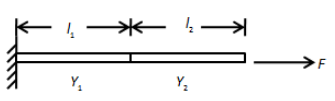
Find the net elongation of the composite rod (Assume A = cross section of each rod).
A. \[FA\left( {\dfrac{{{l_1}}}{{{Y_1}}} + \dfrac{{{l_2}}}{{{Y_2}}}} \right)\]
B. \[\dfrac{F}{A}\left( {\dfrac{{{l_1}}}{{{Y_1}}} + \dfrac{{{l_2}}}{{{Y_2}}}} \right)\]
C. \[\dfrac{F}{A}\dfrac{{{l_1}{l_2}}}{{{Y_1} + {Y_2}}}\]
D. \[\dfrac{{{Y_1}{Y_2}\left( {{l_1} + {l_2}} \right)}}{{{l_1}{Y_1} + {l_2}{Y_2}}}\]
Answer
 Verified
568.8k+ views
Hint:Recall the expression for the Young’s modulus and express the elongation produced in the both rods separately. The change in the length of the composite rod is equal to the sum of elongation of the respective lengths of the rod. Substitute the elongations of the both lengths and determine the net elongation of the composite rod.
Formula used:
\[Y = \dfrac{{F\,l}}{{A\,\Delta l}}\]
Here, F is the applied force, l is the original length of the rod, A is the cross-sectional area of the rod and \[\Delta l\] is the change in the length of the rod.
Complete step by step answer:
We assume there is a small elongation \[\delta {l_1}\] in the rod of length \[{l_1}\] and \[\delta {l_2}\] is the small elongation in the rod of length \[{l_2}\] by the application of applied force F.
We have the expression for the Young’s modulus is,
\[Y = \dfrac{{F\,l}}{{A\,\Delta l}}\]
Here, F is the applied force, l is the original length of the rod, A is the cross-sectional area of the rod and \[\Delta l\] is the change in the length of the rod.
We can express the small elongation produced in the rod of length \[{l_1}\]using the above equation as,
\[\delta {l_1} = \dfrac{{F\,{l_1}}}{{A\,{Y_1}}}\] …… (1)
We can also express the small elongation produced in the rod of length \[{l_2}\]using the above equation as,
\[\delta {l_2} = \dfrac{{F\,{l_2}}}{{A\,{Y_2}}}\] …… (2)
These small elongations in the lengths \[{l_1}\] and \[{l_2}\] will entirely contribute to change in the length of the composite rod. The change in the length of the composite rod is,
\[\Delta l = \delta {l_1} + \delta {l_2}\]
Using equation (1) and (2) in the above equation, we get,
\[\Delta l = \dfrac{{F\,{l_1}}}{{A\,{Y_1}}} + \dfrac{{F\,{l_2}}}{{A\,{Y_2}}}\]
\[ \therefore \Delta l = \dfrac{F}{A}\left( {\dfrac{{{l_1}}}{{\,{Y_1}}} + \dfrac{{{l_2}}}{{{Y_2}}}} \right)\]
So, the correct answer is option B.
Note:The composite rod is formed by joining the two metal rods of different materials. The Young’s modulus depends on the property of the material and therefore, the Young’s modulus is different for the two rods. The elongation produced in the rod depends on the Young’s modulus of the rod and therefore, the elongation is different for the two rods.
Formula used:
\[Y = \dfrac{{F\,l}}{{A\,\Delta l}}\]
Here, F is the applied force, l is the original length of the rod, A is the cross-sectional area of the rod and \[\Delta l\] is the change in the length of the rod.
Complete step by step answer:
We assume there is a small elongation \[\delta {l_1}\] in the rod of length \[{l_1}\] and \[\delta {l_2}\] is the small elongation in the rod of length \[{l_2}\] by the application of applied force F.
We have the expression for the Young’s modulus is,
\[Y = \dfrac{{F\,l}}{{A\,\Delta l}}\]
Here, F is the applied force, l is the original length of the rod, A is the cross-sectional area of the rod and \[\Delta l\] is the change in the length of the rod.
We can express the small elongation produced in the rod of length \[{l_1}\]using the above equation as,
\[\delta {l_1} = \dfrac{{F\,{l_1}}}{{A\,{Y_1}}}\] …… (1)
We can also express the small elongation produced in the rod of length \[{l_2}\]using the above equation as,
\[\delta {l_2} = \dfrac{{F\,{l_2}}}{{A\,{Y_2}}}\] …… (2)
These small elongations in the lengths \[{l_1}\] and \[{l_2}\] will entirely contribute to change in the length of the composite rod. The change in the length of the composite rod is,
\[\Delta l = \delta {l_1} + \delta {l_2}\]
Using equation (1) and (2) in the above equation, we get,
\[\Delta l = \dfrac{{F\,{l_1}}}{{A\,{Y_1}}} + \dfrac{{F\,{l_2}}}{{A\,{Y_2}}}\]
\[ \therefore \Delta l = \dfrac{F}{A}\left( {\dfrac{{{l_1}}}{{\,{Y_1}}} + \dfrac{{{l_2}}}{{{Y_2}}}} \right)\]
So, the correct answer is option B.
Note:The composite rod is formed by joining the two metal rods of different materials. The Young’s modulus depends on the property of the material and therefore, the Young’s modulus is different for the two rods. The elongation produced in the rod depends on the Young’s modulus of the rod and therefore, the elongation is different for the two rods.
Recently Updated Pages
Master Class 11 Computer Science: Engaging Questions & Answers for Success

Master Class 11 Business Studies: Engaging Questions & Answers for Success
Master Class 11 Economics: Engaging Questions & Answers for Success
Master Class 11 English: Engaging Questions & Answers for Success
Master Class 11 Maths: Engaging Questions & Answers for Success
Master Class 11 Biology: Engaging Questions & Answers for Success
Trending doubts
One Metric ton is equal to kg A 10000 B 1000 C 100 class 11 physics CBSE
There are 720 permutations of the digits 1 2 3 4 5 class 11 maths CBSE
Discuss the various forms of bacteria class 11 biology CBSE
Draw a diagram of a plant cell and label at least eight class 11 biology CBSE
State the laws of reflection of light
Explain zero factorial class 11 maths CBSE