




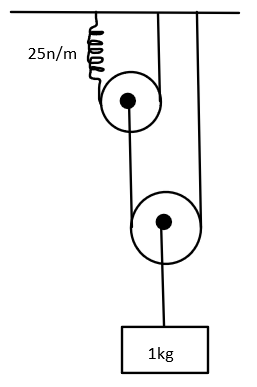
Find the natural frequency of oscillation of the system as shown in the figure. Pulleys are massless and frictionless. Spring and string are also massless. (Take ${\pi ^2} = 10$)
A) $\dfrac{\pi }{2}\,Hz$
B) $\sqrt \pi \,Hz$
C) $\dfrac{{10}}{{\sqrt \pi }}\,Hz$
D) $\pi \,Hz$
Answer
 Verified
663.3k+ views
Hint: You can easily solve this question by considering how much each pulley, thus each string and thus the spring will move when the mass goes down by a length of $x$. Using this, you can write the force on the string as ${F_{spring}}\, = \, - k{x_{acting}}$ and use the same to find the frequency of oscillation.
Complete step by step answer:
We will approach the solution exactly as told in the hint section of the solution to the question.
Let’s first see how the force applied due to the mass of $1\, kg$ is being divided between the pulleys and among the strings and spring.
Let us assume that the force is $F$.
We can see that the lower pulley has two strings to support the weight. Hence, the force gets equally distributed between them. Thus, we can say that both sides now experience a force of magnitude of $\dfrac{F}{2}$.
Now, the upper pulley experiences a total force of $\dfrac{F}{2}$ magnitude, which further gets equally distributed on both sides, thus, we can say that the spring and the string experience an equal force of magnitude $\dfrac{F}{4}$.
Now, we will check what happens when the body moves down by a distance $x$,
When the mass of $1\, kg$ goes down by a distance of $x$, the lower pulley also goes down by the same distance of $x$. Since one side of the string is fixed, it can not move down by the distance $x$, hence, the string attached to the upper pulley goes down by a distance of $2x$. If it happens, the upper pulley would move down by a distance of $2x$. Again, one side of the string is fixed, hence, spring will have to compensate for it by moving a distance of $4x$.
Now, we have found out the force acting on the spring as well as the actual displacement of the spring when the mass goes down by a distance of $x$.
We can write it mathematically as
$\dfrac{F}{4} = - k\left( {4x} \right)$
Further simplifying, we can write it as:
$\Rightarrow F = - 16kx$
The value of spring constant $\left( k \right)$ as given in the question is $25\,n/m$
Substituting the value of spring constant here, we get:
$\Rightarrow F = - \left( {16 \times 25} \right)x$
$\Rightarrow F = - 400x $
Now, we can confidently say that the object performs SHM with $\omega = \sqrt {400} = 20\,rad/s$
We already know that frequency can be given as
$f = \dfrac{\omega }{{2\pi }}$
Substituting in the value of $\omega $ , we get
$\Rightarrow f = \dfrac{{20}}{{2\pi }}$
Simplifying and then putting $10 = {\pi ^2}$(approximation) as told in the question, we get:
$\Rightarrow f = \pi \,Hz$
Hence, the correct option is option (D).
Note:
Many students believe that if the object is moving down by a distance of $x$ each string and spring will do the same, which is a completely wrong assumption and causes them to lose marks. Also, always remember that this is the best approach to solve such questions.
Complete step by step answer:
We will approach the solution exactly as told in the hint section of the solution to the question.
Let’s first see how the force applied due to the mass of $1\, kg$ is being divided between the pulleys and among the strings and spring.
Let us assume that the force is $F$.
We can see that the lower pulley has two strings to support the weight. Hence, the force gets equally distributed between them. Thus, we can say that both sides now experience a force of magnitude of $\dfrac{F}{2}$.
Now, the upper pulley experiences a total force of $\dfrac{F}{2}$ magnitude, which further gets equally distributed on both sides, thus, we can say that the spring and the string experience an equal force of magnitude $\dfrac{F}{4}$.
Now, we will check what happens when the body moves down by a distance $x$,
When the mass of $1\, kg$ goes down by a distance of $x$, the lower pulley also goes down by the same distance of $x$. Since one side of the string is fixed, it can not move down by the distance $x$, hence, the string attached to the upper pulley goes down by a distance of $2x$. If it happens, the upper pulley would move down by a distance of $2x$. Again, one side of the string is fixed, hence, spring will have to compensate for it by moving a distance of $4x$.
Now, we have found out the force acting on the spring as well as the actual displacement of the spring when the mass goes down by a distance of $x$.
We can write it mathematically as
$\dfrac{F}{4} = - k\left( {4x} \right)$
Further simplifying, we can write it as:
$\Rightarrow F = - 16kx$
The value of spring constant $\left( k \right)$ as given in the question is $25\,n/m$
Substituting the value of spring constant here, we get:
$\Rightarrow F = - \left( {16 \times 25} \right)x$
$\Rightarrow F = - 400x $
Now, we can confidently say that the object performs SHM with $\omega = \sqrt {400} = 20\,rad/s$
We already know that frequency can be given as
$f = \dfrac{\omega }{{2\pi }}$
Substituting in the value of $\omega $ , we get
$\Rightarrow f = \dfrac{{20}}{{2\pi }}$
Simplifying and then putting $10 = {\pi ^2}$(approximation) as told in the question, we get:
$\Rightarrow f = \pi \,Hz$
Hence, the correct option is option (D).
Note:
Many students believe that if the object is moving down by a distance of $x$ each string and spring will do the same, which is a completely wrong assumption and causes them to lose marks. Also, always remember that this is the best approach to solve such questions.
Recently Updated Pages
Which will be the least stable resonating structure class 11 chemistry CBSE

How many 5 digit telephone numbers can be construc-class-11-maths-CBSE
How do you find the angle of the resultant vector class 11 physics CBSE
Draw labelled diagram of the following i Gram seed class 11 biology CBSE
1 Quintal is equal to a 110 kg b 10 kg c 100kg d 1000 class 11 physics CBSE
What is the need and importance of classification class 11 biology CBSE
Trending doubts
Find the value of the expression given below sin 30circ class 11 maths CBSE
One Metric ton is equal to kg A 10000 B 1000 C 100 class 11 physics CBSE
10 examples of friction in our daily life
Draw a diagram of a plant cell and label at least eight class 11 biology CBSE
Difference between physical and chemical change class 11 chemistry CBSE
Proton was discovered by A Thomson B Rutherford C Chadwick class 11 chemistry CBSE