




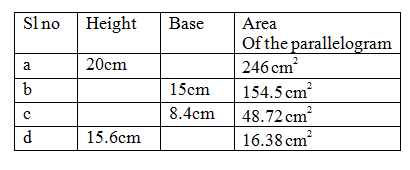
Find the missing values.\[\]
Answer
 Verified
583.8k+ views
Hint: We know that area of the parallelogram is the product of the lengths of base and height. If the height of the parallelogram is $h$ and base is $b$ the area $A$ is given by $A=bh$.We put the known values given in the question for each rows corresponding to serial numbers a, b, c, d, and find the respective known. \[\]
Complete step by step answer:
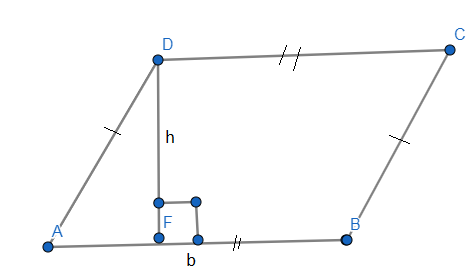
We know that a parallelogram is a quadrilateral where the opposite sides are equal in length and parallel to each other. We have drawn the figure of the parallelogram ABCD where AB=CD and AD=BC. The parallelogram also has equal opposite angles. If draw any perpendicular from any vertex on the opposite side, the perpendicular is called the height of the parallelogram conventionally denoted as $h$ and the where the opposite side is called base denoted as $b.$ In the figure the perpendicular is drawn from vertex D on AB. So $h=DF,b=AB$. \[\]
We also know that area of the parallelogram is the product of the lengths of base and height. So the area $A$ of the parallelogram can be written as
\[A=AB\times DF= h\times b\]
Now let us observe the given table.\[\]
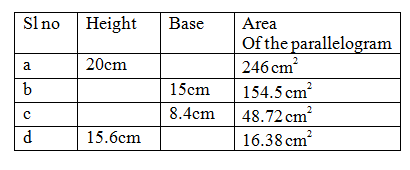
(a) We see that for serial number ‘a’ in the first row the base $b$ and area $A$ of the parallelogram is given. The height is missing values. Here we have $b=20\text{cm},A=246\text{c}{{\text{m}}^{2}}$. We put these value in the formula for area and get the height $h$ in cm.
\[\begin{align}
& A=h\times b \\
& \Rightarrow 246=h\times 20 \\
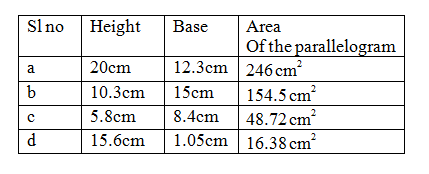
& \Rightarrow h=\dfrac{246}{20}=12.3 \\
\end{align}\]
(b) We see that for serial number ‘b’ in the second row the height ‘h’ and area $A$ of the parallelogram is given. The base is the missing value. Here we have $h=15\text{cm},A=154.5\text{c}{{\text{m}}^{2}}$. We put these value in the formula for area and get the base $b$ in cm.
\[\begin{align}
& A=h\times b \\
& \Rightarrow 154.5=15\times b \\
& \Rightarrow b=\dfrac{154.5}{15}=10.3 \\
\end{align}\]
(c) We see that for serial number ‘c’ in the third row the height ‘h’ and area $A$ of the parallelogram is given. The base is the missing value. Here we have $h=8.4\text{cm},A=48.72\text{c}{{\text{m}}^{2}}$ . We put this value in the formula for area and get the base $b$ in cm.
\[\begin{align}
& A=h\times b \\
& \Rightarrow 48.72=8.4\times b \\
& \Rightarrow b=\dfrac{48.72}{8.4}=5.8 \\
\end{align}\]
(d) We see that for serial number ‘a’ in the first row the base $b$ and area $A$ of the parallelogram is given. The height is missing values. Here we have $b=15.6\text{cm},A=16.38\text{c}{{\text{m}}^{2}}$ . We put these value in the formula for area and get the height $h$ in cm.
\[\begin{align}
& A=h\times b \\
& \Rightarrow 16.38=h\times 15.6 \\
& \Rightarrow h=\dfrac{16.38}{15.6}=1.05 \\
\end{align}\]
We now fill the table with the obtained value.\[\]
Note:
We only need to be careful of the division in decimals If the angles of the parallelogram is right angles, then it is called a rectangle whose area is $A=ab$ where $a,b$ are lengths of the sides of the rectangle. If all sides of the rectangle are equal the rectangle is square whose area is ${{a}^{2}}$ where $a$ length of the side.
Complete step by step answer:
We know that a parallelogram is a quadrilateral where the opposite sides are equal in length and parallel to each other. We have drawn the figure of the parallelogram ABCD where AB=CD and AD=BC. The parallelogram also has equal opposite angles. If draw any perpendicular from any vertex on the opposite side, the perpendicular is called the height of the parallelogram conventionally denoted as $h$ and the where the opposite side is called base denoted as $b.$ In the figure the perpendicular is drawn from vertex D on AB. So $h=DF,b=AB$. \[\]
We also know that area of the parallelogram is the product of the lengths of base and height. So the area $A$ of the parallelogram can be written as
\[A=AB\times DF= h\times b\]
Now let us observe the given table.\[\]
(a) We see that for serial number ‘a’ in the first row the base $b$ and area $A$ of the parallelogram is given. The height is missing values. Here we have $b=20\text{cm},A=246\text{c}{{\text{m}}^{2}}$. We put these value in the formula for area and get the height $h$ in cm.
\[\begin{align}
& A=h\times b \\
& \Rightarrow 246=h\times 20 \\
& \Rightarrow h=\dfrac{246}{20}=12.3 \\
\end{align}\]
(b) We see that for serial number ‘b’ in the second row the height ‘h’ and area $A$ of the parallelogram is given. The base is the missing value. Here we have $h=15\text{cm},A=154.5\text{c}{{\text{m}}^{2}}$. We put these value in the formula for area and get the base $b$ in cm.
\[\begin{align}
& A=h\times b \\
& \Rightarrow 154.5=15\times b \\
& \Rightarrow b=\dfrac{154.5}{15}=10.3 \\
\end{align}\]
(c) We see that for serial number ‘c’ in the third row the height ‘h’ and area $A$ of the parallelogram is given. The base is the missing value. Here we have $h=8.4\text{cm},A=48.72\text{c}{{\text{m}}^{2}}$ . We put this value in the formula for area and get the base $b$ in cm.
\[\begin{align}
& A=h\times b \\
& \Rightarrow 48.72=8.4\times b \\
& \Rightarrow b=\dfrac{48.72}{8.4}=5.8 \\
\end{align}\]
(d) We see that for serial number ‘a’ in the first row the base $b$ and area $A$ of the parallelogram is given. The height is missing values. Here we have $b=15.6\text{cm},A=16.38\text{c}{{\text{m}}^{2}}$ . We put these value in the formula for area and get the height $h$ in cm.
\[\begin{align}
& A=h\times b \\
& \Rightarrow 16.38=h\times 15.6 \\
& \Rightarrow h=\dfrac{16.38}{15.6}=1.05 \\
\end{align}\]
We now fill the table with the obtained value.\[\]
Note:
We only need to be careful of the division in decimals If the angles of the parallelogram is right angles, then it is called a rectangle whose area is $A=ab$ where $a,b$ are lengths of the sides of the rectangle. If all sides of the rectangle are equal the rectangle is square whose area is ${{a}^{2}}$ where $a$ length of the side.
Recently Updated Pages
Master Class 10 Computer Science: Engaging Questions & Answers for Success

Master Class 10 General Knowledge: Engaging Questions & Answers for Success
Master Class 10 English: Engaging Questions & Answers for Success
Master Class 10 Social Science: Engaging Questions & Answers for Success
Master Class 10 Maths: Engaging Questions & Answers for Success
Master Class 10 Science: Engaging Questions & Answers for Success
Trending doubts
What is the median of the first 10 natural numbers class 10 maths CBSE
Which women's tennis player has 24 Grand Slam singles titles?
Who is the Brand Ambassador of Incredible India?
Why is there a time difference of about 5 hours between class 10 social science CBSE
Write a letter to the principal requesting him to grant class 10 english CBSE
A moving boat is observed from the top of a 150 m high class 10 maths CBSE