




How do you find the measures of the angles of a triangle if the measure of one angle is twice the measure of a second angle and the third angle measures 3 times the second angle decreased by 12?
Answer
 Verified
607.2k+ views
Hint: We first use the given relations between the angles of the triangle. We assume the second angle as a variable. Based on the variable, we find the other two angles. We use the theorem of angles of triangles adding up to ${{180}^{\circ }}$. We solve the variable to find the solution.
Complete step-by-step solution:
We need to find the measures of angles of a triangle whose relations between the angles are given.
One angle is twice the measure of a second angle and the third angle measures 3 times the second angle decreased by 12.
Let’s assume the second angle being $x$. The first angle is twice the second angle.
The measure of the first angle is $2\times x=2x$.
The third angle measures 3 times the second angle decreased by 12.
The third angle is $3\times x-12=3x-12$.
We also know that the sum of all three angles of a triangle is always equal to ${{180}^{\circ }}$.
The angles in our triangle are $x,2x,3x-12$. The addition will give ${{180}^{\circ }}$.
So, $x+2x+\left( 3x-12 \right)=180$.
Now we solve the binary operations.
$\begin{align}
& x+2x+3x-12=180 \\
& \Rightarrow 6x-12=180 \\
& \Rightarrow 6x=180+12=192 \\
\end{align}$
Now, we divide both sides of the equation with 6 and get
$\begin{align}
& \dfrac{6x}{6}=\dfrac{192}{6} \\
& \Rightarrow x=32 \\
\end{align}$
Therefore, the second angle is ${{32}^{\circ }}$.
The other angles are $2x=2\times {{32}^{\circ }}={{64}^{\circ }}$ and $3\times {{32}^{\circ }}-12={{84}^{\circ }}$.
Therefore, the angles of the triangle are ${{32}^{\circ }},{{64}^{\circ }},{{84}^{\circ }}$.
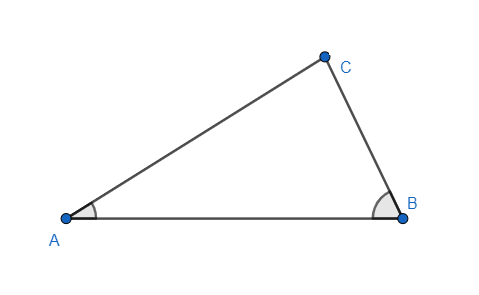
Note: The theorem of ‘sum of all three angles of a triangle is always equal to ${{180}^{\circ }}$’ is true for any kind of triangles. The binary operations and the division can also be explained in the form GCD of the divisor and the dividend.
Complete step-by-step solution:
We need to find the measures of angles of a triangle whose relations between the angles are given.
One angle is twice the measure of a second angle and the third angle measures 3 times the second angle decreased by 12.
Let’s assume the second angle being $x$. The first angle is twice the second angle.
The measure of the first angle is $2\times x=2x$.
The third angle measures 3 times the second angle decreased by 12.
The third angle is $3\times x-12=3x-12$.
We also know that the sum of all three angles of a triangle is always equal to ${{180}^{\circ }}$.
The angles in our triangle are $x,2x,3x-12$. The addition will give ${{180}^{\circ }}$.
So, $x+2x+\left( 3x-12 \right)=180$.
Now we solve the binary operations.
$\begin{align}
& x+2x+3x-12=180 \\
& \Rightarrow 6x-12=180 \\
& \Rightarrow 6x=180+12=192 \\
\end{align}$
Now, we divide both sides of the equation with 6 and get
$\begin{align}
& \dfrac{6x}{6}=\dfrac{192}{6} \\
& \Rightarrow x=32 \\
\end{align}$
Therefore, the second angle is ${{32}^{\circ }}$.
The other angles are $2x=2\times {{32}^{\circ }}={{64}^{\circ }}$ and $3\times {{32}^{\circ }}-12={{84}^{\circ }}$.
Therefore, the angles of the triangle are ${{32}^{\circ }},{{64}^{\circ }},{{84}^{\circ }}$.
Note: The theorem of ‘sum of all three angles of a triangle is always equal to ${{180}^{\circ }}$’ is true for any kind of triangles. The binary operations and the division can also be explained in the form GCD of the divisor and the dividend.
Recently Updated Pages
Basicity of sulphurous acid and sulphuric acid are

Master Class 12 Economics: Engaging Questions & Answers for Success
Master Class 12 Biology: Engaging Questions & Answers for Success
Master Class 11 English: Engaging Questions & Answers for Success
Master Class 11 Physics: Engaging Questions & Answers for Success
Master Class 11 Computer Science: Engaging Questions & Answers for Success
Trending doubts
What is the Total Duration of Football Match?
In football, which nation is called "La Roja"?
Why is there a time difference of about 5 hours between class 10 social science CBSE
What is the award for the best player at the FIFA World Cup?
Define Potential, Developed, Stock and Reserved resources
Draw the diagram of the sectional view of the human class 10 biology CBSE