




How do you find the measure of the diagonal of a rectangle with sides \[20\] and \[48\]?
Answer
 Verified
543.9k+ views
Hint: In the given question, we have been given that there is a figure. We have been given the measures of its sides. We have to calculate the measure of its diagonal. We are going to solve it by drawing a rectangle, marking points on it, making a diagonal and then applying Pythagoras Theorem on it.
Complete step by step answer:
We are going to use Pythagoras Theorem, which is,
\[{\left( {Hypo} \right)^2} = {\left( {Base} \right)^2} + {\left( {Perp} \right)^2}\]
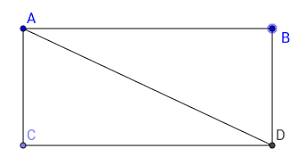
Consider the given rectangle.
We have to calculate the length of \[AD\].
Consider the right triangle \[\Delta ACD\].
In the given triangle, we are going to use Pythagoras Theorem, which is,
\[{\left( {Hypo} \right)^2} = {\left( {Base} \right)^2} + {\left( {Perp} \right)^2}\]
In this triangle, \[Base = CD = 48\] and \[Perp = AC = 20\].
So, we have,
\[Hypo = AD = \sqrt {A{C^2} + C{D^2}} = \sqrt {{{20}^2} + {{48}^2}} = \sqrt {2704} \]
We know, \[{52^2} = 2704\]
Hence, \[AD = 52\]
Thus, the length of the diagonal is \[52\].
Note: In the given question, we had to find the diagonal of a given rectangle whose sides were given. We did that by using the Pythagoras Theorem. The point where there could be an error is to recognize the perpendicular, base and hypotenuse to calculate one of the unknown quantities. The squares of the perpendicular and base are added, so the side to give care to is hypotenuse – hypotenuse is the side opposite to the right-angle. So, while solving the questions of this type, it is important to remember these points.
Complete step by step answer:
We are going to use Pythagoras Theorem, which is,
\[{\left( {Hypo} \right)^2} = {\left( {Base} \right)^2} + {\left( {Perp} \right)^2}\]
Consider the given rectangle.
We have to calculate the length of \[AD\].
Consider the right triangle \[\Delta ACD\].
In the given triangle, we are going to use Pythagoras Theorem, which is,
\[{\left( {Hypo} \right)^2} = {\left( {Base} \right)^2} + {\left( {Perp} \right)^2}\]
In this triangle, \[Base = CD = 48\] and \[Perp = AC = 20\].
So, we have,
\[Hypo = AD = \sqrt {A{C^2} + C{D^2}} = \sqrt {{{20}^2} + {{48}^2}} = \sqrt {2704} \]
We know, \[{52^2} = 2704\]
Hence, \[AD = 52\]
Thus, the length of the diagonal is \[52\].
Note: In the given question, we had to find the diagonal of a given rectangle whose sides were given. We did that by using the Pythagoras Theorem. The point where there could be an error is to recognize the perpendicular, base and hypotenuse to calculate one of the unknown quantities. The squares of the perpendicular and base are added, so the side to give care to is hypotenuse – hypotenuse is the side opposite to the right-angle. So, while solving the questions of this type, it is important to remember these points.
Recently Updated Pages
Master Class 10 Computer Science: Engaging Questions & Answers for Success

Master Class 10 General Knowledge: Engaging Questions & Answers for Success
Master Class 10 English: Engaging Questions & Answers for Success
Master Class 10 Social Science: Engaging Questions & Answers for Success
Master Class 10 Maths: Engaging Questions & Answers for Success
Master Class 10 Science: Engaging Questions & Answers for Success
Trending doubts
What is the median of the first 10 natural numbers class 10 maths CBSE
Which women's tennis player has 24 Grand Slam singles titles?
Who is the Brand Ambassador of Incredible India?
Why is there a time difference of about 5 hours between class 10 social science CBSE
Write a letter to the principal requesting him to grant class 10 english CBSE
A moving boat is observed from the top of a 150 m high class 10 maths CBSE