



Find the measure of an interior and exterior angle at the vertex of an isosceles triangle measures \[45{}^\circ \].
\[\begin{align}
& \text{A}\text{. interior angle =67}\text{.5 degree, exterior angle =135 degree} \\
& \text{B}\text{. interior angle =75 degree, exterior angle =135 degree} \\
& \text{C}\text{. interior angle =67}\text{.5 degree, exterior angle =135 degree} \\
& \text{D}\text{. interior angle =67}\text{.5 degree, exterior angle =35 degree} \\
\end{align}\]
Answer
 Verified
645.3k+ views
Hint: From the question, it is given that the vertex of an isosceles triangle measures \[45{}^\circ \]. Let us assume a triangle ABC, let us assume \[\angle \text{B=4}{{\text{5}}^{\circ }}\].We know that in a triangle, the sum of all the angles is equal to \[{{180}^{\circ }}\]. We know that in an isosceles triangle, the measure of two angles are equal. By using this concept, we can find the measure of angle A and angle C. We know that the sum of two opposite interior angles is equal to the exterior angle.
So, now let us calculate the sum of exterior angles opposite to vertex A and vertex C. In this way, we can also calculate the measure of exterior angle.
Complete step-by-step answer:
From the question, it is given that the vertex of an isosceles triangle measures \[45{}^\circ \].
Let us assume a triangle ABC, let us assume
\[\angle \text{B=4}{{\text{5}}^{\circ }}.....(1)\]
We know that in a triangle, the sum of all the angles is equal to \[{{180}^{\circ }}\].
So, in \[\Delta ABC\]
\[\angle A+\angle B+\angle C={{180}^{\circ }}.....(2)\]
Let us substitute equation (1) in equation (2), then we get
\[\begin{align}
& \Rightarrow \angle A+{{45}^{\circ }}+\angle C={{180}^{\circ }} \\
& \Rightarrow \angle A+\angle C={{135}^{\circ }}....(3) \\
\end{align}\]
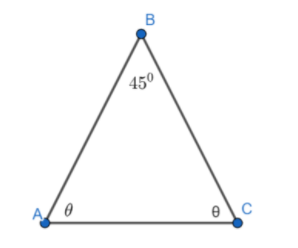
We know that in an isosceles triangle, the measure of two angles are equal.
So, it is clear that
\[\angle A=\angle C.....(4)\]
Now let us substitute equation (4) in equation (3), then we get
\[\begin{align}
& \Rightarrow \angle A+\angle A={{135}^{\circ }} \\
& \Rightarrow 2\angle A={{135}^{\circ }} \\
\end{align}\]
Now by using cross multiplication, then we get
\[\begin{align}
& \Rightarrow \angle A={{\left( \dfrac{135}{2} \right)}^{\circ }} \\
& \Rightarrow \angle A={{67.5}^{\circ }}.....(4) \\
\end{align}\]
So, it is clear that \[{{67.5}^{\circ }}\] is the interior angle of the given isosceles triangle.
We know that the sum of two opposite interior angles is equal to the exterior angle.
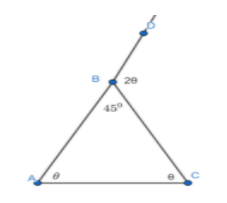
So, now let us calculate the sum of exterior angle opposite to vertex A and vertex C.
From the diagram, it is clear that \[\angle CBD\] is the opposite exterior angle of interior angles \[\angle A\] and \[\angle C\].
\[\Rightarrow \angle CBD=\angle A+\angle C....(5)\]
Substitute equation (4) in equation (5), then we get
\[\Rightarrow \angle CBD=2\angle A....(6)\]
Now let us substitute equation (4) in equation (6), then we get
\[\begin{align}
& \Rightarrow \angle CBD=2\left( {{67.5}^{\circ }} \right) \\
& \Rightarrow \angle CBD={{135}^{\circ }}....(7) \\
\end{align}\]
From equation (7), it is clear that the measure of an exterior angle of the given isosceles triangle is equal to \[{{135}^{\circ }}\].
Hence, we can say that option A is correct.
Note:Some students may assume that the sum of two opposite interior angles is equal to twice of an exterior angle. This is a huge misconception. If this misconception is followed, then the students will get a wrong measure of exterior angle. So, they may mark the wrong option as well. Hence, this misconception should get avoided. Otherwise, this question can not be answered correctly.
So, now let us calculate the sum of exterior angles opposite to vertex A and vertex C. In this way, we can also calculate the measure of exterior angle.
Complete step-by-step answer:
From the question, it is given that the vertex of an isosceles triangle measures \[45{}^\circ \].
Let us assume a triangle ABC, let us assume
\[\angle \text{B=4}{{\text{5}}^{\circ }}.....(1)\]
We know that in a triangle, the sum of all the angles is equal to \[{{180}^{\circ }}\].
So, in \[\Delta ABC\]
\[\angle A+\angle B+\angle C={{180}^{\circ }}.....(2)\]
Let us substitute equation (1) in equation (2), then we get
\[\begin{align}
& \Rightarrow \angle A+{{45}^{\circ }}+\angle C={{180}^{\circ }} \\
& \Rightarrow \angle A+\angle C={{135}^{\circ }}....(3) \\
\end{align}\]
We know that in an isosceles triangle, the measure of two angles are equal.
So, it is clear that
\[\angle A=\angle C.....(4)\]
Now let us substitute equation (4) in equation (3), then we get
\[\begin{align}
& \Rightarrow \angle A+\angle A={{135}^{\circ }} \\
& \Rightarrow 2\angle A={{135}^{\circ }} \\
\end{align}\]
Now by using cross multiplication, then we get
\[\begin{align}
& \Rightarrow \angle A={{\left( \dfrac{135}{2} \right)}^{\circ }} \\
& \Rightarrow \angle A={{67.5}^{\circ }}.....(4) \\
\end{align}\]
So, it is clear that \[{{67.5}^{\circ }}\] is the interior angle of the given isosceles triangle.
We know that the sum of two opposite interior angles is equal to the exterior angle.
So, now let us calculate the sum of exterior angle opposite to vertex A and vertex C.
From the diagram, it is clear that \[\angle CBD\] is the opposite exterior angle of interior angles \[\angle A\] and \[\angle C\].
\[\Rightarrow \angle CBD=\angle A+\angle C....(5)\]
Substitute equation (4) in equation (5), then we get
\[\Rightarrow \angle CBD=2\angle A....(6)\]
Now let us substitute equation (4) in equation (6), then we get
\[\begin{align}
& \Rightarrow \angle CBD=2\left( {{67.5}^{\circ }} \right) \\
& \Rightarrow \angle CBD={{135}^{\circ }}....(7) \\
\end{align}\]
From equation (7), it is clear that the measure of an exterior angle of the given isosceles triangle is equal to \[{{135}^{\circ }}\].
Hence, we can say that option A is correct.
Note:Some students may assume that the sum of two opposite interior angles is equal to twice of an exterior angle. This is a huge misconception. If this misconception is followed, then the students will get a wrong measure of exterior angle. So, they may mark the wrong option as well. Hence, this misconception should get avoided. Otherwise, this question can not be answered correctly.
Recently Updated Pages
Basicity of sulphurous acid and sulphuric acid are

Master Class 12 Economics: Engaging Questions & Answers for Success
Master Class 12 Biology: Engaging Questions & Answers for Success
Master Class 11 English: Engaging Questions & Answers for Success
Master Class 11 Physics: Engaging Questions & Answers for Success
Master Class 11 Computer Science: Engaging Questions & Answers for Success
Trending doubts
What is BLO What is the full form of BLO class 8 social science CBSE
Citizens of India can vote at the age of A 18 years class 8 social science CBSE
Full form of STD, ISD and PCO
Give me the opposite gender of Duck class 8 english CBSE
One cusec is equal to how many liters class 8 maths CBSE
What is the feminine gender of a stag class 8 english CBSE