




Find the maximum volume of the cylinder which can be inscribed in a sphere of radius of $3\sqrt 3 $ cm. (leave the answer in terms of $\pi $ )
Answer
 Verified
636k+ views
Hint: In order to find the maximum volume of the cylinder which is to be inscribed in a sphere, the concept of maxima and minima is used. The function of volume of cylinder$\left( {V = \pi {R^2}H} \right)$ in terms of height of sphere is to be differentiated twice first to get the critical points and then to check the sign of the double derivative.
Complete step by step answer:
To solve this problem the formula for volume of the cylinder should be remembered. Also the knowledge of Pythagoras theorem is required.
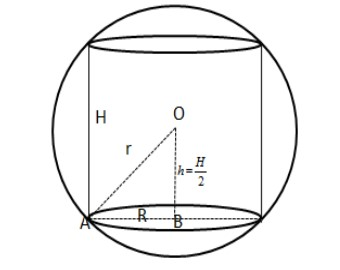
As it is clear from the figure below that the radius of the sphere = r cm, radius of the cylinder =R cm and the height of the cylinder = h cm.
In a right triangle OAB , using Pythagoras theorem ( If H is the hypotenuse , B is the base and P is the height of the right angles triangle, then by Pythagoras theorem ${H^2} = {B^2} + {P^2}$ )
\[
O{A^2} = A{B^2} + O{B^2} \\
{r^2} = {R^2} + {\left( {\dfrac{H}{2}} \right)^2} \\
{r^2} = {R^2} + \dfrac{{{H^2}}}{4} \\
{R^2} = {r^2} - \dfrac{{{H^2}}}{4}......(1) \\
\]
Now, the volume of the cylinder is given by
$V = \pi {R^2}H$
Substituting the value of ${R^2}$ in the volume of the cylinder,
\[
V = \pi \left( {{r^2} - \dfrac{{{H^2}}}{4}} \right)H \\
V = \pi \left( {{r^2}H - \dfrac{{{H^3}}}{4}} \right)......(2) \\
\]
Now, differentiating equation (2) concerning to H,
$\dfrac{{dV}}{{dH}} = \pi \left( {{r^2} - \dfrac{{3{H^2}}}{4}} \right)......(3)$
For obtaining the critical points put $\dfrac{{dV}}{{dH}} = 0$
$
\pi \left( {{r^2} - \dfrac{{3{H^2}}}{4}} \right) = 0 \\
\Rightarrow {r^2} - \dfrac{{3{H^2}}}{4} = 0 \\
{H^2} = \dfrac{{4{r^2}}}{3} \\
H = \dfrac{{2r}}{{\sqrt 3 }}......(4) \\
$
For checking whether this value is giving the maximum volume, differentiate equation (3) again and substitute the value H obtained in equation (4)
\[
\dfrac{{{d^2}V}}{{{d^2}H}} = \pi \left( {0 - \dfrac{{6H}}{4}} \right) \\
\left( {\dfrac{{{d^2}V}}{{{d^2}H}}} \right) = - \pi \left( {\dfrac{3}{2}\left( {\dfrac{{2r}}{{\sqrt 3 }}} \right)} \right) \\
\]
The sign of the second derivative is negative. So, $H = \dfrac{{2r}}{{\sqrt 3 }}$ is a point of maxima
$
\dfrac{{{H^2}}}{4} = \dfrac{{{{\left( {2r} \right)}^2}}}{{{{\left( {\sqrt 3 } \right)}^2}4}} \\
\dfrac{{{H^2}}}{4} = \dfrac{{4{r^2}}}{{12}} \\
\dfrac{{{H^2}}}{4} = \dfrac{{{r^2}}}{3}......(5) \\
$
Substitute the value of $\dfrac{{{H^2}}}{4}$ in equation (2),
$
V = \pi \left( {{r^2} - \dfrac{{{r^2}}}{3}} \right)\dfrac{{2r}}{{\sqrt 3 }} \\
V = \pi \left( {\dfrac{{2{r^2}}}{3}} \right)\dfrac{{2r}}{{\sqrt 3 }} \\
V = \dfrac{{4{r^3}\pi }}{{3\sqrt 3 }}......(6) \\
$
Now put $r = 3\sqrt 3 $ in equation (6)
$
V = \dfrac{{4{{\left( {3\sqrt 3 } \right)}^3}\pi }}{{3\sqrt 3 }} \\
V = \dfrac{{4\left( {81\sqrt 3 } \right)\pi }}{{3\sqrt 3 }} \\
V = 108\pi \\
$
Hence, the volume of the largest cylinder that can be inscribed in a sphere of radius $3\sqrt 3 $ cm is $108 cm^3$.
Note: When finding the maxima and minima always make sure to find the second order derivative and then proceed with finding the values.
Complete step by step answer:
To solve this problem the formula for volume of the cylinder should be remembered. Also the knowledge of Pythagoras theorem is required.
As it is clear from the figure below that the radius of the sphere = r cm, radius of the cylinder =R cm and the height of the cylinder = h cm.
In a right triangle OAB , using Pythagoras theorem ( If H is the hypotenuse , B is the base and P is the height of the right angles triangle, then by Pythagoras theorem ${H^2} = {B^2} + {P^2}$ )
\[
O{A^2} = A{B^2} + O{B^2} \\
{r^2} = {R^2} + {\left( {\dfrac{H}{2}} \right)^2} \\
{r^2} = {R^2} + \dfrac{{{H^2}}}{4} \\
{R^2} = {r^2} - \dfrac{{{H^2}}}{4}......(1) \\
\]
Now, the volume of the cylinder is given by
$V = \pi {R^2}H$
Substituting the value of ${R^2}$ in the volume of the cylinder,
\[
V = \pi \left( {{r^2} - \dfrac{{{H^2}}}{4}} \right)H \\
V = \pi \left( {{r^2}H - \dfrac{{{H^3}}}{4}} \right)......(2) \\
\]
Now, differentiating equation (2) concerning to H,
$\dfrac{{dV}}{{dH}} = \pi \left( {{r^2} - \dfrac{{3{H^2}}}{4}} \right)......(3)$
For obtaining the critical points put $\dfrac{{dV}}{{dH}} = 0$
$
\pi \left( {{r^2} - \dfrac{{3{H^2}}}{4}} \right) = 0 \\
\Rightarrow {r^2} - \dfrac{{3{H^2}}}{4} = 0 \\
{H^2} = \dfrac{{4{r^2}}}{3} \\
H = \dfrac{{2r}}{{\sqrt 3 }}......(4) \\
$
For checking whether this value is giving the maximum volume, differentiate equation (3) again and substitute the value H obtained in equation (4)
\[
\dfrac{{{d^2}V}}{{{d^2}H}} = \pi \left( {0 - \dfrac{{6H}}{4}} \right) \\
\left( {\dfrac{{{d^2}V}}{{{d^2}H}}} \right) = - \pi \left( {\dfrac{3}{2}\left( {\dfrac{{2r}}{{\sqrt 3 }}} \right)} \right) \\
\]
The sign of the second derivative is negative. So, $H = \dfrac{{2r}}{{\sqrt 3 }}$ is a point of maxima
$
\dfrac{{{H^2}}}{4} = \dfrac{{{{\left( {2r} \right)}^2}}}{{{{\left( {\sqrt 3 } \right)}^2}4}} \\
\dfrac{{{H^2}}}{4} = \dfrac{{4{r^2}}}{{12}} \\
\dfrac{{{H^2}}}{4} = \dfrac{{{r^2}}}{3}......(5) \\
$
Substitute the value of $\dfrac{{{H^2}}}{4}$ in equation (2),
$
V = \pi \left( {{r^2} - \dfrac{{{r^2}}}{3}} \right)\dfrac{{2r}}{{\sqrt 3 }} \\
V = \pi \left( {\dfrac{{2{r^2}}}{3}} \right)\dfrac{{2r}}{{\sqrt 3 }} \\
V = \dfrac{{4{r^3}\pi }}{{3\sqrt 3 }}......(6) \\
$
Now put $r = 3\sqrt 3 $ in equation (6)
$
V = \dfrac{{4{{\left( {3\sqrt 3 } \right)}^3}\pi }}{{3\sqrt 3 }} \\
V = \dfrac{{4\left( {81\sqrt 3 } \right)\pi }}{{3\sqrt 3 }} \\
V = 108\pi \\
$
Hence, the volume of the largest cylinder that can be inscribed in a sphere of radius $3\sqrt 3 $ cm is $108 cm^3$.
Note: When finding the maxima and minima always make sure to find the second order derivative and then proceed with finding the values.
Recently Updated Pages
Master Class 12 Business Studies: Engaging Questions & Answers for Success

Master Class 12 Chemistry: Engaging Questions & Answers for Success
Master Class 12 Biology: Engaging Questions & Answers for Success
Class 12 Question and Answer - Your Ultimate Solutions Guide
Master Class 11 English: Engaging Questions & Answers for Success
Master Class 11 Social Science: Engaging Questions & Answers for Success
Trending doubts
Which are the Top 10 Largest Countries of the World?
The total number of vertebrae in man is a30 b31 c32 class 12 biology CBSE
Draw a labelled sketch of the human eye class 12 physics CBSE
The number of cranial nerves in a frog is A 10 pairs class 12 biology CBSE
Differentiate between homogeneous and heterogeneous class 12 chemistry CBSE
Differentiate between Pyramid of energy and pyramid class 12 biology CBSE