




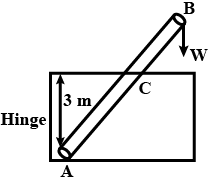
Find the magnitude and direction of the force exerted by the hinge on the rod.
A.$17/3kgf$ in the downward direction.
B.$8kgf$ in the downward direction
C.$4kgf$ in the downward direction.
D.$5kgf$ in the downward direction.
Answer
 Verified
597k+ views
Hint: To solve this problem we should first understand about fluid, properties of fluids, Variation of pressure with depth, Buoyant force and the concept behind these terms including all the information regarding them. And by applying this information we can easily approach our answer, so let briefly study them.
Complete answer:
Fluid is a substance which doesn't have any fixed shape, liquids and gas both are having the property to flow therefore are said to be fluids. It is easy to exert external pressure.
Buoyant force : It works on the principle that states that the buoyancy force on an object is equal to the weight of the fluid displaced by an object or the product of both density of the fluid and the submerged volume times the gravitational acceleration $g$ .
When a body is immersed in water or any other fluid, the body exerts a force from the downward direction opposite to the direction of the gravitational force, which results in decrease in its weight.
For example - A ball of plastic floats in water rather than sinking to the base by its weight.
Buoyancy is caused by the differences in pressure acting on opposite sides of an object immersed in any fluid. It is also known as the buoyant force, the phenomenon is due to the Buoyant Force.
Since external weight suspended $ = \dfrac{7}{3}g$
Weight of the rod $ = 12g$ downwards
Buoyant force$ = V\rho g = \dfrac{{10}}{d}\rho g = 20g$ upwards
Thus, for rod to remain in equilibrium force due to hinge$ = 20g - 12g - \dfrac{7}{3}g$ downwards
$ = \dfrac{{17}}{3}kgf$ downwards.
So, the correct answer is option A - $17/3kgf$ in the downward direction.
Note: It is an upward force experienced by a fluid that opposes the weight of an object immersed in any fluid. we know, the pressure in a fluid column increases with depth. Therefore, the pressure at the bottom of an object submerged in the fluid is greater than that at the top. The difference in this pressure results in a net upward force on the object which is called buoyancy.
Complete answer:
Fluid is a substance which doesn't have any fixed shape, liquids and gas both are having the property to flow therefore are said to be fluids. It is easy to exert external pressure.
Buoyant force : It works on the principle that states that the buoyancy force on an object is equal to the weight of the fluid displaced by an object or the product of both density of the fluid and the submerged volume times the gravitational acceleration $g$ .
When a body is immersed in water or any other fluid, the body exerts a force from the downward direction opposite to the direction of the gravitational force, which results in decrease in its weight.
For example - A ball of plastic floats in water rather than sinking to the base by its weight.
Buoyancy is caused by the differences in pressure acting on opposite sides of an object immersed in any fluid. It is also known as the buoyant force, the phenomenon is due to the Buoyant Force.
Since external weight suspended $ = \dfrac{7}{3}g$
Weight of the rod $ = 12g$ downwards
Buoyant force$ = V\rho g = \dfrac{{10}}{d}\rho g = 20g$ upwards
Thus, for rod to remain in equilibrium force due to hinge$ = 20g - 12g - \dfrac{7}{3}g$ downwards
$ = \dfrac{{17}}{3}kgf$ downwards.
So, the correct answer is option A - $17/3kgf$ in the downward direction.
Note: It is an upward force experienced by a fluid that opposes the weight of an object immersed in any fluid. we know, the pressure in a fluid column increases with depth. Therefore, the pressure at the bottom of an object submerged in the fluid is greater than that at the top. The difference in this pressure results in a net upward force on the object which is called buoyancy.
Recently Updated Pages
Master Class 11 Computer Science: Engaging Questions & Answers for Success

Master Class 11 Business Studies: Engaging Questions & Answers for Success
Master Class 11 Economics: Engaging Questions & Answers for Success
Master Class 11 English: Engaging Questions & Answers for Success
Master Class 11 Maths: Engaging Questions & Answers for Success
Master Class 11 Biology: Engaging Questions & Answers for Success
Trending doubts
One Metric ton is equal to kg A 10000 B 1000 C 100 class 11 physics CBSE
There are 720 permutations of the digits 1 2 3 4 5 class 11 maths CBSE
Discuss the various forms of bacteria class 11 biology CBSE
Draw a diagram of a plant cell and label at least eight class 11 biology CBSE
State the laws of reflection of light
Explain zero factorial class 11 maths CBSE