




Find the lowest number, which is more than 7 to be divided by 20, 50, and 100 exactly.
Answer
 Verified
594.3k+ views
Hint: LCM or LCF is a method by which we can find out a common number. By using this common number, one can divide any number in the given set. In the above problem, we first find the LCM, and after adding number 7 to the result, will give us the required number.
Here, the question is not asking for the LCM directly but is asking the lowest number, which is more by 7, which will divide the numbers 20, 50, and 100 exactly without leaving any remainder behind. Hence, the question’s equation is reduced to $7 + x = LCM$, where $x$ is the desired result.
Complete Answer:
To determine the LCM, find the factors of \[20,50,100\]is:
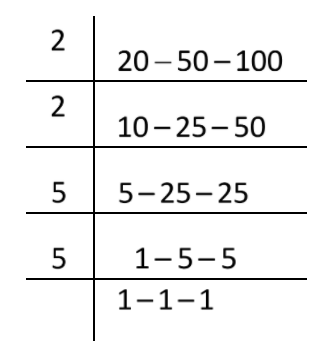
The common factors among the numbers $20,50,100$ are $2 \times 2 \times 5 \times 5$.
Hence, \[LCM(100,50,20) = 2 \times 2 \times 5 \times 5 = 100\]
Now, let $x$ be the smallest integer, which when added to 7, will divide the numbers 20, 50, and 100 exactly.
Hence,
$
100 = 7 + x \\
x = 100 - 7 \\
x = 93 \\
$
Hence, $x = 93$ it is the smallest number that, when added with 7, will divide the numbers 10, 20, and 50 exactly.
Note: LCM of given numbers is exactly divisible by each of the numbers. During the LCM calculation, students must know the tables of various numbers, and they have to perform the operations step by step. Lastly, they have to multiply all the numbers by which they are dividing the given set of numbers. The least common multiple, lowest common multiple, or smallest common multiple of two integers a and b, usually denoted by LCM (a, b), is the smallest positive integer that is divisible by both a and b.
Here, the question is not asking for the LCM directly but is asking the lowest number, which is more by 7, which will divide the numbers 20, 50, and 100 exactly without leaving any remainder behind. Hence, the question’s equation is reduced to $7 + x = LCM$, where $x$ is the desired result.
Complete Answer:
To determine the LCM, find the factors of \[20,50,100\]is:
The common factors among the numbers $20,50,100$ are $2 \times 2 \times 5 \times 5$.
Hence, \[LCM(100,50,20) = 2 \times 2 \times 5 \times 5 = 100\]
Now, let $x$ be the smallest integer, which when added to 7, will divide the numbers 20, 50, and 100 exactly.
Hence,
$
100 = 7 + x \\
x = 100 - 7 \\
x = 93 \\
$
Hence, $x = 93$ it is the smallest number that, when added with 7, will divide the numbers 10, 20, and 50 exactly.
Note: LCM of given numbers is exactly divisible by each of the numbers. During the LCM calculation, students must know the tables of various numbers, and they have to perform the operations step by step. Lastly, they have to multiply all the numbers by which they are dividing the given set of numbers. The least common multiple, lowest common multiple, or smallest common multiple of two integers a and b, usually denoted by LCM (a, b), is the smallest positive integer that is divisible by both a and b.
Recently Updated Pages
Master Class 10 Computer Science: Engaging Questions & Answers for Success

Master Class 10 General Knowledge: Engaging Questions & Answers for Success
Master Class 10 English: Engaging Questions & Answers for Success
Master Class 10 Social Science: Engaging Questions & Answers for Success
Master Class 10 Maths: Engaging Questions & Answers for Success
Master Class 10 Science: Engaging Questions & Answers for Success
Trending doubts
What is the median of the first 10 natural numbers class 10 maths CBSE
Which women's tennis player has 24 Grand Slam singles titles?
Who is the Brand Ambassador of Incredible India?
Why is there a time difference of about 5 hours between class 10 social science CBSE
Write a letter to the principal requesting him to grant class 10 english CBSE
A moving boat is observed from the top of a 150 m high class 10 maths CBSE