




Find the locus of the middle points of chords of the parabola which are normal to the curve.
Answer
 Verified
651.3k+ views
Hint: Write the equation of normal to the parabola at a general point on it and see where it intersects the curve again. Find the midpoint.
Complete step-by-step answer:
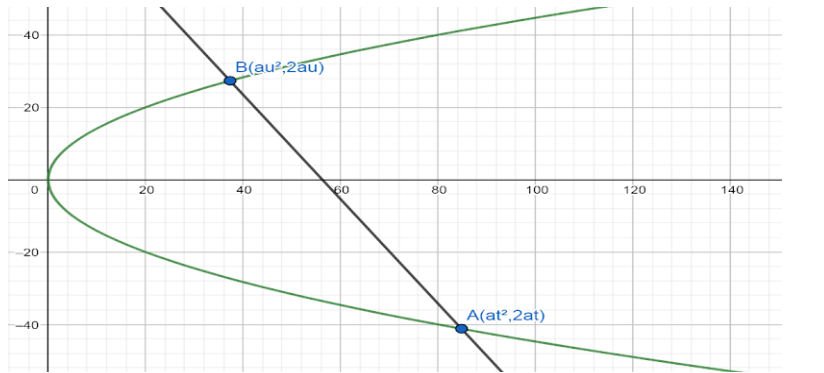
Consider the above picture. \[A\left( a{{t}^{2}},2at \right)\] and \[B\left( a{{u}^{2}},2au \right)\]are two variable points on the standard parabola \[{{y}^{2}}=4ax\] with parameters \[t\] and \[u\] respectively.
It is given that $AB$ is normal to the parabola at\[B\].
We can write equations for $AB$ using the formula for normals which is,
Normal at a point with parameter (\[t\]) is given by,
\[y+tx=2at+a{{t}^{3}}\]
So we get the equation of line \[AB\] as,
\[AB:y+ux=2au+a{{u}^{3}}\]
We know that normal to the parabola at point with parameter \[t\] cuts it again at another point with parameter$-t-\dfrac{2}{t}$.
We can prove this by solving the equation of normal i.e. \[AB\] and parabola together.
So we get point\[A\]as,
$A=\left( a{{\left( -t-\dfrac{2}{t} \right)}^{2}},2a\left( -t-\dfrac{2}{t} \right) \right)$
Now let point \[\left( h,k \right)\]lie on our locus. Since they lie on the locus it is the midpoint of our variable chord\[AB\].
So using the midpoint formula which is,
Xmid=\[\dfrac{x1+x2}{2}\]
ymid= \[\dfrac{y1+y2}{2}\]
We write,
$h=\left\{ \dfrac{\left( x~coordinate~of~A \right)+\left( x~coordinate~of~B \right)}{2} \right\}$
$k=\left\{ \dfrac{\left( y~coordinate~of~A \right)+\left( y~coordinate~of~B \right)}{2} \right\}$
And,
$h=\left\{ \dfrac{\left( \text{a}{{\text{t}}^{2}} \right)+\left( a{{\left( -t-\dfrac{2}{t} \right)}^{2}} \right)}{2} \right\}$
$2h=\left( \text{a}{{\text{t}}^{2}} \right)+\left( a{{\left( -t-\dfrac{2}{t} \right)}^{2}} \right)$
\[\dfrac{2h}{a}={{\text{t}}^{2}}+{{\left( -t-\dfrac{2}{t} \right)}^{2}}\]
\[\dfrac{2h}{a}={{\text{t}}^{2}}+\left( {{\left( -t \right)}^{2}}+{{\left( -\dfrac{2}{t} \right)}^{2}}+2(-t)\left( -\dfrac{2}{t} \right) \right)\]
\[\dfrac{2h}{a}=2{{t}^{2}}+\dfrac{4}{{{t}^{2}}}+4\]
\[\dfrac{h}{a}={{t}^{2}}+\dfrac{2}{{{t}^{2}}}+2...(i)\]
$k=\left\{ \dfrac{\left( 2at \right)+\left( 2a\left( -t-\dfrac{2}{t} \right) \right)}{2} \right\}$
$2k=\left( 2at \right)+\left( 2a\left( -t-\dfrac{2}{t} \right) \right)$
$\dfrac{2k}{a}=2t+2\left( -t-\dfrac{2}{t} \right)$
$\dfrac{2k}{a}=\dfrac{-4}{t}$
$t=\dfrac{-2a}{k}...(ii)$
So our next task in finding the locus is eliminating the variables from the above equations.
Substituting equation \[\left( ii \right)\] in \[\left( i \right)\] we get,
$\dfrac{h}{a}={{\left( \dfrac{-2a}{k} \right)}^{2}}+\dfrac{2}{{{\left( \dfrac{-2a}{k} \right)}^{2}}}+2$
$\dfrac{h}{a}={{\left( \dfrac{-2a}{k} \right)}^{2}}+2{{\left( \dfrac{k}{-2a} \right)}^{2}}+2$
$\dfrac{h}{a}=\dfrac{4{{a}^{2}}}{{{k}^{2}}}+2\dfrac{{{k}^{2}}}{4{{a}^{2}}}+2$
$\dfrac{h}{a}=\dfrac{4{{a}^{2}}}{{{k}^{2}}}+\dfrac{{{k}^{2}}}{2{{a}^{2}}}+2$
$h=\dfrac{4{{a}^{3}}}{{{k}^{2}}}+\dfrac{{{k}^{2}}}{2a}+2$
This is the required locus.
Now since \[\left( h,k \right)\]are general points on our locus we can replace \[h\] by \[x\] and \[k\] by \[y\].
$x=\dfrac{4{{a}^{3}}}{{{y}^{2}}}+\dfrac{{{y}^{2}}}{2{{a}}}+2$
This is the required locus.
Note: Students have to think carefully while deciding which is the variable before eliminating. In this question students might eliminate \[a\] which will give them the wrong answer. Also they may use their different techniques to eliminate the variable from the equations. Also, if they feel it is redundant to use \[\left( h,k \right)\]first and then replace it as \[\left( x,y \right)\]they may use \[\left( x,y \right)\]from the start as well.
Complete step-by-step answer:
Consider the above picture. \[A\left( a{{t}^{2}},2at \right)\] and \[B\left( a{{u}^{2}},2au \right)\]are two variable points on the standard parabola \[{{y}^{2}}=4ax\] with parameters \[t\] and \[u\] respectively.
It is given that $AB$ is normal to the parabola at\[B\].
We can write equations for $AB$ using the formula for normals which is,
Normal at a point with parameter (\[t\]) is given by,
\[y+tx=2at+a{{t}^{3}}\]
So we get the equation of line \[AB\] as,
\[AB:y+ux=2au+a{{u}^{3}}\]
We know that normal to the parabola at point with parameter \[t\] cuts it again at another point with parameter$-t-\dfrac{2}{t}$.
We can prove this by solving the equation of normal i.e. \[AB\] and parabola together.
So we get point\[A\]as,
$A=\left( a{{\left( -t-\dfrac{2}{t} \right)}^{2}},2a\left( -t-\dfrac{2}{t} \right) \right)$
Now let point \[\left( h,k \right)\]lie on our locus. Since they lie on the locus it is the midpoint of our variable chord\[AB\].
So using the midpoint formula which is,
Xmid=\[\dfrac{x1+x2}{2}\]
ymid= \[\dfrac{y1+y2}{2}\]
We write,
$h=\left\{ \dfrac{\left( x~coordinate~of~A \right)+\left( x~coordinate~of~B \right)}{2} \right\}$
$k=\left\{ \dfrac{\left( y~coordinate~of~A \right)+\left( y~coordinate~of~B \right)}{2} \right\}$
And,
$h=\left\{ \dfrac{\left( \text{a}{{\text{t}}^{2}} \right)+\left( a{{\left( -t-\dfrac{2}{t} \right)}^{2}} \right)}{2} \right\}$
$2h=\left( \text{a}{{\text{t}}^{2}} \right)+\left( a{{\left( -t-\dfrac{2}{t} \right)}^{2}} \right)$
\[\dfrac{2h}{a}={{\text{t}}^{2}}+{{\left( -t-\dfrac{2}{t} \right)}^{2}}\]
\[\dfrac{2h}{a}={{\text{t}}^{2}}+\left( {{\left( -t \right)}^{2}}+{{\left( -\dfrac{2}{t} \right)}^{2}}+2(-t)\left( -\dfrac{2}{t} \right) \right)\]
\[\dfrac{2h}{a}=2{{t}^{2}}+\dfrac{4}{{{t}^{2}}}+4\]
\[\dfrac{h}{a}={{t}^{2}}+\dfrac{2}{{{t}^{2}}}+2...(i)\]
$k=\left\{ \dfrac{\left( 2at \right)+\left( 2a\left( -t-\dfrac{2}{t} \right) \right)}{2} \right\}$
$2k=\left( 2at \right)+\left( 2a\left( -t-\dfrac{2}{t} \right) \right)$
$\dfrac{2k}{a}=2t+2\left( -t-\dfrac{2}{t} \right)$
$\dfrac{2k}{a}=\dfrac{-4}{t}$
$t=\dfrac{-2a}{k}...(ii)$
So our next task in finding the locus is eliminating the variables from the above equations.
Substituting equation \[\left( ii \right)\] in \[\left( i \right)\] we get,
$\dfrac{h}{a}={{\left( \dfrac{-2a}{k} \right)}^{2}}+\dfrac{2}{{{\left( \dfrac{-2a}{k} \right)}^{2}}}+2$
$\dfrac{h}{a}={{\left( \dfrac{-2a}{k} \right)}^{2}}+2{{\left( \dfrac{k}{-2a} \right)}^{2}}+2$
$\dfrac{h}{a}=\dfrac{4{{a}^{2}}}{{{k}^{2}}}+2\dfrac{{{k}^{2}}}{4{{a}^{2}}}+2$
$\dfrac{h}{a}=\dfrac{4{{a}^{2}}}{{{k}^{2}}}+\dfrac{{{k}^{2}}}{2{{a}^{2}}}+2$
$h=\dfrac{4{{a}^{3}}}{{{k}^{2}}}+\dfrac{{{k}^{2}}}{2a}+2$
This is the required locus.
Now since \[\left( h,k \right)\]are general points on our locus we can replace \[h\] by \[x\] and \[k\] by \[y\].
$x=\dfrac{4{{a}^{3}}}{{{y}^{2}}}+\dfrac{{{y}^{2}}}{2{{a}}}+2$
This is the required locus.
Note: Students have to think carefully while deciding which is the variable before eliminating. In this question students might eliminate \[a\] which will give them the wrong answer. Also they may use their different techniques to eliminate the variable from the equations. Also, if they feel it is redundant to use \[\left( h,k \right)\]first and then replace it as \[\left( x,y \right)\]they may use \[\left( x,y \right)\]from the start as well.
Recently Updated Pages
Master Class 12 Economics: Engaging Questions & Answers for Success

Master Class 12 English: Engaging Questions & Answers for Success
Master Class 12 Social Science: Engaging Questions & Answers for Success
Master Class 12 Maths: Engaging Questions & Answers for Success
Master Class 12 Physics: Engaging Questions & Answers for Success
Master Class 11 Social Science: Engaging Questions & Answers for Success
Trending doubts
One Metric ton is equal to kg A 10000 B 1000 C 100 class 11 physics CBSE
Difference Between Prokaryotic Cells and Eukaryotic Cells
Find the value of the expression given below sin 30circ class 11 maths CBSE
Two of the body parts which do not appear in MRI are class 11 biology CBSE
Draw a diagram of nephron and explain its structur class 11 biology CBSE
10 examples of friction in our daily life