




Find the linear speed of the sphere when it starts pure rolling.
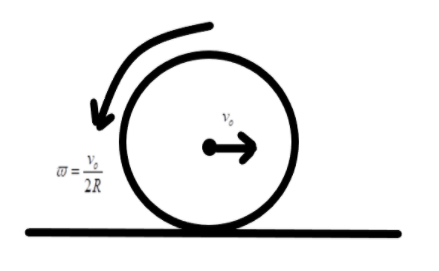
$
A.{\text{ v = }}\dfrac{{{v_o}}}{7} \\
B.{\text{ v = }}\dfrac{{2{v_o}}}{7} \\
C.{\text{ v = }}\dfrac{{3{v_o}}}{7} \\
D.{\text{ v = }}\dfrac{{4{v_o}}}{7} \\
$
Answer
 Verified
598.2k+ views
Hint: To find linear speed take a distance r at the center of the rotation, a point on the object has a linear speed which is equal to the angular speed multiplied by the angular speed multiplied by the distance r. Therefore units of linear speed are meters per second.
Complete step-by-step answer:
Linear speed at time t is;
$
t = \dfrac{{3{v_o}}}{{7\mu g}} is \\
v = {v_o} - \mu g\dfrac{{3{v_o}}}{{7\mu g}} = \dfrac{{4{v_o}}}{7} \\
$
The linear distance always measures the concrete distance traveled by the moving body. In linear speed the word linear is used because straightening out the arc traveled by the object along the circle which results in a line of the same length, so that’s the usual definition of the speed as distance over time can be used. In other words we can also say that the linear speed of a point on a rotating object depends on its distance from the center of rotation.
The radius measures an arc length which is applied to the study of circular motion. In physics the average speed of an object is defined as the ratio of distance travelled by time elapsed.
Therefore the option (D) is the correct answer.
Note: There is a difference between angular speed and linear speed; angular speed is the rate at which the thing turns, described in units like revolution per minute, degree per second, radians per hour, etc. therefore the linear speed is the speed at which a point on a edge of the object travels in its circular path around the center of the object.
Complete step-by-step answer:
Linear speed at time t is;
$
t = \dfrac{{3{v_o}}}{{7\mu g}} is \\
v = {v_o} - \mu g\dfrac{{3{v_o}}}{{7\mu g}} = \dfrac{{4{v_o}}}{7} \\
$
The linear distance always measures the concrete distance traveled by the moving body. In linear speed the word linear is used because straightening out the arc traveled by the object along the circle which results in a line of the same length, so that’s the usual definition of the speed as distance over time can be used. In other words we can also say that the linear speed of a point on a rotating object depends on its distance from the center of rotation.
The radius measures an arc length which is applied to the study of circular motion. In physics the average speed of an object is defined as the ratio of distance travelled by time elapsed.
Therefore the option (D) is the correct answer.
Note: There is a difference between angular speed and linear speed; angular speed is the rate at which the thing turns, described in units like revolution per minute, degree per second, radians per hour, etc. therefore the linear speed is the speed at which a point on a edge of the object travels in its circular path around the center of the object.
Recently Updated Pages
Master Class 11 Computer Science: Engaging Questions & Answers for Success

Master Class 11 Business Studies: Engaging Questions & Answers for Success
Master Class 11 Economics: Engaging Questions & Answers for Success
Master Class 11 English: Engaging Questions & Answers for Success
Master Class 11 Maths: Engaging Questions & Answers for Success
Master Class 11 Biology: Engaging Questions & Answers for Success
Trending doubts
One Metric ton is equal to kg A 10000 B 1000 C 100 class 11 physics CBSE
There are 720 permutations of the digits 1 2 3 4 5 class 11 maths CBSE
Discuss the various forms of bacteria class 11 biology CBSE
Draw a diagram of a plant cell and label at least eight class 11 biology CBSE
State the laws of reflection of light
Explain zero factorial class 11 maths CBSE