




How do you find the limit of $ \dfrac{{2 - {e^x}}}{{2 + 3{e^x}}} $ as $ x $ approaches to infinity?
Answer
 Verified
586.5k+ views
Hint: In order to determine the limit of the above function, replace all the $ {e^x} $ with $ {e^{ - x}} $ in the expression by multiplying and dividing the limit with $ {e^{ - x}} $ in order to obtain a consistent result as when $ x \to \infty $ then $ {e^{ - x}} \to 0 $ . With the use of exponent law , simplify the limit and put the result $ {e^{ - x}} \to 0 $ when $ x \to \infty $ to obtain the required result.
Complete step by step solution:
We are given a exponential function in variable $ x $ i.e. $ \dfrac{{2 - {e^x}}}{{2 + 3{e^x}}} $ having limit $ x \to \infty $ .
$ \mathop {\lim }\limits_{x \to \infty } \dfrac{{2 - {e^x}}}{{2 + 3{e^x}}} $
To better understand and calculate the limits of the above expression, let's look into the graph of the $ y = \dfrac{{2 - {e^x}}}{{2 + 3{e^x}}} $ .
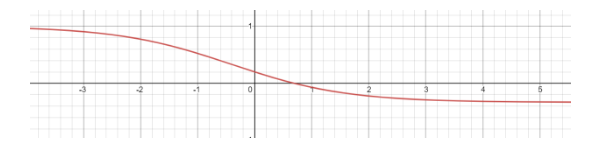
As we can clearly see that the if the limit for $ x \to \infty $, then $ {e^x} \to \infty $ which will make the function inconsistent but one the other side we can see is $ x \to \infty $ then $ {e^{ - x}} \to 0 $
So it's better to replace the $ {e^x} $ with $ {e^{ - x}} $ in the expression to get the result of the limit completely in the consistent form.
And to do so , we will be multiplying and dividing the limit expression with $ {e^{ - x}} $ , rewriting the limit function as
\[
\mathop {\lim }\limits_{x \to \infty } \dfrac{{2 - {e^x}}}{{2 + 3{e^x}}} = \mathop {\lim }\limits_{x \to \infty } \dfrac{{2 - {e^x}}}{{2 + 3{e^x}}} \times \dfrac{{{e^{ - x}}}}{{{e^{ - x}}}} \\
\therefore \mathop {\lim }\limits_{x \to \infty } \dfrac{{2 - {e^x}}}{{2 + 3{e^x}}} = \mathop {\lim }\limits_{x \to \infty } \dfrac{{{e^{ - x}}\left( {2 - {e^x}} \right)}}{{{e^{ - x}}\left( {2 + 3{e^x}} \right)}} \;
\]
Using the distributive law of multiplication to expand and multiply the terms as $ A\left( {B + C} \right) = AB + AC $ , we can rewrite the limit as
\[\mathop {\lim }\limits_{x \to \infty } \dfrac{{2 - {e^x}}}{{2 + 3{e^x}}} = \mathop {\lim }\limits_{x \to \infty } \dfrac{{2{e^{ - x}} - {e^{ - x}}.{e^x}}}{{2{e^{ - x}} + 3{e^{ - x}}.{e^x}}}\]
Using the exponent law to simplify the above expression as $ {a^m} \times {a^n} = {a^{m + n}} $ . We get
\[\mathop {\lim }\limits_{x \to \infty } \dfrac{{2 - {e^x}}}{{2 + 3{e^x}}} = \mathop {\lim }\limits_{x \to \infty } \dfrac{{2{e^{ - x}} - 1}}{{2{e^{ - x}} + 3}}\]
Now using the result $ {e^x} \to 0 $ as $ x \to \infty $ , we have
\[
\mathop {\lim }\limits_{x \to \infty } \dfrac{{2 - {e^x}}}{{2 + 3{e^x}}} = \mathop {\lim }\limits_{x \to \infty } \dfrac{{2\left( 0 \right) - 1}}{{2\left( 0 \right) + 3}} \\
\therefore \mathop {\lim }\limits_{x \to \infty } \dfrac{{2 - {e^x}}}{{2 + 3{e^x}}} = - \dfrac{1}{3} \;
\]
Hence the above result is completely inconsistent.
Therefore the limit of $ \dfrac{{2 - {e^x}}}{{2 + 3{e^x}}} $ as $ x \to \infty $ is equal to \[ - \dfrac{1}{3}\].
So, the correct answer is “ \[ - \dfrac{1}{3}\]”.
Note: 1. Don’t forget to cross-check your answer.
2.After putting the Limit the result should never in the indeterminate form $ \dfrac{0}{0}\,or\,\dfrac{{ \pm \infty }}{{ \pm \infty }} $ . If it is contained, apply some operation to modify the result or use the L-Hospitals rule .
3. $ e $ is the exponential constant having value equal to $ 2.71828 $
4.Avoid any step jump in such types of questions as this might increase the chances of mistakes.
5. While expanding the terms, use the proper sign with the terms.
Complete step by step solution:
We are given a exponential function in variable $ x $ i.e. $ \dfrac{{2 - {e^x}}}{{2 + 3{e^x}}} $ having limit $ x \to \infty $ .
$ \mathop {\lim }\limits_{x \to \infty } \dfrac{{2 - {e^x}}}{{2 + 3{e^x}}} $
To better understand and calculate the limits of the above expression, let's look into the graph of the $ y = \dfrac{{2 - {e^x}}}{{2 + 3{e^x}}} $ .
As we can clearly see that the if the limit for $ x \to \infty $, then $ {e^x} \to \infty $ which will make the function inconsistent but one the other side we can see is $ x \to \infty $ then $ {e^{ - x}} \to 0 $
So it's better to replace the $ {e^x} $ with $ {e^{ - x}} $ in the expression to get the result of the limit completely in the consistent form.
And to do so , we will be multiplying and dividing the limit expression with $ {e^{ - x}} $ , rewriting the limit function as
\[
\mathop {\lim }\limits_{x \to \infty } \dfrac{{2 - {e^x}}}{{2 + 3{e^x}}} = \mathop {\lim }\limits_{x \to \infty } \dfrac{{2 - {e^x}}}{{2 + 3{e^x}}} \times \dfrac{{{e^{ - x}}}}{{{e^{ - x}}}} \\
\therefore \mathop {\lim }\limits_{x \to \infty } \dfrac{{2 - {e^x}}}{{2 + 3{e^x}}} = \mathop {\lim }\limits_{x \to \infty } \dfrac{{{e^{ - x}}\left( {2 - {e^x}} \right)}}{{{e^{ - x}}\left( {2 + 3{e^x}} \right)}} \;
\]
Using the distributive law of multiplication to expand and multiply the terms as $ A\left( {B + C} \right) = AB + AC $ , we can rewrite the limit as
\[\mathop {\lim }\limits_{x \to \infty } \dfrac{{2 - {e^x}}}{{2 + 3{e^x}}} = \mathop {\lim }\limits_{x \to \infty } \dfrac{{2{e^{ - x}} - {e^{ - x}}.{e^x}}}{{2{e^{ - x}} + 3{e^{ - x}}.{e^x}}}\]
Using the exponent law to simplify the above expression as $ {a^m} \times {a^n} = {a^{m + n}} $ . We get
\[\mathop {\lim }\limits_{x \to \infty } \dfrac{{2 - {e^x}}}{{2 + 3{e^x}}} = \mathop {\lim }\limits_{x \to \infty } \dfrac{{2{e^{ - x}} - 1}}{{2{e^{ - x}} + 3}}\]
Now using the result $ {e^x} \to 0 $ as $ x \to \infty $ , we have
\[
\mathop {\lim }\limits_{x \to \infty } \dfrac{{2 - {e^x}}}{{2 + 3{e^x}}} = \mathop {\lim }\limits_{x \to \infty } \dfrac{{2\left( 0 \right) - 1}}{{2\left( 0 \right) + 3}} \\
\therefore \mathop {\lim }\limits_{x \to \infty } \dfrac{{2 - {e^x}}}{{2 + 3{e^x}}} = - \dfrac{1}{3} \;
\]
Hence the above result is completely inconsistent.
Therefore the limit of $ \dfrac{{2 - {e^x}}}{{2 + 3{e^x}}} $ as $ x \to \infty $ is equal to \[ - \dfrac{1}{3}\].
So, the correct answer is “ \[ - \dfrac{1}{3}\]”.
Note: 1. Don’t forget to cross-check your answer.
2.After putting the Limit the result should never in the indeterminate form $ \dfrac{0}{0}\,or\,\dfrac{{ \pm \infty }}{{ \pm \infty }} $ . If it is contained, apply some operation to modify the result or use the L-Hospitals rule .
3. $ e $ is the exponential constant having value equal to $ 2.71828 $
4.Avoid any step jump in such types of questions as this might increase the chances of mistakes.
5. While expanding the terms, use the proper sign with the terms.
Recently Updated Pages
Master Class 11 English: Engaging Questions & Answers for Success

Master Class 11 Physics: Engaging Questions & Answers for Success
Master Class 11 Computer Science: Engaging Questions & Answers for Success
Master Class 11 Chemistry: Engaging Questions & Answers for Success
Master Class 11 Social Science: Engaging Questions & Answers for Success
Master Class 11 Accountancy: Engaging Questions & Answers for Success
Trending doubts
Difference Between Prokaryotic Cells and Eukaryotic Cells
Two of the body parts which do not appear in MRI are class 11 biology CBSE
One Metric ton is equal to kg A 10000 B 1000 C 100 class 11 physics CBSE
10 examples of friction in our daily life
Draw a diagram of nephron and explain its structur class 11 biology CBSE
Draw a diagram of a plant cell and label at least eight class 11 biology CBSE