




Find the length which at a distance of 5280 m will subtend an angle of 1’ at the eye.
Answer
 Verified
611.7k+ views
Hint: Draw a diagram for the given information in question and use trigonometric ratio $''\tan \theta ''$ for finding the relation between given quantity and unknown.
As 1’ is a very small angle, use approximation.
Complete step-by-step answer:
Let the required length be ‘l’.
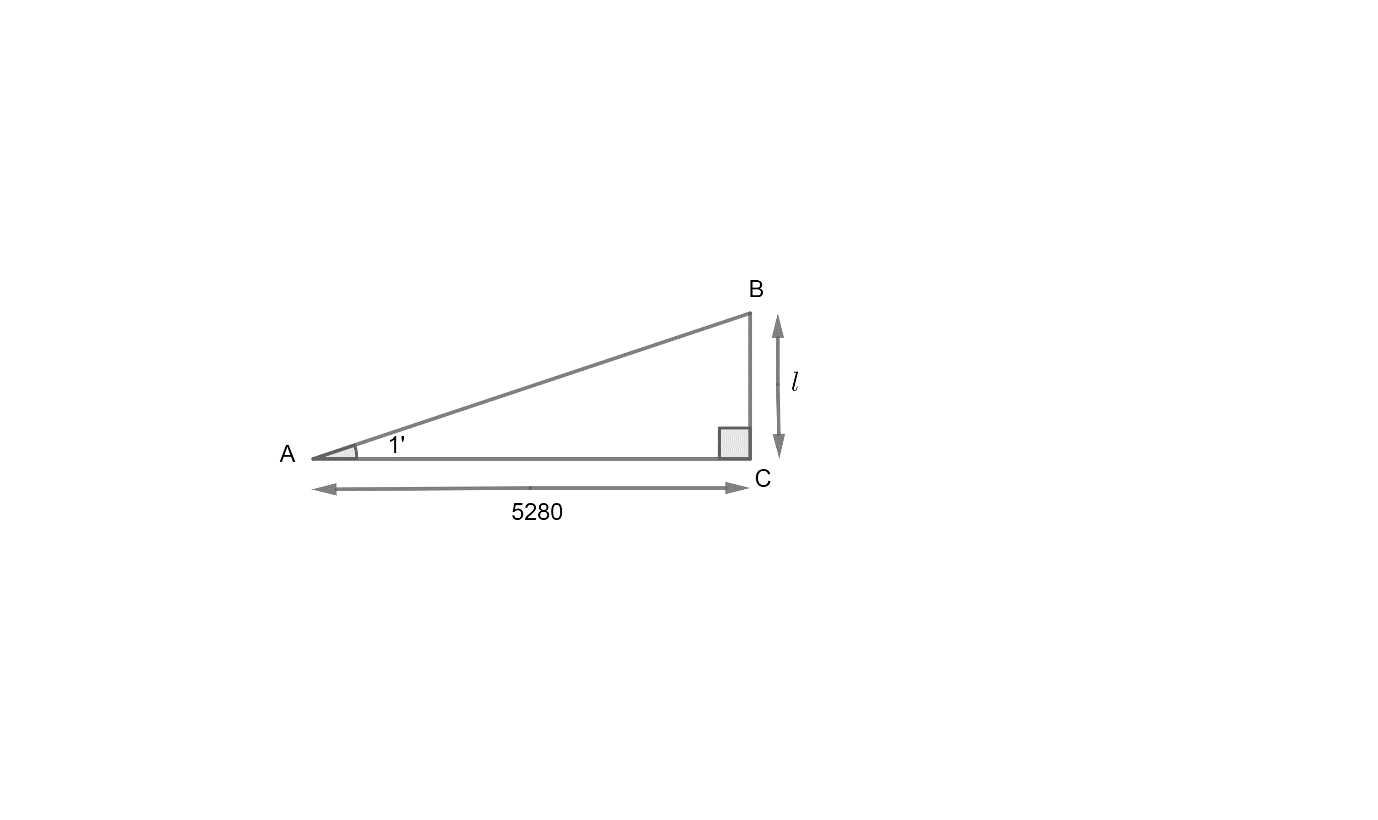
We can use the formula of $\tan \theta $ (for $\angle A$) to find the relation between BC and AC.
We know, $\tan \theta =\dfrac{Perpendicular}{Base}$
$\tan A=\dfrac{BC}{AC}$
Given, $\angle A=1'$
As angle $\angle A$ is very small, we have to use approximation.
We know for small angles: $\sin \theta \approx \tan \theta \approx \theta $
$\begin{align}
& \Rightarrow \tan 1'=\dfrac{BC}{AC} \\
& \Rightarrow 1'=\dfrac{BC}{AC} \\
& \Rightarrow {{\left( \dfrac{1}{60} \right)}^{{}^\circ }}=\dfrac{BC}{AC} \\
\end{align}$
There are 60 minutes in 1 degree;
i.e. $60'=1{}^\circ $
$\Rightarrow 1'={{\left( \dfrac{1}{60} \right)}^{{}^\circ }}$
Now, we have to convert the degree into radian.
Formula: $\left( x\ \text{degree} \right)\times \dfrac{\pi }{180}=\left( \text{equivalent radian} \right)$
On changing ${{\left( \dfrac{1}{60} \right)}^{{}^\circ }}$into radian, equation will become;
$\Rightarrow {{\left( \dfrac{1}{60} \right)}^{{}^\circ }}\times \dfrac{\pi
}{180}=\dfrac{BC}{AC}$
$\Rightarrow \dfrac{1}{60}\times \dfrac{\pi }{180}=\dfrac{l}{5280}$
Using cross multiplication, equation will become;
$\Rightarrow 60\times 180\times l=5280\times \pi $
Dividing both sides by $\left( 60\times 180 \right)$, equation will become;
$\begin{align}
& \Rightarrow l=\dfrac{5280\times \pi }{60\times 180} \\
& \Rightarrow l=\dfrac{5280\times 3.14}{60\times 180}\left( \pi =3.14 \right) \\
& \Rightarrow l=\dfrac{16579.2}{60\times 180} \\
& \Rightarrow l=1.535 \\
\end{align}$
Hence the length which at a distance of 5280 m subtends an angle of 1’ at eye = 1.525m.
Note: Another method:
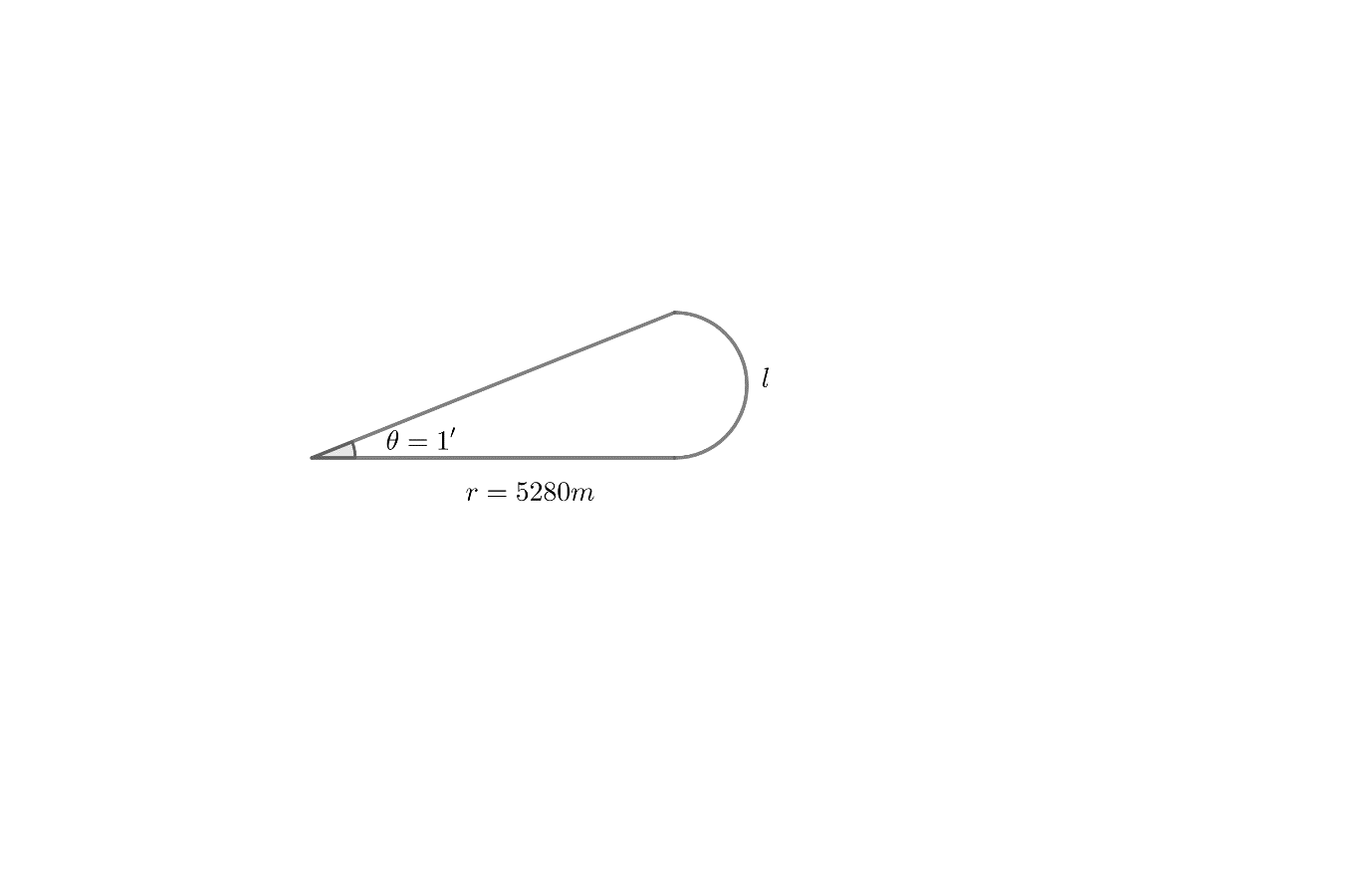
\[\begin{align}
& \theta =\dfrac{l}{r} \\
& 1'=\dfrac{l}{5280} \\
& {{\left( \dfrac{1}{60} \right)}^{{}^\circ }}\times \dfrac{\pi }{180}=\dfrac{l}{5280} \\
& \Rightarrow l=\dfrac{5280\times \pi }{60\times 180} \\
& \Rightarrow l=1.535m \\
\end{align}\]
A student can make mistakes by forgetting to change the angle from degrees to radian. When we are applying the formula, we are taking other quantities in their S.I unit. So, we have to take $\theta $ also in its S.I unit. S.I unit of $\theta $ is radian.
As 1’ is a very small angle, use approximation.
Complete step-by-step answer:
Let the required length be ‘l’.
We can use the formula of $\tan \theta $ (for $\angle A$) to find the relation between BC and AC.
We know, $\tan \theta =\dfrac{Perpendicular}{Base}$
$\tan A=\dfrac{BC}{AC}$
Given, $\angle A=1'$
As angle $\angle A$ is very small, we have to use approximation.
We know for small angles: $\sin \theta \approx \tan \theta \approx \theta $
$\begin{align}
& \Rightarrow \tan 1'=\dfrac{BC}{AC} \\
& \Rightarrow 1'=\dfrac{BC}{AC} \\
& \Rightarrow {{\left( \dfrac{1}{60} \right)}^{{}^\circ }}=\dfrac{BC}{AC} \\
\end{align}$
There are 60 minutes in 1 degree;
i.e. $60'=1{}^\circ $
$\Rightarrow 1'={{\left( \dfrac{1}{60} \right)}^{{}^\circ }}$
Now, we have to convert the degree into radian.
Formula: $\left( x\ \text{degree} \right)\times \dfrac{\pi }{180}=\left( \text{equivalent radian} \right)$
On changing ${{\left( \dfrac{1}{60} \right)}^{{}^\circ }}$into radian, equation will become;
$\Rightarrow {{\left( \dfrac{1}{60} \right)}^{{}^\circ }}\times \dfrac{\pi
}{180}=\dfrac{BC}{AC}$
$\Rightarrow \dfrac{1}{60}\times \dfrac{\pi }{180}=\dfrac{l}{5280}$
Using cross multiplication, equation will become;
$\Rightarrow 60\times 180\times l=5280\times \pi $
Dividing both sides by $\left( 60\times 180 \right)$, equation will become;
$\begin{align}
& \Rightarrow l=\dfrac{5280\times \pi }{60\times 180} \\
& \Rightarrow l=\dfrac{5280\times 3.14}{60\times 180}\left( \pi =3.14 \right) \\
& \Rightarrow l=\dfrac{16579.2}{60\times 180} \\
& \Rightarrow l=1.535 \\
\end{align}$
Hence the length which at a distance of 5280 m subtends an angle of 1’ at eye = 1.525m.
Note: Another method:
\[\begin{align}
& \theta =\dfrac{l}{r} \\
& 1'=\dfrac{l}{5280} \\
& {{\left( \dfrac{1}{60} \right)}^{{}^\circ }}\times \dfrac{\pi }{180}=\dfrac{l}{5280} \\
& \Rightarrow l=\dfrac{5280\times \pi }{60\times 180} \\
& \Rightarrow l=1.535m \\
\end{align}\]
A student can make mistakes by forgetting to change the angle from degrees to radian. When we are applying the formula, we are taking other quantities in their S.I unit. So, we have to take $\theta $ also in its S.I unit. S.I unit of $\theta $ is radian.
Recently Updated Pages
Master Class 10 Computer Science: Engaging Questions & Answers for Success

Master Class 10 General Knowledge: Engaging Questions & Answers for Success
Master Class 10 English: Engaging Questions & Answers for Success
Master Class 10 Social Science: Engaging Questions & Answers for Success
Master Class 10 Maths: Engaging Questions & Answers for Success
Master Class 10 Science: Engaging Questions & Answers for Success
Trending doubts
What is the median of the first 10 natural numbers class 10 maths CBSE
Which women's tennis player has 24 Grand Slam singles titles?
Who is the Brand Ambassador of Incredible India?
Why is there a time difference of about 5 hours between class 10 social science CBSE
Write a letter to the principal requesting him to grant class 10 english CBSE
A moving boat is observed from the top of a 150 m high class 10 maths CBSE