




Find the length of the tangent from the point $$\left( {5,7} \right)$$ to the line $${x^2} + {y^2} - 4x - 6y + 9 = 0$$?
Answer
 Verified
552.9k+ views
Hint: Here in this question, we need to find the length of the tangent from the given point to the line equation. For this, first we need to compare the given equation with the circle equation of center – radius form to find the center and radius of the circle then further simplify using a Pythagoras theorem and distance formula to get the required solution.
Complete step by step answer:
If any circle being a center at point $$\left( {h,k} \right)$$ and having a radius ‘$$r$$’, then center-radius form of the circle equation is in the format $${\left( {x - h} \right)^2} + {\left( {y - k} \right)^2} = {r^2}$$.
Consider the given question:
We need to find the length of the tangent from the point $$\left( {5,7} \right)$$ to the line $${x^2} + {y^2} - 4x - 6y + 9 = 0$$.
Given,
$${x^2} + {y^2} - 4x - 6y + 9 = 0$$ ------ (1)
Rewrite this equation into the center-radius form,
$$ \Rightarrow \,\,\,{x^2} + {y^2} - 4x - 6y + 9 = 0$$
Subtract both side by 9
$$ \Rightarrow \,\,\,{x^2} + {y^2} - 4x - 6y = - 9$$
Add both side by 4 and 9, then
$$ \Rightarrow \,\,\,{x^2} + {y^2} - 4x - 6y + 4 + 9 = - 9 + 4 + 9$$
$$ \Rightarrow \,\,\,{x^2} - 4x + 4 + {y^2} - 6y + 9 = 4$$
$$ \Rightarrow \,\,\,\left( {{x^2} - 4x + 4} \right) + \left( {{y^2} - 6y + 9} \right) = 4$$
$$ \Rightarrow \,\,\,\left( {{x^2} - 2\left( 2 \right)x + {2^2}} \right) + \left( {{y^2} - 2\left( 3 \right)y + {3^2}} \right) = {2^2}$$------ (2)
By using a algebraic identity: $${\left( {a - b} \right)^2} = {a^2} + {b^2} - 2ab$$.
Then equation (2) becomes
$$ \Rightarrow \,\,\,\,{\left( {x - 2} \right)^2} + {\left( {y - 3} \right)^2} = {2^2}$$
Where, $$2$$ and $$3$$ are the coordinates of the center of the circle, and $$2$$ is the radius.
So, the center of the circle is at $$\left( {2,3} \right)$$, and the radius $$r = 2$$.
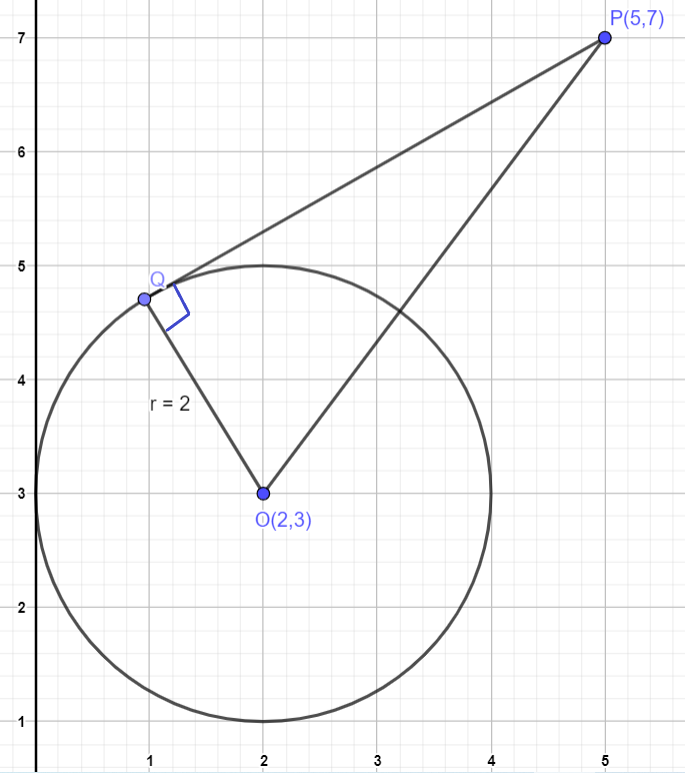
As shown in the figure, $$O$$ is the center of the circle, $$Q$$ is the point of tangency, and $$OQ$$ is the radius. Then,
$$OPQ$$ form a right triangle.
By Pythagorean theorem: $$P{O^2} = P{Q^2} + O{Q^2}$$. ------ (3)
Now, find a length of a $$PO$$ using a distance formula $$ = \sqrt {{{\left( {{x_2} - {x_1}} \right)}^2} + {{\left( {{y_2} - {y_1}} \right)}^2}} $$. Then,
$$ \Rightarrow \,\,\,PO = \sqrt {{{\left( {5 - 2} \right)}^2} + {{\left( {7 - 3} \right)}^2}} $$
$$ \Rightarrow \,\,\,PO = \sqrt {{{\left( 3 \right)}^2} + {{\left( 4 \right)}^2}} $$
$$ \Rightarrow \,\,\,PO = \sqrt {9 + 16} $$
$$ \Rightarrow \,\,\,PO = \sqrt {25} $$
$$\therefore \,\,\,PO = 5$$.
Then equation (3) becomes:
$$ \Rightarrow \,\,\,P{Q^2} = P{O^2} - O{Q^2}$$
$$ \Rightarrow \,\,\,P{Q^2} = {5^2} - {2^2}$$
$$ \Rightarrow \,\,\,P{Q^2} = 25 - 4$$
$$ \Rightarrow \,\,\,P{Q^2} = 21$$
$$ \Rightarrow \,\,\,PQ = \pm \sqrt {21} $$
We know that the length cannot be negative.
Hence, length of tangent $$PQ = \sqrt {21} $$ units.
Note:
Remember, the Pythagoras theorem applies only in the right angle triangle and we should know that the tangent of a circle always forms a right angle at a point of tendency. The Pythagoras theorem states that in a right triangle $$ABC$$, the square of the hypotenuse is equal to the sum of the square of the other two legs. If $$AB$$, $$BC$$, and $$AC$$ are the sides of the triangle, then: $$B{C^2} = A{B^2} + A{C^2}$$.
Complete step by step answer:
If any circle being a center at point $$\left( {h,k} \right)$$ and having a radius ‘$$r$$’, then center-radius form of the circle equation is in the format $${\left( {x - h} \right)^2} + {\left( {y - k} \right)^2} = {r^2}$$.
Consider the given question:
We need to find the length of the tangent from the point $$\left( {5,7} \right)$$ to the line $${x^2} + {y^2} - 4x - 6y + 9 = 0$$.
Given,
$${x^2} + {y^2} - 4x - 6y + 9 = 0$$ ------ (1)
Rewrite this equation into the center-radius form,
$$ \Rightarrow \,\,\,{x^2} + {y^2} - 4x - 6y + 9 = 0$$
Subtract both side by 9
$$ \Rightarrow \,\,\,{x^2} + {y^2} - 4x - 6y = - 9$$
Add both side by 4 and 9, then
$$ \Rightarrow \,\,\,{x^2} + {y^2} - 4x - 6y + 4 + 9 = - 9 + 4 + 9$$
$$ \Rightarrow \,\,\,{x^2} - 4x + 4 + {y^2} - 6y + 9 = 4$$
$$ \Rightarrow \,\,\,\left( {{x^2} - 4x + 4} \right) + \left( {{y^2} - 6y + 9} \right) = 4$$
$$ \Rightarrow \,\,\,\left( {{x^2} - 2\left( 2 \right)x + {2^2}} \right) + \left( {{y^2} - 2\left( 3 \right)y + {3^2}} \right) = {2^2}$$------ (2)
By using a algebraic identity: $${\left( {a - b} \right)^2} = {a^2} + {b^2} - 2ab$$.
Then equation (2) becomes
$$ \Rightarrow \,\,\,\,{\left( {x - 2} \right)^2} + {\left( {y - 3} \right)^2} = {2^2}$$
Where, $$2$$ and $$3$$ are the coordinates of the center of the circle, and $$2$$ is the radius.
So, the center of the circle is at $$\left( {2,3} \right)$$, and the radius $$r = 2$$.
As shown in the figure, $$O$$ is the center of the circle, $$Q$$ is the point of tangency, and $$OQ$$ is the radius. Then,
$$OPQ$$ form a right triangle.
By Pythagorean theorem: $$P{O^2} = P{Q^2} + O{Q^2}$$. ------ (3)
Now, find a length of a $$PO$$ using a distance formula $$ = \sqrt {{{\left( {{x_2} - {x_1}} \right)}^2} + {{\left( {{y_2} - {y_1}} \right)}^2}} $$. Then,
$$ \Rightarrow \,\,\,PO = \sqrt {{{\left( {5 - 2} \right)}^2} + {{\left( {7 - 3} \right)}^2}} $$
$$ \Rightarrow \,\,\,PO = \sqrt {{{\left( 3 \right)}^2} + {{\left( 4 \right)}^2}} $$
$$ \Rightarrow \,\,\,PO = \sqrt {9 + 16} $$
$$ \Rightarrow \,\,\,PO = \sqrt {25} $$
$$\therefore \,\,\,PO = 5$$.
Then equation (3) becomes:
$$ \Rightarrow \,\,\,P{Q^2} = P{O^2} - O{Q^2}$$
$$ \Rightarrow \,\,\,P{Q^2} = {5^2} - {2^2}$$
$$ \Rightarrow \,\,\,P{Q^2} = 25 - 4$$
$$ \Rightarrow \,\,\,P{Q^2} = 21$$
$$ \Rightarrow \,\,\,PQ = \pm \sqrt {21} $$
We know that the length cannot be negative.
Hence, length of tangent $$PQ = \sqrt {21} $$ units.
Note:
Remember, the Pythagoras theorem applies only in the right angle triangle and we should know that the tangent of a circle always forms a right angle at a point of tendency. The Pythagoras theorem states that in a right triangle $$ABC$$, the square of the hypotenuse is equal to the sum of the square of the other two legs. If $$AB$$, $$BC$$, and $$AC$$ are the sides of the triangle, then: $$B{C^2} = A{B^2} + A{C^2}$$.
Recently Updated Pages
Class 10 Question and Answer - Your Ultimate Solutions Guide

Master Class 12 Economics: Engaging Questions & Answers for Success
Master Class 12 Social Science: Engaging Questions & Answers for Success
Master Class 12 English: Engaging Questions & Answers for Success
Master Class 12 Maths: Engaging Questions & Answers for Success
Master Class 12 Physics: Engaging Questions & Answers for Success
Trending doubts
Explain the Treaty of Vienna of 1815 class 10 social science CBSE
The slogan Jai Hind was given by A Lal Bahadur Shastri class 10 social science CBSE
10 examples of evaporation in daily life with explanations
What is the full form of POSCO class 10 social science CBSE
Identify the feminine form of noun nephew a shenephew class 10 english CBSE
CSIR full form?