



Find the length of the side of a cube whose total surface area is $ 216 $ square cm.
Answer
 Verified
603.3k+ views
Hint: Cube is the three-dimensional solid object surrounded by the six square faces or the sides with the three meeting at each vertex and has six faces, twelve edges and eight vertices. Use the general formula for the total surface area of the cube, $ A = 6{l^2} $ , where “l” is the length of the cube.
Complete step-by-step answer:
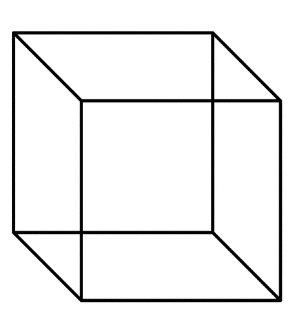
Given that the total surface area of the cube $ = 216c{m^2} $
Place the formula on the left hand side of the above equation.
$ 6{l^2} = 216 $
When the number in multiplicative changes its side, it goes to division and vice-versa.
$ {l^2} = \dfrac{{216}}{6} $
$ \Rightarrow {l^2} = 36 $
Now, take square-root on both the sides of the equation.
$ \Rightarrow \sqrt {{l^2}} = \sqrt {36} $
Square and square-root cancel each other on the left hand side of the equation-
$ \Rightarrow l = \sqrt {{6^2}} $
Now, we know that $ 36 $ is the square of $ 6 $ , square and square cancels each other.
$ \Rightarrow l = 6cm $
Hence, the required answer is length of the cube is $ 6cm $
Note: The squares and the square roots are opposite to each other and so cancel each other. Perfect square number is the square of an integer, simply it is the product of the same integer with itself. For example - $ 25{\text{ = 5 }} \times {\text{ 5, 25 = }}{{\text{5}}^2} $ , generally it is denoted by n to the power two i.e. $ {n^2} $ . The perfect square is the number which can be expressed as the product of the two equal integers. For example: $ 9 $ , it can be expressed as the product of equal integers. $ 9 = 3 \times 3 $ . Remember the difference between the area and total surface area of any object.
Complete step-by-step answer:
Given that the total surface area of the cube $ = 216c{m^2} $
Place the formula on the left hand side of the above equation.
$ 6{l^2} = 216 $
When the number in multiplicative changes its side, it goes to division and vice-versa.
$ {l^2} = \dfrac{{216}}{6} $
$ \Rightarrow {l^2} = 36 $
Now, take square-root on both the sides of the equation.
$ \Rightarrow \sqrt {{l^2}} = \sqrt {36} $
Square and square-root cancel each other on the left hand side of the equation-
$ \Rightarrow l = \sqrt {{6^2}} $
Now, we know that $ 36 $ is the square of $ 6 $ , square and square cancels each other.
$ \Rightarrow l = 6cm $
Hence, the required answer is length of the cube is $ 6cm $
Note: The squares and the square roots are opposite to each other and so cancel each other. Perfect square number is the square of an integer, simply it is the product of the same integer with itself. For example - $ 25{\text{ = 5 }} \times {\text{ 5, 25 = }}{{\text{5}}^2} $ , generally it is denoted by n to the power two i.e. $ {n^2} $ . The perfect square is the number which can be expressed as the product of the two equal integers. For example: $ 9 $ , it can be expressed as the product of equal integers. $ 9 = 3 \times 3 $ . Remember the difference between the area and total surface area of any object.
Recently Updated Pages
Master Class 12 Business Studies: Engaging Questions & Answers for Success

Master Class 12 Biology: Engaging Questions & Answers for Success
Master Class 12 Chemistry: Engaging Questions & Answers for Success
Class 12 Question and Answer - Your Ultimate Solutions Guide
Master Class 11 Social Science: Engaging Questions & Answers for Success
Master Class 11 English: Engaging Questions & Answers for Success
Trending doubts
Find the sum of series 1 + 2 + 3 + 4 + 5 + + 100 class 9 maths CBSE
Fill the blanks with the suitable prepositions 1 The class 9 english CBSE
Difference Between Plant Cell and Animal Cell
How many hours before the closure of election must class 9 social science CBSE
What is pollution? How many types of pollution? Define it
Name 10 Living and Non living things class 9 biology CBSE