




Find the length of the side if the diagonals of the rhombus are 16 and 18?
Answer
 Verified
491.4k+ views
Hint: A rhombus is a two-dimensional object with four equal sides and four angles that can or cannot be 90 degrees, but opposite angles are always the same, and both rhombus diagonals are perpendicular and bisect each other.
Complete answer:
We have first drawn its diagram
The diagram of rhombus according to the data
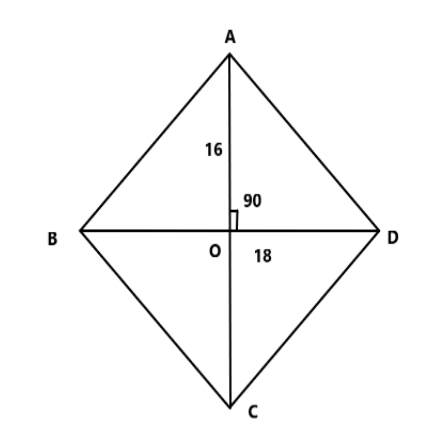
ABCD is a rhombus, and O is the intersection point of both diagonals, bisecting both diagonals, and both diagonals are perpendicular to each other by definition.
We now find AO and OD,
We know that diagonals bisect each other,
So,
$ \Rightarrow AO = \dfrac{{16}}{2} = 8$
$ \Rightarrow OD = \dfrac{{18}}{2} = 9$
we will now, apply Pythagoras theorem in the triangle AOD, to find the length of the side AD.$ \Rightarrow OD = \dfrac{{18}}{2} = 9$
by Pythagoras theorem
$ \Rightarrow A{D^2} = A{O^2} + O{D^2}$
$ \Rightarrow AD = \sqrt {A{O^2} + O{D^2}} $
We have substituted the values of AO and OD
$ \Rightarrow AD = \sqrt {{8^2} + {9^2}} $
$ \Rightarrow AD = \sqrt {145} $$ \Rightarrow AD = \sqrt {145} $
Hence, the measure of the side of the rhombus is $\sqrt {145} $ .
Note:
We should have suitable knowledge of general shapes here, as lack of knowledge can sometimes confuse us in simple issues. By the way, we may apply the straightforward formula $4{AB}^2$=${AC}^2+{BD}^2$ to determine the length of the side.
Complete answer:
We have first drawn its diagram
The diagram of rhombus according to the data
ABCD is a rhombus, and O is the intersection point of both diagonals, bisecting both diagonals, and both diagonals are perpendicular to each other by definition.
We now find AO and OD,
We know that diagonals bisect each other,
So,
$ \Rightarrow AO = \dfrac{{16}}{2} = 8$
$ \Rightarrow OD = \dfrac{{18}}{2} = 9$
we will now, apply Pythagoras theorem in the triangle AOD, to find the length of the side AD.$ \Rightarrow OD = \dfrac{{18}}{2} = 9$
by Pythagoras theorem
$ \Rightarrow A{D^2} = A{O^2} + O{D^2}$
$ \Rightarrow AD = \sqrt {A{O^2} + O{D^2}} $
We have substituted the values of AO and OD
$ \Rightarrow AD = \sqrt {{8^2} + {9^2}} $
$ \Rightarrow AD = \sqrt {145} $$ \Rightarrow AD = \sqrt {145} $
Hence, the measure of the side of the rhombus is $\sqrt {145} $ .
Note:
We should have suitable knowledge of general shapes here, as lack of knowledge can sometimes confuse us in simple issues. By the way, we may apply the straightforward formula $4{AB}^2$=${AC}^2+{BD}^2$ to determine the length of the side.
Recently Updated Pages
Master Class 10 Computer Science: Engaging Questions & Answers for Success

Master Class 10 General Knowledge: Engaging Questions & Answers for Success
Master Class 10 English: Engaging Questions & Answers for Success
Master Class 10 Social Science: Engaging Questions & Answers for Success
Master Class 10 Maths: Engaging Questions & Answers for Success
Master Class 10 Science: Engaging Questions & Answers for Success
Trending doubts
What is the median of the first 10 natural numbers class 10 maths CBSE
Which women's tennis player has 24 Grand Slam singles titles?
Who is the Brand Ambassador of Incredible India?
Why is there a time difference of about 5 hours between class 10 social science CBSE
Write a letter to the principal requesting him to grant class 10 english CBSE
A moving boat is observed from the top of a 150 m high class 10 maths CBSE