




Find the length of the hypotenuse of the right triangle whose vertices are given by the points $( - 2,1),(1,1)$and$(1,2)$
(A)$\sqrt {10} $
(B)$\sqrt 5 $
(C)$10$
(D)$2\sqrt 5 $
Answer
 Verified
661.5k+ views
Hint: Let\[X \equiv ( - 2,1)\], $Y \equiv (1,1)$, and$Z \equiv (1,2)$. Compute the lengths of the sides XY, YZ and XZ using the distance formula:
Distance between the two points $P \equiv (a,b)$ and $Q \equiv (c,d)$ is given by
$ d(P,Q) \equiv \sqrt {{{(c - a)}^2} + {{(d - b)}^2}} $
Compare the lengths of the sides. The largest length is the required answer.
Complete step by step solution: Let’s look at what is given to us.
We have a right angled triangle.
We also have the coordinates of the vertices of this right triangle, namely, $( - 2,1),(1,1)$and$(1,2)$
We are asked to compute the length of the hypotenuse of the said right triangle.
The hypotenuse of a right triangle is the side of the triangle which is opposite to the right angle.
Suppose $\vartriangle XYZ$ is the given right triangle.
Also, let \[X \equiv ( - 2,1)\],$Y \equiv (1,1)$, and $Z \equiv (1,2)$
Here is a pictorial representation of a right angled triangle.
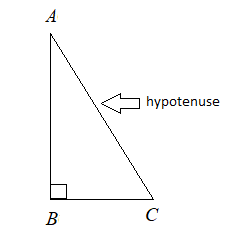
Since we do not know the vertex of $\vartriangle XYZ$ which forms a right angle, we will need to calculate the length of each side.
Since the coordinates of the vertices are given, we will use the distance formula:
Distance between the two points $P \equiv (a,b)$ and $Q \equiv (c,d)$ is given by
$d(P,Q) \equiv \sqrt {{{(c - a)}^2} + {{(d - b)}^2}} $
Therefore, in $\vartriangle XYZ$, let us consider the length of side XY.
$XY \equiv \sqrt {{{(1 - ( - 2))}^2} + {{(1 - 1)}^2}} = \sqrt {{{(1 + 2)}^2} + {{(0)}^2}} = \sqrt 9 = 3$
Similarly, we can find the lengths of sides YZ and XZ.
$YZ \equiv \sqrt {{{(1 - 1)}^2} + {{(2 - 1)}^2}} = \sqrt {{{(0)}^2} + {{(1)}^2}} = \sqrt 1 = 1$
$ZX\equiv \sqrt {{{(1 - ( - 2))}^2} + {{(2 - 1)}^2}} = \sqrt {{{(3)}^2} + {{(1)}^2}} = \sqrt {10} $
We know that the hypotenuse is the longest side of the right angled triangle.
So, let us compare the distances that we just calculated.
We know that $1 < 3$.
Also, we know that $9 < 10$.
Therefore, taking square roots on both the sides, we get $3 < \sqrt {10} $
Thus, we have $1 < 3 < \sqrt {10} $
This implies that the length of side XZ is greater than the lengths of the sides XY and YZ.
Hence XZ is the hypotenuse of the given triangle and its length is $\sqrt {10} $ units.
Note: While using the distance formula, one should be careful as some students tend to miss one of the steps.
The steps can be done one by one:
1) Substitute the values
2) Find the differences
3) Square the differences
4) Add the square values
5) Take the square root.
Distance between the two points $P \equiv (a,b)$ and $Q \equiv (c,d)$ is given by
$ d(P,Q) \equiv \sqrt {{{(c - a)}^2} + {{(d - b)}^2}} $
Compare the lengths of the sides. The largest length is the required answer.
Complete step by step solution: Let’s look at what is given to us.
We have a right angled triangle.
We also have the coordinates of the vertices of this right triangle, namely, $( - 2,1),(1,1)$and$(1,2)$
We are asked to compute the length of the hypotenuse of the said right triangle.
The hypotenuse of a right triangle is the side of the triangle which is opposite to the right angle.
Suppose $\vartriangle XYZ$ is the given right triangle.
Also, let \[X \equiv ( - 2,1)\],$Y \equiv (1,1)$, and $Z \equiv (1,2)$
Here is a pictorial representation of a right angled triangle.
Since we do not know the vertex of $\vartriangle XYZ$ which forms a right angle, we will need to calculate the length of each side.
Since the coordinates of the vertices are given, we will use the distance formula:
Distance between the two points $P \equiv (a,b)$ and $Q \equiv (c,d)$ is given by
$d(P,Q) \equiv \sqrt {{{(c - a)}^2} + {{(d - b)}^2}} $
Therefore, in $\vartriangle XYZ$, let us consider the length of side XY.
$XY \equiv \sqrt {{{(1 - ( - 2))}^2} + {{(1 - 1)}^2}} = \sqrt {{{(1 + 2)}^2} + {{(0)}^2}} = \sqrt 9 = 3$
Similarly, we can find the lengths of sides YZ and XZ.
$YZ \equiv \sqrt {{{(1 - 1)}^2} + {{(2 - 1)}^2}} = \sqrt {{{(0)}^2} + {{(1)}^2}} = \sqrt 1 = 1$
$ZX\equiv \sqrt {{{(1 - ( - 2))}^2} + {{(2 - 1)}^2}} = \sqrt {{{(3)}^2} + {{(1)}^2}} = \sqrt {10} $
We know that the hypotenuse is the longest side of the right angled triangle.
So, let us compare the distances that we just calculated.
We know that $1 < 3$.
Also, we know that $9 < 10$.
Therefore, taking square roots on both the sides, we get $3 < \sqrt {10} $
Thus, we have $1 < 3 < \sqrt {10} $
This implies that the length of side XZ is greater than the lengths of the sides XY and YZ.
Hence XZ is the hypotenuse of the given triangle and its length is $\sqrt {10} $ units.
Note: While using the distance formula, one should be careful as some students tend to miss one of the steps.
The steps can be done one by one:
1) Substitute the values
2) Find the differences
3) Square the differences
4) Add the square values
5) Take the square root.
Recently Updated Pages
Write any three differences between metals and nonmetals class 10 social science CBSE

Amit standing on a horizontal plane finds a bird flying class 10 maths CBSE
Two circles of radii 5 cm and 3 cm intersect at two class 10 maths CBSE
Solve the following i John and Jivanti together have class 10 maths CBSE
What is the relation between orthocenter circumcentre class 10 maths CBSE
Two plane mirrors are inclined at 70circ A ray incident class 10 physics CBSE
Trending doubts
Explain the Treaty of Vienna of 1815 class 10 social science CBSE
1 GB equals how many MB?
10 examples of evaporation in daily life with explanations
What is the full form of POSCO class 10 social science CBSE
Which is the hottest planet in the Solar system A Earth class 10 social science CBSE
Name any four life processes in living things class 10 biology CBSE