




How do you find the length of a curve in calculus?
Answer
 Verified
585k+ views
Hint: The length of a curve represented by a function, $y=f\left( x \right)$ can be found by differentiating the curve into a large number of parts. These parts are so small that they are not a curve but a straight line. We can then find the distance between the two points forming these small divisions. By integrating the length of these individual parts together, we can find out the actual length of the curve.
Complete Step by Step Solution:
A continuous curve can be represented as a function, $y=f\left( x \right)$. We can get the curve by plotting the points generated by the function in a graph. Consider a curve represented by $y=f\left( x \right)$ as shown in the figure.
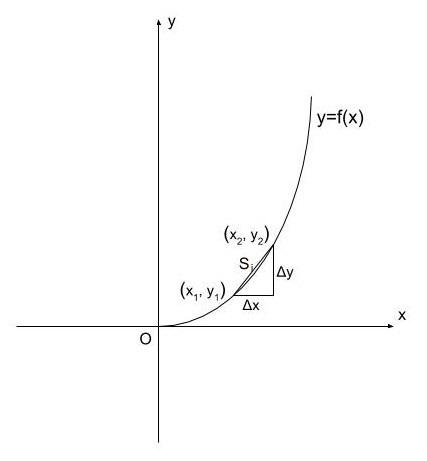
Let us divide the curve into n numbers of equal parts. We can notice that each part gets shorter when we increase the number of divisions.
Let $\Delta x$ and $\Delta y$ be the horizontal and vertical components of each division and S be the length of the division.
If $\left( {{x}_{1}},{{y}_{1}} \right)$ and $\left( {{x}_{2}},{{y}_{2}} \right)$ are the two ends one division, its length will be given by the equation
$\Rightarrow {{S}_{1}}=\sqrt{{{\left( {{x}_{2}}-{{x}_{1}} \right)}^{2}}+{{\left( {{y}_{2}}-{{y}_{1}} \right)}^{2}}}$
$\Rightarrow {{S}_{1}}=\sqrt{\Delta {{x}_{1}}^{2}+\Delta {{y}_{1}}^{2}}$
Similarly, ${{S}_{2}}=\sqrt{\Delta {{x}_{2}}^{2}+\Delta {{y}_{2}}^{2}}$, ${{S}_{3}}=\sqrt{\Delta {{x}_{3}}^{2}+\Delta {{y}_{3}}^{2}}$ …, ${{S}_{n}}=\sqrt{\Delta {{x}_{n}}^{2}+\Delta {{y}_{n}}^{2}}$.
The total length of the curve will be equal to the summation of all these divisions. Therefore
$\Rightarrow S\approx \sum\limits_{i=1}^{n}{\sqrt{{{\left( \Delta {{x}_{i}} \right)}^{2}}+{{\left( \Delta {{y}_{i}} \right)}^{2}}}}$
where $i=1$ denotes that the incremental value is equal to one.
The first derivative of the function ${f}'\left( x \right)$ is equal to $\dfrac{\Delta y}{\Delta x}$ since it is equal to the rate of change of the output y with respect to the input x.
Now let us multiply and divide $\Delta {{y}_{i}}$ by $\Delta {{x}_{i}}$ to introduce ${f}'\left( x \right)$in the equation.
$\Rightarrow S\approx \sum\limits_{i=1}^{n}{\sqrt{\Delta {{x}_{i}}^{2}+{{\left( \Delta {{x}_{i}}\dfrac{\Delta {{y}_{i}}}{\Delta {{x}_{i}}} \right)}^{2}}}}$
$\Rightarrow S\approx \sum\limits_{i=1}^{n}{\sqrt{\Delta {{x}_{i}}^{2}\left( 1+{{\left( \dfrac{\Delta {{y}_{i}}}{\Delta {{x}_{i}}} \right)}^{2}} \right)}}$
$\Rightarrow S\approx \sum\limits_{i=1}^{n}{\Delta {{x}_{i}}\sqrt{\left( 1+{{\left( \dfrac{\Delta {{y}_{i}}}{\Delta {{x}_{i}}} \right)}^{2}} \right)}}$
As the number of divisions becomes very large ($\underset{n\to \infty }{\mathop{\lim }}\,$), the length of the division, S will get closer to zero. Also, the accuracy of our calculation will be increased. The values $\Delta x$and $\Delta y$ will become very small and they are denoted as dx and dy.
$\Rightarrow S\approx \sum\limits_{i=1}^{n}{\Delta {{x}_{i}}\sqrt{\left( 1+{{\left( \dfrac{dy}{dx} \right)}^{2}} \right)}}$
Since ${f}'\left( x \right)={}^{dy}/{}_{dx}$
$\Rightarrow S\approx \sum\limits_{i=1}^{n}{\Delta {{x}_{i}}\sqrt{\left( 1+{{\left( {f}'\left( x \right) \right)}^{2}} \right)}}$
The above summation can be expressed as an integral
$\Rightarrow S=\int\limits_{a}^{b}{\Delta {{x}_{i}}\sqrt{\left( 1+{{\left( {f}'\left( x \right) \right)}^{2}} \right)}}$ ……(1)
Where a and b are the starting and ending points of the curve. Equation (1) can be used to calculate the length of the curve formed by the function $y=f\left( x \right)$ with starting and ending points equal to a and b respectively.
Note:
We can also calculate the length of any portion of the given curve using equation (1). By knowing the coordinates of the starting and ending points of the portion of a given curve, we can replace points a and b with those points in equation (1) to find out its length.
Complete Step by Step Solution:
A continuous curve can be represented as a function, $y=f\left( x \right)$. We can get the curve by plotting the points generated by the function in a graph. Consider a curve represented by $y=f\left( x \right)$ as shown in the figure.
Let us divide the curve into n numbers of equal parts. We can notice that each part gets shorter when we increase the number of divisions.
Let $\Delta x$ and $\Delta y$ be the horizontal and vertical components of each division and S be the length of the division.
If $\left( {{x}_{1}},{{y}_{1}} \right)$ and $\left( {{x}_{2}},{{y}_{2}} \right)$ are the two ends one division, its length will be given by the equation
$\Rightarrow {{S}_{1}}=\sqrt{{{\left( {{x}_{2}}-{{x}_{1}} \right)}^{2}}+{{\left( {{y}_{2}}-{{y}_{1}} \right)}^{2}}}$
$\Rightarrow {{S}_{1}}=\sqrt{\Delta {{x}_{1}}^{2}+\Delta {{y}_{1}}^{2}}$
Similarly, ${{S}_{2}}=\sqrt{\Delta {{x}_{2}}^{2}+\Delta {{y}_{2}}^{2}}$, ${{S}_{3}}=\sqrt{\Delta {{x}_{3}}^{2}+\Delta {{y}_{3}}^{2}}$ …, ${{S}_{n}}=\sqrt{\Delta {{x}_{n}}^{2}+\Delta {{y}_{n}}^{2}}$.
The total length of the curve will be equal to the summation of all these divisions. Therefore
$\Rightarrow S\approx \sum\limits_{i=1}^{n}{\sqrt{{{\left( \Delta {{x}_{i}} \right)}^{2}}+{{\left( \Delta {{y}_{i}} \right)}^{2}}}}$
where $i=1$ denotes that the incremental value is equal to one.
The first derivative of the function ${f}'\left( x \right)$ is equal to $\dfrac{\Delta y}{\Delta x}$ since it is equal to the rate of change of the output y with respect to the input x.
Now let us multiply and divide $\Delta {{y}_{i}}$ by $\Delta {{x}_{i}}$ to introduce ${f}'\left( x \right)$in the equation.
$\Rightarrow S\approx \sum\limits_{i=1}^{n}{\sqrt{\Delta {{x}_{i}}^{2}+{{\left( \Delta {{x}_{i}}\dfrac{\Delta {{y}_{i}}}{\Delta {{x}_{i}}} \right)}^{2}}}}$
$\Rightarrow S\approx \sum\limits_{i=1}^{n}{\sqrt{\Delta {{x}_{i}}^{2}\left( 1+{{\left( \dfrac{\Delta {{y}_{i}}}{\Delta {{x}_{i}}} \right)}^{2}} \right)}}$
$\Rightarrow S\approx \sum\limits_{i=1}^{n}{\Delta {{x}_{i}}\sqrt{\left( 1+{{\left( \dfrac{\Delta {{y}_{i}}}{\Delta {{x}_{i}}} \right)}^{2}} \right)}}$
As the number of divisions becomes very large ($\underset{n\to \infty }{\mathop{\lim }}\,$), the length of the division, S will get closer to zero. Also, the accuracy of our calculation will be increased. The values $\Delta x$and $\Delta y$ will become very small and they are denoted as dx and dy.
$\Rightarrow S\approx \sum\limits_{i=1}^{n}{\Delta {{x}_{i}}\sqrt{\left( 1+{{\left( \dfrac{dy}{dx} \right)}^{2}} \right)}}$
Since ${f}'\left( x \right)={}^{dy}/{}_{dx}$
$\Rightarrow S\approx \sum\limits_{i=1}^{n}{\Delta {{x}_{i}}\sqrt{\left( 1+{{\left( {f}'\left( x \right) \right)}^{2}} \right)}}$
The above summation can be expressed as an integral
$\Rightarrow S=\int\limits_{a}^{b}{\Delta {{x}_{i}}\sqrt{\left( 1+{{\left( {f}'\left( x \right) \right)}^{2}} \right)}}$ ……(1)
Where a and b are the starting and ending points of the curve. Equation (1) can be used to calculate the length of the curve formed by the function $y=f\left( x \right)$ with starting and ending points equal to a and b respectively.
Note:
We can also calculate the length of any portion of the given curve using equation (1). By knowing the coordinates of the starting and ending points of the portion of a given curve, we can replace points a and b with those points in equation (1) to find out its length.
Recently Updated Pages
Master Class 12 Business Studies: Engaging Questions & Answers for Success

Master Class 12 Chemistry: Engaging Questions & Answers for Success
Master Class 12 Biology: Engaging Questions & Answers for Success
Class 12 Question and Answer - Your Ultimate Solutions Guide
Master Class 11 Social Science: Engaging Questions & Answers for Success
Master Class 11 Chemistry: Engaging Questions & Answers for Success
Trending doubts
Which are the Top 10 Largest Countries of the World?
Draw a labelled sketch of the human eye class 12 physics CBSE
Name the crygenes that control cotton bollworm and class 12 biology CBSE
Differentiate between homogeneous and heterogeneous class 12 chemistry CBSE
How many molecules of ATP and NADPH are required information class 12 biology CBSE
In a transcription unit the promoter is said to be class 12 biology CBSE