



Find the LCM of 12, 36 and 160 by prime factorization method.
Answer
 Verified
631.2k+ views
Hint: By using prime factorization, split the given number as a product of prime numbers. Thus, from three prime numbers find the LCM taking the common term together and multiply together the rest of the terms.
Complete step-by-step answer:
The method of prime factorization is used to break down or express a given number as a product of prime numbers. More so, if a prime number occurs more than once in the factorization, it is usually expressed in exponential form to make it look more compact. Here, a prime number is a whole number greater than 1 that is only divisible by 1 and itself. Another way to say it is that a prime number has exactly two factors, namely 1 and itself. Let us explain prime factorization in steps.
First let us list down a few prime numbers: 2, 3, 5, 7, 11, 13, 17, etcetera.
Now, we have been asked to find the LCM of 12, 36 and 160.
Let us check again if the numbers are divisible by the prime number 2. After the repeated division of 2, you end up getting a prime number. Thus, we can form the prime factorization as,
$12=2\times 2\times 3$
$36=2\times 2\times 3\times 3$
$160=2\times 2\times 2\times 2\times 2\times 5$
Thus, to find the LCM from the above $\left( 2\times 2 \right)=4$ is common for the three numbers 12, 36 and 160.
Thus, we can write the LCM as (4 $\times $ the rest of the prime numbers)
$\therefore LCM=4\times 3\times 3\times 3\times 2\times 2\times 2\times 5=4320$
Thus, we got the LCM $=4320$ .
Note: We can also find the LCM using the division method.
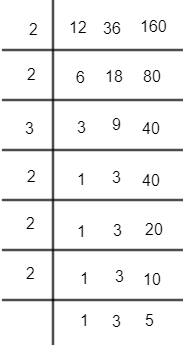
$\therefore LCM=2\times 2\times 3\times 3\times 2\times 2\times 2\times 3\times 5$
$={{2}^{5}}\times {{3}^{2}}\times 5=4320$
Complete step-by-step answer:
The method of prime factorization is used to break down or express a given number as a product of prime numbers. More so, if a prime number occurs more than once in the factorization, it is usually expressed in exponential form to make it look more compact. Here, a prime number is a whole number greater than 1 that is only divisible by 1 and itself. Another way to say it is that a prime number has exactly two factors, namely 1 and itself. Let us explain prime factorization in steps.
First let us list down a few prime numbers: 2, 3, 5, 7, 11, 13, 17, etcetera.
Now, we have been asked to find the LCM of 12, 36 and 160.
Let us check again if the numbers are divisible by the prime number 2. After the repeated division of 2, you end up getting a prime number. Thus, we can form the prime factorization as,
$12=2\times 2\times 3$
$36=2\times 2\times 3\times 3$
$160=2\times 2\times 2\times 2\times 2\times 5$
Thus, to find the LCM from the above $\left( 2\times 2 \right)=4$ is common for the three numbers 12, 36 and 160.
Thus, we can write the LCM as (4 $\times $ the rest of the prime numbers)
$\therefore LCM=4\times 3\times 3\times 3\times 2\times 2\times 2\times 5=4320$
Thus, we got the LCM $=4320$ .
Note: We can also find the LCM using the division method.
$\therefore LCM=2\times 2\times 3\times 3\times 2\times 2\times 2\times 3\times 5$
$={{2}^{5}}\times {{3}^{2}}\times 5=4320$
Recently Updated Pages
Master Class 12 Business Studies: Engaging Questions & Answers for Success

Master Class 12 Biology: Engaging Questions & Answers for Success
Master Class 12 Chemistry: Engaging Questions & Answers for Success
Class 12 Question and Answer - Your Ultimate Solutions Guide
Master Class 11 Social Science: Engaging Questions & Answers for Success
Master Class 11 English: Engaging Questions & Answers for Success
Trending doubts
What is BLO What is the full form of BLO class 8 social science CBSE
Citizens of India can vote at the age of A 18 years class 8 social science CBSE
Right to vote is a AFundamental Right BFundamental class 8 social science CBSE
10 slogans on organ donation class 8 english CBSE
Name the states through which the Tropic of Cancer class 8 social science CBSE
What are the methods of reducing friction. Explain