




Find the lateral surface and total surface area of a cuboid of length 80 cm, breadth 40 cm and height 20cm.
Answer
 Verified
658.5k+ views
Hint: In this question the dimensions of the cuboid are given to us. We need to find the lateral surface area and total surface area of the cuboid. Use the basic formula for lateral surface and surface area of cuboid to get the answer.
Complete step-by-step answer:
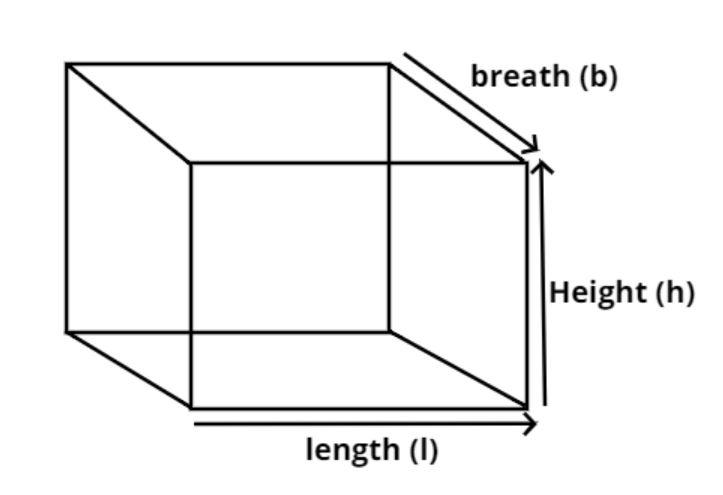
As we see that the cuboid has 6 faces.
And it is given that length (l) = 80 cm.
Breadth (b) = 40 cm
Height (h) = 20 cm.
Now we have to find the lateral surface area and total surface area of the cuboid.
Lateral surface area - The sum of surface areas of all sides except the top and bottom face of solid is defined as the lateral surface area of a solid.
So the lateral surface area (L.S.A) of the cuboid is = $2\left( {lh + bh} \right) = 2h\left( {l + b} \right)$ (see figure).
So substitute the values in this equation we have,
$ \Rightarrow L.S.A = 2\left( {20} \right)\left( {80 + 40} \right) = 40\left( {120} \right) = 4800$ $cm^2$.
Total surface area (T.S.A) of the cuboid is the sum of surface areas of all sides.
$ \Rightarrow T.S.A = 2\left( {lb + bh + hl} \right)$
So substitute the values in this equation we have,
$ \Rightarrow T.S.A = 2\left[ {\left( {80 \times 40} \right) + \left( {40 \times 20} \right) + \left( {20 \times 80} \right)} \right]$
Now simplify the above equation we have,
$ \Rightarrow T.S.A = 2\left[ {3200 + 800 + 1600} \right] = 2\left( {5600} \right) = 11200$ $cm^2$.
So, this is the required answer.
Note: Whenever we face such types of problems the key concept is simply to have the basic understanding of the basic formula for lateral surface and total surface area of basic shapes like cuboid. This will always help you get on the right track to get the answer.
Complete step-by-step answer:
As we see that the cuboid has 6 faces.
And it is given that length (l) = 80 cm.
Breadth (b) = 40 cm
Height (h) = 20 cm.
Now we have to find the lateral surface area and total surface area of the cuboid.
Lateral surface area - The sum of surface areas of all sides except the top and bottom face of solid is defined as the lateral surface area of a solid.
So the lateral surface area (L.S.A) of the cuboid is = $2\left( {lh + bh} \right) = 2h\left( {l + b} \right)$ (see figure).
So substitute the values in this equation we have,
$ \Rightarrow L.S.A = 2\left( {20} \right)\left( {80 + 40} \right) = 40\left( {120} \right) = 4800$ $cm^2$.
Total surface area (T.S.A) of the cuboid is the sum of surface areas of all sides.
$ \Rightarrow T.S.A = 2\left( {lb + bh + hl} \right)$
So substitute the values in this equation we have,
$ \Rightarrow T.S.A = 2\left[ {\left( {80 \times 40} \right) + \left( {40 \times 20} \right) + \left( {20 \times 80} \right)} \right]$
Now simplify the above equation we have,
$ \Rightarrow T.S.A = 2\left[ {3200 + 800 + 1600} \right] = 2\left( {5600} \right) = 11200$ $cm^2$.
So, this is the required answer.
Note: Whenever we face such types of problems the key concept is simply to have the basic understanding of the basic formula for lateral surface and total surface area of basic shapes like cuboid. This will always help you get on the right track to get the answer.
Recently Updated Pages
Master Class 11 English: Engaging Questions & Answers for Success

Master Class 11 Social Science: Engaging Questions & Answers for Success
Master Class 11 Maths: Engaging Questions & Answers for Success
Master Class 11 Biology: Engaging Questions & Answers for Success
Master Class 11 Physics: Engaging Questions & Answers for Success
Master Class 11 Chemistry: Engaging Questions & Answers for Success
Trending doubts
Explain the Treaty of Vienna of 1815 class 10 social science CBSE
First Cotton Mill of India
In which year voting age was reduced from 21 to 18?
What planets have no moons Which one has only one moon class 10 physics CBSE
What is the full form of POSCO class 10 social science CBSE
Define Potential, Developed, Stock and Reserved resources