




How do you find the inverse of an exponential function?
Answer
 Verified
573.6k+ views
Hint: Here, we need to find the inverse of an exponential function. We will write the exponential function and we will assume that it is equal to \[y\]. Then, we will use the rule of logarithms to simplify the equation for the particular variable \[x\]. Then, we will interchange the variables to find the required inverse of the exponential function.
Complete step-by-step answer:
The exponential function is given by \[f\left( x \right) = a{b^x}\], where \[b\] is a positive real number, and \[b \ne 1\].
Let \[f\left( x \right)\] be equal to \[y\].
Therefore, we get
\[y = a{b^x}\]
We will use the rule of logarithms to simplify the equation for the particular variable \[x\].
First, we will isolate the exponential expression.
Dividing both sides of the equation by \[a\], we get
\[ \Rightarrow \dfrac{y}{a} = {b^x}\]
If an equation is of the form \[x = {b^y}\], it can be written using logarithms as \[y = {\log _b}x\], where \[x > 0\], \[b > 0\] and \[b\] is not equal to 1.
Therefore, since \[\dfrac{y}{a} = {b^x}\], we get the equation
\[x = {\log _b}\left( {\dfrac{y}{a}} \right)\]
Now, we will interchange the variables to find the value of the inverse of the exponential function.
Interchanging the variable \[x\] and variable \[y\], we get
\[ \Rightarrow y = {\log _b}\left( {\dfrac{x}{a}} \right)\]
This is the value of the inverse of \[f\left( x \right)\].
Therefore, we get
\[ \Rightarrow {f^{ - 1}}\left( x \right) = {\log _b}\left( {\dfrac{x}{a}} \right)\]
Therefore, the inverse of an exponential function \[a{b^x}\] is given by the expression \[{\log _b}\left( {\dfrac{x}{a}} \right)\].
Note: We can verify the inverse by drawing the graph of an exponential function and its inverse.
Let the exponential function be \[y = 2 \times {3^x}\].
We will draw the graphs of \[y = 2 \times {3^x}\] and its inverse, that is \[y = {\log _3}\left( {\dfrac{x}{2}} \right)\].
If the graphs are symmetrical along the line \[x = y\], then the two functions are the inverse of each other.
Drawing the graphs, we get
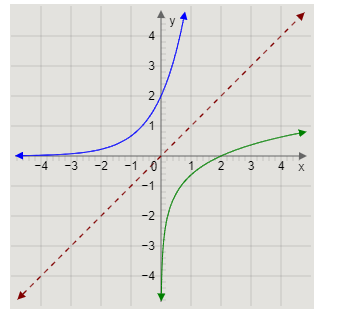
The red line is the graph of the equation \[x = y\], the blue curve is the graph of the equation \[y = 2 \times {3^x}\], and the green curve is the graph of the equation \[y = {\log _3}\left( {\dfrac{x}{2}} \right)\].
We can observe that the graphs are symmetrical along the line \[x = y\].
Therefore, we have verified that \[y = 2 \times {3^x}\] is the inverse of \[y = {\log _3}\left( {\dfrac{x}{2}} \right)\], and \[y = {\log _3}\left( {\dfrac{x}{2}} \right)\] is the inverse of \[y = 2 \times {3^x}\].
Complete step-by-step answer:
The exponential function is given by \[f\left( x \right) = a{b^x}\], where \[b\] is a positive real number, and \[b \ne 1\].
Let \[f\left( x \right)\] be equal to \[y\].
Therefore, we get
\[y = a{b^x}\]
We will use the rule of logarithms to simplify the equation for the particular variable \[x\].
First, we will isolate the exponential expression.
Dividing both sides of the equation by \[a\], we get
\[ \Rightarrow \dfrac{y}{a} = {b^x}\]
If an equation is of the form \[x = {b^y}\], it can be written using logarithms as \[y = {\log _b}x\], where \[x > 0\], \[b > 0\] and \[b\] is not equal to 1.
Therefore, since \[\dfrac{y}{a} = {b^x}\], we get the equation
\[x = {\log _b}\left( {\dfrac{y}{a}} \right)\]
Now, we will interchange the variables to find the value of the inverse of the exponential function.
Interchanging the variable \[x\] and variable \[y\], we get
\[ \Rightarrow y = {\log _b}\left( {\dfrac{x}{a}} \right)\]
This is the value of the inverse of \[f\left( x \right)\].
Therefore, we get
\[ \Rightarrow {f^{ - 1}}\left( x \right) = {\log _b}\left( {\dfrac{x}{a}} \right)\]
Therefore, the inverse of an exponential function \[a{b^x}\] is given by the expression \[{\log _b}\left( {\dfrac{x}{a}} \right)\].
Note: We can verify the inverse by drawing the graph of an exponential function and its inverse.
Let the exponential function be \[y = 2 \times {3^x}\].
We will draw the graphs of \[y = 2 \times {3^x}\] and its inverse, that is \[y = {\log _3}\left( {\dfrac{x}{2}} \right)\].
If the graphs are symmetrical along the line \[x = y\], then the two functions are the inverse of each other.
Drawing the graphs, we get
The red line is the graph of the equation \[x = y\], the blue curve is the graph of the equation \[y = 2 \times {3^x}\], and the green curve is the graph of the equation \[y = {\log _3}\left( {\dfrac{x}{2}} \right)\].
We can observe that the graphs are symmetrical along the line \[x = y\].
Therefore, we have verified that \[y = 2 \times {3^x}\] is the inverse of \[y = {\log _3}\left( {\dfrac{x}{2}} \right)\], and \[y = {\log _3}\left( {\dfrac{x}{2}} \right)\] is the inverse of \[y = 2 \times {3^x}\].
Recently Updated Pages
Master Class 11 Social Science: Engaging Questions & Answers for Success

Master Class 11 Physics: Engaging Questions & Answers for Success
Master Class 11 Maths: Engaging Questions & Answers for Success
Master Class 11 Economics: Engaging Questions & Answers for Success
Master Class 11 Computer Science: Engaging Questions & Answers for Success
Master Class 11 Chemistry: Engaging Questions & Answers for Success
Trending doubts
One Metric ton is equal to kg A 10000 B 1000 C 100 class 11 physics CBSE
There are 720 permutations of the digits 1 2 3 4 5 class 11 maths CBSE
1 Quintal is equal to a 110 kg b 10 kg c 100kg d 1000 class 11 physics CBSE
State and prove Bernoullis theorem class 11 physics CBSE
Difference Between Prokaryotic Cells and Eukaryotic Cells
Which among the following are examples of coming together class 11 social science CBSE