




How do you find the inflection point of a logarithmic function?
Answer
 Verified
589.2k+ views
Hint: For a function, an inflection point is a point where the curve changes its shape from concave up to concave down. We can find an inflection point by checking whether its slope at a point has the highest value than any other point. That point is called an inflection point.
Complete step by step answer:
As per the given question, we have to find the inflection points of the logarithmic function.
Let the logarithmic function be \[\ln x\].
For finding the inflection point of a logarithmic function, we need to take the derivative of the logarithmic function.
We know that the derivative of \[\ln x\] is \[\dfrac{1}{x}\].
Let \[y=\ln x\].
So, the first derivative which is denoted as \[{y}'\] will be\[{y}'=\dfrac{1}{x}\].
we can decide the inflection points based on the second derivative of the function which is given by \[{y}''=\dfrac{d}{dx}({y}')\].
Here, we only require the power rule \[\dfrac{d}{dx}(a{{x}^{n}})=(na){{x}^{n-1}}\].
So, the second derivative which is denoted as \[{y}''\] is \[{y}''=\dfrac{-1}{{{x}^{2}}}\].
If \[{y}''=0\] then it is the inflection point. Here, \[{y}''=0\] for \[x=\pm \infty \]. This implies \[\ln x\] do not have any inflection point.
This implies that \[\ln x\] is a strictly increasing function.
The graph of \[y=\ln x\] is as shown below:
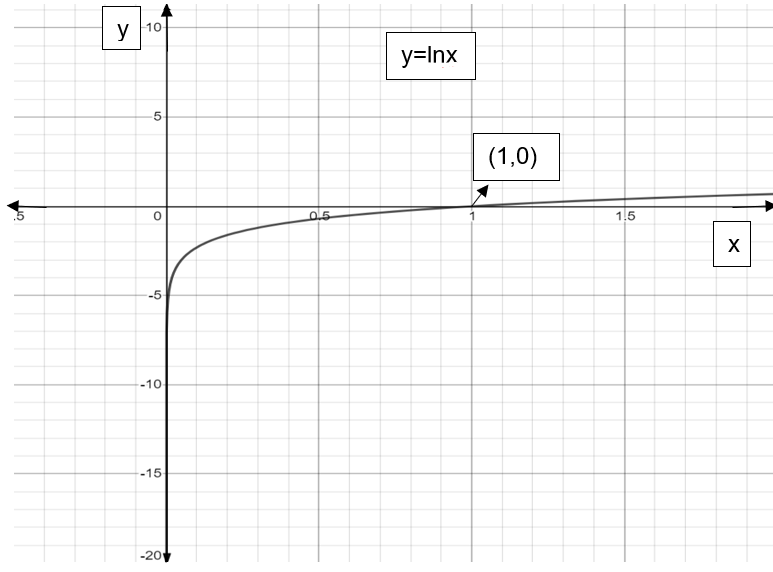
Therefore, in this way, we can find the inflection point of any logarithmic function.
Note:
In order to solve these types of problems, we must have enough knowledge about inflection points. We need to know the derivation methods to find the derivative of a function. We should avoid calculation mistakes to get the correct solution. While drawing graphs plot the points wisely to avoid any confusion.
Complete step by step answer:
As per the given question, we have to find the inflection points of the logarithmic function.
Let the logarithmic function be \[\ln x\].
For finding the inflection point of a logarithmic function, we need to take the derivative of the logarithmic function.
We know that the derivative of \[\ln x\] is \[\dfrac{1}{x}\].
Let \[y=\ln x\].
So, the first derivative which is denoted as \[{y}'\] will be\[{y}'=\dfrac{1}{x}\].
we can decide the inflection points based on the second derivative of the function which is given by \[{y}''=\dfrac{d}{dx}({y}')\].
Here, we only require the power rule \[\dfrac{d}{dx}(a{{x}^{n}})=(na){{x}^{n-1}}\].
So, the second derivative which is denoted as \[{y}''\] is \[{y}''=\dfrac{-1}{{{x}^{2}}}\].
If \[{y}''=0\] then it is the inflection point. Here, \[{y}''=0\] for \[x=\pm \infty \]. This implies \[\ln x\] do not have any inflection point.
This implies that \[\ln x\] is a strictly increasing function.
The graph of \[y=\ln x\] is as shown below:
Therefore, in this way, we can find the inflection point of any logarithmic function.
Note:
In order to solve these types of problems, we must have enough knowledge about inflection points. We need to know the derivation methods to find the derivative of a function. We should avoid calculation mistakes to get the correct solution. While drawing graphs plot the points wisely to avoid any confusion.
Recently Updated Pages
Master Class 12 Business Studies: Engaging Questions & Answers for Success

Master Class 12 Biology: Engaging Questions & Answers for Success
Master Class 12 Chemistry: Engaging Questions & Answers for Success
Class 12 Question and Answer - Your Ultimate Solutions Guide
Master Class 11 Social Science: Engaging Questions & Answers for Success
Master Class 11 English: Engaging Questions & Answers for Success
Trending doubts
What is the full form of NDA a National Democratic class 10 social science CBSE
Explain the Treaty of Vienna of 1815 class 10 social science CBSE
Who Won 36 Oscar Awards? Record Holder Revealed
Bharatiya Janata Party was founded in the year A 1979 class 10 social science CBSE
What is the median of the first 10 natural numbers class 10 maths CBSE
Why is it 530 pm in india when it is 1200 afternoon class 10 social science CBSE