




Find the image of the point P (3, 5, 7) in the plane 2x + y + z = 0.
A.(- 9, -1, 1)
B.(9, 1, 1)
C.(1, 9, 1)
D.(1, -9, 1)
Answer
 Verified
643.8k+ views
Hint: In these types of questions suppose a point Q \[\left( {{x_1},{\text{ }}{y_1},{\text{ }}{z_1}} \right)\] as image of point P then use the concept of midpoint of a line PQ that says if a line PQ where P \[\left( {{x_1},{\text{ }}{y_1},{\text{ }}{z_1}} \right)\] and point Q \[\left( {{x_2},{\text{ }}{y_2},{\text{ }}{z_2}} \right)\] then if there exist a point M (a, b, c) which divides the Line PQ equally then the coordinates of midpoint can be find as$\dfrac{{{x_1} + {x_2}}}{2} = a$, $\dfrac{{{y_1} + {y_2}}}{2} = b$and \[\dfrac{{{z_1} + {z_2}}}{2} = c\] use this information to approach the solution to the question.
Complete step-by-step answer:
To find the image of point P let assume a point on plane O
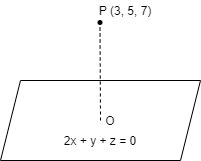
As we know by the given information equation of plane is 2x + y + z = 0 (equation 1)
As we know the equation of plane (ax + by + cz = k) when a line PO where P have some coordinates (p, q, r) and Q with coordinates (x, y, z) is given by \[\dfrac{{p - x}}{a} = \dfrac{{q - y}}{b} = \dfrac{{r - z}}{c} = k\]
Substituting the given values in the above equation
\[\dfrac{{3 - x}}{2} = \dfrac{{5 - y}}{1} = \dfrac{{7 - z}}{1} = k\]
So any point on the line PO can be represented as
x = 3 – 2k, y = 5 – k, z = 7 – k
Therefore the coordinates of point O are [(3 – 2k), (5 – k), (7 – k)]
Substituting these values in the equation 1
2 (3 – 2k) + (5 – k) + (7 – k) = 0
$ \Rightarrow $6 – 4k + 5 – k + 7 – k = 0
$ \Rightarrow $18 – 6k = 0
$ \Rightarrow $k = $\dfrac{{18}}{6}$
$ \Rightarrow $k = 3
Substituting the value of k in coordinates of O
x = 3 – 2(3), y = 5 – 3, z = 7 – 3
$ \Rightarrow $ x = – 3, y = 2, z = 4
Now let’s Q \[\left( {{x_1},{\text{ }}{y_1},{\text{ }}{z_1}} \right)\] be the image of P
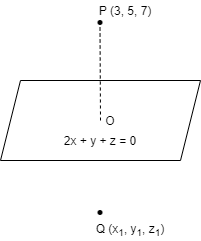
So using the midpoint formula since the distance of point P and point Q are same from point O
Therefore by the midpoint formula
Substituting the values in the midpoint formula$\dfrac{{{x_1} + {x_2}}}{2} = a$, $\dfrac{{{y_1} + {y_2}}}{2} = b$and \[\dfrac{{{z_1} + {z_2}}}{2} = c\]
$\dfrac{{3 + {x_1}}}{2} = - 3$, $\dfrac{{5 + {y_1}}}{2} = 2$and \[\dfrac{{7 + {z_1}}}{2} = 4\]
$ \Rightarrow $${x_1} = - 6 - 3$, ${y_1} = 4 - 5$and \[{z_1} = 8 - 7\]
$ \Rightarrow $${x_1} = - 9$, ${y_1} = - 1$and \[{z_1} = 1\]
Therefore the coordinates of the image of P are (-9, -1, 1)
Hence option A is the correct option.
Note: The term “plane” which was introduced in the above question is the flat surface which exists in 2 dimensions with infinite size this concept can be explained with the help of an example suppose there is a person traveling between the X and Y axis so the surface formed by the X and Y axis is called Plane here the plane formed by X and Y axis is XY plane.
Complete step-by-step answer:
To find the image of point P let assume a point on plane O
As we know by the given information equation of plane is 2x + y + z = 0 (equation 1)
As we know the equation of plane (ax + by + cz = k) when a line PO where P have some coordinates (p, q, r) and Q with coordinates (x, y, z) is given by \[\dfrac{{p - x}}{a} = \dfrac{{q - y}}{b} = \dfrac{{r - z}}{c} = k\]
Substituting the given values in the above equation
\[\dfrac{{3 - x}}{2} = \dfrac{{5 - y}}{1} = \dfrac{{7 - z}}{1} = k\]
So any point on the line PO can be represented as
x = 3 – 2k, y = 5 – k, z = 7 – k
Therefore the coordinates of point O are [(3 – 2k), (5 – k), (7 – k)]
Substituting these values in the equation 1
2 (3 – 2k) + (5 – k) + (7 – k) = 0
$ \Rightarrow $6 – 4k + 5 – k + 7 – k = 0
$ \Rightarrow $18 – 6k = 0
$ \Rightarrow $k = $\dfrac{{18}}{6}$
$ \Rightarrow $k = 3
Substituting the value of k in coordinates of O
x = 3 – 2(3), y = 5 – 3, z = 7 – 3
$ \Rightarrow $ x = – 3, y = 2, z = 4
Now let’s Q \[\left( {{x_1},{\text{ }}{y_1},{\text{ }}{z_1}} \right)\] be the image of P
So using the midpoint formula since the distance of point P and point Q are same from point O
Therefore by the midpoint formula
Substituting the values in the midpoint formula$\dfrac{{{x_1} + {x_2}}}{2} = a$, $\dfrac{{{y_1} + {y_2}}}{2} = b$and \[\dfrac{{{z_1} + {z_2}}}{2} = c\]
$\dfrac{{3 + {x_1}}}{2} = - 3$, $\dfrac{{5 + {y_1}}}{2} = 2$and \[\dfrac{{7 + {z_1}}}{2} = 4\]
$ \Rightarrow $${x_1} = - 6 - 3$, ${y_1} = 4 - 5$and \[{z_1} = 8 - 7\]
$ \Rightarrow $${x_1} = - 9$, ${y_1} = - 1$and \[{z_1} = 1\]
Therefore the coordinates of the image of P are (-9, -1, 1)
Hence option A is the correct option.
Note: The term “plane” which was introduced in the above question is the flat surface which exists in 2 dimensions with infinite size this concept can be explained with the help of an example suppose there is a person traveling between the X and Y axis so the surface formed by the X and Y axis is called Plane here the plane formed by X and Y axis is XY plane.
Recently Updated Pages
Master Class 11 English: Engaging Questions & Answers for Success

Master Class 11 Social Science: Engaging Questions & Answers for Success
Master Class 11 Maths: Engaging Questions & Answers for Success
Master Class 11 Biology: Engaging Questions & Answers for Success
Master Class 11 Physics: Engaging Questions & Answers for Success
Master Class 11 Chemistry: Engaging Questions & Answers for Success
Trending doubts
One Metric ton is equal to kg A 10000 B 1000 C 100 class 11 physics CBSE
What is cell theory Who formulated it class 11 biology CBSE
Phyllotaxy is the arrangement of ALeaflets BLeaves class 11 biology CBSE
Difference Between Prokaryotic Cells and Eukaryotic Cells
The symbiotic association of fungi and algae is called class 11 biology CBSE
Cell theory was formulated by A Schleiden and Schwann class 11 biology CBSE