




How do you find the hypotenuse of an isosceles right triangle?
Answer
 Verified
588.9k+ views
Hint: In this question, we have to find out the required expression from the given particulars.
We need to first consider what an isosceles right triangle is. For that we need to know the definition of an isosceles triangle right triangle
We need to apply Pythagoras theorem on this triangle, so we can find out the required solution.
Complete step-by-step solution:
We need to find the hypotenuse of an isosceles right triangle.
In geometry, an isosceles triangle is a triangle that has two sides of equal length.
In geometry, a right angled triangle is a triangle that has one right angle.
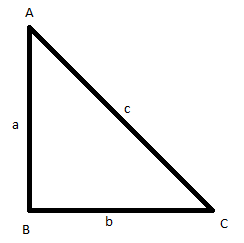
Let , ABC is an isosceles right triangle with \[\angle ABC = 90^\circ \].
Since it is also an isosceles triangle, let AB = BC.
Also as it is a right angle triangle we can apply Pythagoras theorem which states,
\[{\left( {Hypotenuse} \right)^2} = {\left( {Height} \right)^2} + {\left( {Base} \right)^2}\]
i.e.\[A{C^2} = A{B^2} + B{C^2}\]
i.e.\[A{C^2} = A{B^2} + A{B^2}\], [since, AB = BC].
Let us adding we get,
i.e.\[A{C^2} = 2A{B^2}\]
on taking square root on both sides we get,
i.e.\[AC = \sqrt {2A{B^2}} \]
on rewriting we get
i.e.\[AC = \sqrt 2 AB\]
Hence, the hypotenuse of an isosceles right triangle is \[\sqrt 2 \] $\times$ the equal side of the triangle.
Note: Right angled triangle:
In geometry, a right angled triangle is a triangle that has one right angle.
Pythagoras theorem states that,
If ABC is a right angled triangle then,
\[{\left( {Hypotenuse} \right)^2} = {\left( {Height} \right)^2} + {\left( {Base} \right)^2}\]
\[A{C^2} = A{B^2} + B{C^2}\]
Isosceles triangle:
In geometry, an isosceles triangle is a triangle that has two sides of equal length.
An isosceles triangles definition states it as a polygon that consists of two equal sides, two equal angles, three edges, three vertices and the sum of internal angles of a triangle equal to \[180^\circ \].
We need to first consider what an isosceles right triangle is. For that we need to know the definition of an isosceles triangle right triangle
We need to apply Pythagoras theorem on this triangle, so we can find out the required solution.
Complete step-by-step solution:
We need to find the hypotenuse of an isosceles right triangle.
In geometry, an isosceles triangle is a triangle that has two sides of equal length.
In geometry, a right angled triangle is a triangle that has one right angle.
Let , ABC is an isosceles right triangle with \[\angle ABC = 90^\circ \].
Since it is also an isosceles triangle, let AB = BC.
Also as it is a right angle triangle we can apply Pythagoras theorem which states,
\[{\left( {Hypotenuse} \right)^2} = {\left( {Height} \right)^2} + {\left( {Base} \right)^2}\]
i.e.\[A{C^2} = A{B^2} + B{C^2}\]
i.e.\[A{C^2} = A{B^2} + A{B^2}\], [since, AB = BC].
Let us adding we get,
i.e.\[A{C^2} = 2A{B^2}\]
on taking square root on both sides we get,
i.e.\[AC = \sqrt {2A{B^2}} \]
on rewriting we get
i.e.\[AC = \sqrt 2 AB\]
Hence, the hypotenuse of an isosceles right triangle is \[\sqrt 2 \] $\times$ the equal side of the triangle.
Note: Right angled triangle:
In geometry, a right angled triangle is a triangle that has one right angle.
Pythagoras theorem states that,
If ABC is a right angled triangle then,
\[{\left( {Hypotenuse} \right)^2} = {\left( {Height} \right)^2} + {\left( {Base} \right)^2}\]
\[A{C^2} = A{B^2} + B{C^2}\]
Isosceles triangle:
In geometry, an isosceles triangle is a triangle that has two sides of equal length.
An isosceles triangles definition states it as a polygon that consists of two equal sides, two equal angles, three edges, three vertices and the sum of internal angles of a triangle equal to \[180^\circ \].
Recently Updated Pages
Master Class 12 Business Studies: Engaging Questions & Answers for Success

Master Class 12 Biology: Engaging Questions & Answers for Success
Master Class 12 Chemistry: Engaging Questions & Answers for Success
Class 12 Question and Answer - Your Ultimate Solutions Guide
Master Class 11 Social Science: Engaging Questions & Answers for Success
Master Class 11 English: Engaging Questions & Answers for Success
Trending doubts
Find the sum of series 1 + 2 + 3 + 4 + 5 + + 100 class 9 maths CBSE
Fill the blanks with the suitable prepositions 1 The class 9 english CBSE
Difference Between Plant Cell and Animal Cell
How many hours before the closure of election must class 9 social science CBSE
What is pollution? How many types of pollution? Define it
Name 10 Living and Non living things class 9 biology CBSE