




How do you find the horizontal velocity?
Answer
 Verified
597.9k+ views
Hint: The horizontal velocity that occurs when the object is in projectile motion projectile motion can be defined as it is the motion of an object thrown or projected into the air. The object is referred to as a projectile and its trajectory is called its direction.
Complete step by step solution:
When a particle or object is thrown obliquely near to the surface of the earth, it travels under constant acceleration along a curved path towards the middle of the earth if we assume the object to be remains close to the earth surface.
Here, projectile is called the direction of such an object and the motion is called projectile motion.
In the projectile motion air resistance to the body’s motion must be considered absent.
There are two simultaneous separate rectilinear motions in a positive motion.
Along the x-axis:- uniform velocity responsible for the particle horizontal travel.
In the y-axis:- uniform acceleration responsible for the motion of the particle vertically downwards.
As shown below let us consider a ball projected at an angle with respect to the horizontal x-axis with the original velocity u.
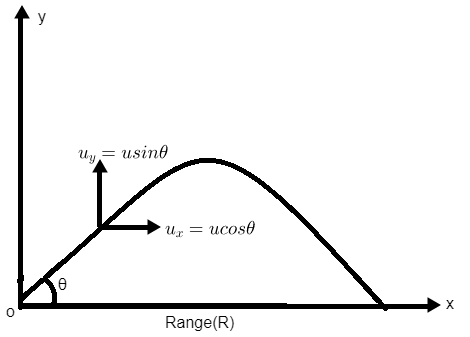
As shown in the figure point o is a point of the projection where the object start its projection with a velocity u.
Now horizontal component will be along x-axis hence we can write as
${{u}_{x}}=u\cos \theta $
When the horizontal component of the velocity.
Note:
As an approach to know how to calculate the horizontal component of the velocity we have seen the definition of the projectile motion in which there are two components of the velocity one is along x-axis which we called horizontal component and the other one is vertical component which is along y-axis.
Complete step by step solution:
When a particle or object is thrown obliquely near to the surface of the earth, it travels under constant acceleration along a curved path towards the middle of the earth if we assume the object to be remains close to the earth surface.
Here, projectile is called the direction of such an object and the motion is called projectile motion.
In the projectile motion air resistance to the body’s motion must be considered absent.
There are two simultaneous separate rectilinear motions in a positive motion.
Along the x-axis:- uniform velocity responsible for the particle horizontal travel.
In the y-axis:- uniform acceleration responsible for the motion of the particle vertically downwards.
As shown below let us consider a ball projected at an angle with respect to the horizontal x-axis with the original velocity u.
As shown in the figure point o is a point of the projection where the object start its projection with a velocity u.
Now horizontal component will be along x-axis hence we can write as
${{u}_{x}}=u\cos \theta $
When the horizontal component of the velocity.
Note:
As an approach to know how to calculate the horizontal component of the velocity we have seen the definition of the projectile motion in which there are two components of the velocity one is along x-axis which we called horizontal component and the other one is vertical component which is along y-axis.
Recently Updated Pages
Master Class 12 Business Studies: Engaging Questions & Answers for Success

Master Class 12 Chemistry: Engaging Questions & Answers for Success
Master Class 12 Biology: Engaging Questions & Answers for Success
Class 12 Question and Answer - Your Ultimate Solutions Guide
Master Class 11 English: Engaging Questions & Answers for Success
Master Class 11 Social Science: Engaging Questions & Answers for Success
Trending doubts
Which are the Top 10 Largest Countries of the World?
Draw a labelled sketch of the human eye class 12 physics CBSE
Differentiate between homogeneous and heterogeneous class 12 chemistry CBSE
Why is the cell called the structural and functional class 12 biology CBSE
When was the first election held in India a 194748 class 12 sst CBSE
Draw ray diagrams each showing i myopic eye and ii class 12 physics CBSE