




How do you find the height of a tree if the angle of elevation of its top changes from 20 degrees to 40 degrees as the observer advances 23 meter towards the base of the tree?
Answer
 Verified
588.6k+ views
Hint: We are given that the angle of elevation of a tree top is 20 degrees which when moved towards the base of the tree changes the angle of elevation to 40 degrees and based on the given information we have to find the height of the tree. We will make use of the trigonometric function (tangent function) in the two triangles and substitute the required values in either of the expressions obtained from the two triangles and then find the height of the tree.
Complete step by step solution:
According to the given question, we are given that the angle of elevation of a tree top is 20 degrees which when moved towards the base of the tree changes the angle of elevation to 40 degrees and based on the given information we have to find the height of the tree.
We will first draw the figure as per what is in the question. We have,
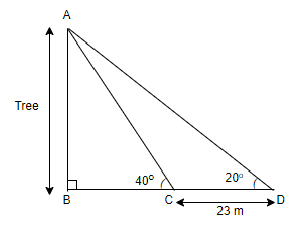
We will use the trigonometric functions to find the height of the tree.
Let the height of the tree be ‘h’ meters, that is, \[AB=h\] meters
And let the distance BC be ‘x’ meters
We will first consider the triangle, \[\vartriangle ABC\],
Here,
\[\tan {{40}^{\circ }}=\dfrac{AB}{BC}\] as we know, tangent function is the ratio of perpendicular and hypotenuse.
\[\Rightarrow \tan {{40}^{\circ }}=\dfrac{h}{x}\]
Writing in terms of ‘x’, we have,
\[\Rightarrow x=\dfrac{h}{\tan {{40}^{\circ }}}\]----(1)
Next, we will consider the triangle, \[\vartriangle ABD\],
Here,
\[\tan {{20}^{\circ }}=\dfrac{AB}{BD}\]
\[\Rightarrow \tan {{20}^{\circ }}=\dfrac{h}{x+23}\]----(2)
We will now substitute the value of ‘x’ from equation (1), we get,
\[\Rightarrow \tan {{20}^{\circ }}=\dfrac{h}{\dfrac{h}{\tan {{40}^{\circ }}}+23}\]----(3)
We know that,
\[\tan {{20}^{\circ }}=0.36\]
\[\tan {{40}^{\circ }}=0.83\]
Substituting the values in the equation (3), we get,
\[\Rightarrow 0.36=\dfrac{h}{\dfrac{h}{0.83}+23}\]
Solving further, we get,
\[\Rightarrow 0.36=\dfrac{h}{1.20h+23}\]
\[\Rightarrow 0.36(1.20h+23)=h\]
Multiplying the terms in the bracket, we will get,
\[\Rightarrow 0.432h+8.28=h\]
\[\Rightarrow h-0.432h=8.28\]
\[\Rightarrow 0.568h=8.28\]
Obtaining the value of ‘h’, we get,
\[\Rightarrow h=14.57\]meters
Therefore, the height of the tree is 14.57 meters.
Note: The trigonometric functions should be written correctly and the substitution of the values in the expressions should be done carefully. The height of the tree can also be obtained by making use of the law of sines. According to the law of sines, we have the following expression, \[\dfrac{\sin A}{a}=\dfrac{\sin B}{b}=\dfrac{\sin C}{c}\] where ‘a’ is the side opposite to angle A, ‘b’ is the side opposite to angle B and ‘c’ is the side opposite to the angle C. using the law of sines appropriately, we will find the height of the tree.
Complete step by step solution:
According to the given question, we are given that the angle of elevation of a tree top is 20 degrees which when moved towards the base of the tree changes the angle of elevation to 40 degrees and based on the given information we have to find the height of the tree.
We will first draw the figure as per what is in the question. We have,
We will use the trigonometric functions to find the height of the tree.
Let the height of the tree be ‘h’ meters, that is, \[AB=h\] meters
And let the distance BC be ‘x’ meters
We will first consider the triangle, \[\vartriangle ABC\],
Here,
\[\tan {{40}^{\circ }}=\dfrac{AB}{BC}\] as we know, tangent function is the ratio of perpendicular and hypotenuse.
\[\Rightarrow \tan {{40}^{\circ }}=\dfrac{h}{x}\]
Writing in terms of ‘x’, we have,
\[\Rightarrow x=\dfrac{h}{\tan {{40}^{\circ }}}\]----(1)
Next, we will consider the triangle, \[\vartriangle ABD\],
Here,
\[\tan {{20}^{\circ }}=\dfrac{AB}{BD}\]
\[\Rightarrow \tan {{20}^{\circ }}=\dfrac{h}{x+23}\]----(2)
We will now substitute the value of ‘x’ from equation (1), we get,
\[\Rightarrow \tan {{20}^{\circ }}=\dfrac{h}{\dfrac{h}{\tan {{40}^{\circ }}}+23}\]----(3)
We know that,
\[\tan {{20}^{\circ }}=0.36\]
\[\tan {{40}^{\circ }}=0.83\]
Substituting the values in the equation (3), we get,
\[\Rightarrow 0.36=\dfrac{h}{\dfrac{h}{0.83}+23}\]
Solving further, we get,
\[\Rightarrow 0.36=\dfrac{h}{1.20h+23}\]
\[\Rightarrow 0.36(1.20h+23)=h\]
Multiplying the terms in the bracket, we will get,
\[\Rightarrow 0.432h+8.28=h\]
\[\Rightarrow h-0.432h=8.28\]
\[\Rightarrow 0.568h=8.28\]
Obtaining the value of ‘h’, we get,
\[\Rightarrow h=14.57\]meters
Therefore, the height of the tree is 14.57 meters.
Note: The trigonometric functions should be written correctly and the substitution of the values in the expressions should be done carefully. The height of the tree can also be obtained by making use of the law of sines. According to the law of sines, we have the following expression, \[\dfrac{\sin A}{a}=\dfrac{\sin B}{b}=\dfrac{\sin C}{c}\] where ‘a’ is the side opposite to angle A, ‘b’ is the side opposite to angle B and ‘c’ is the side opposite to the angle C. using the law of sines appropriately, we will find the height of the tree.
Recently Updated Pages
Basicity of sulphurous acid and sulphuric acid are

Master Class 10 Computer Science: Engaging Questions & Answers for Success
Master Class 10 Social Science: Engaging Questions & Answers for Success
Master Class 10 Science: Engaging Questions & Answers for Success
Class 10 Question and Answer - Your Ultimate Solutions Guide
Master Class 10 Maths: Engaging Questions & Answers for Success
Trending doubts
What is the Total Duration of Football Match?
Explain the Treaty of Vienna of 1815 class 10 social science CBSE
In football, which nation is called "La Roja"?
Why is there a time difference of about 5 hours between class 10 social science CBSE
10 examples of evaporation in daily life with explanations
What is the full form of POSCO class 10 social science CBSE