




Find the height at which the weight will be the same as at the same depth from the surface of the earth.
\[\begin{align}
& A.\,\dfrac{R}{2} \\
& B.\,\sqrt{5}R-R \\
& C.\,\dfrac{\sqrt{5}R-R}{2} \\
& D.\,\dfrac{\sqrt{3}R-R}{2} \\
\end{align}\]
Answer
 Verified
550.8k+ views
Hint: We have to equate the equation of the acceleration due to the gravity of a body at some height on the surface of the earth with the acceleration due to the gravity of a body at some depth below the surface of the earth. By solving this equation, we will get the expression for the height.
Formula used:
\[{{g}_{h}}=\dfrac{g{{R}^{2}}}{{{(R+h)}^{2}}}\]
\[{{g}_{d}}=g\left( 1-\dfrac{d}{R} \right)\]
Complete answer:
From the given information, we have the data as follows.
At some height, the weight will be the same as at the same depth from the surface of the earth.
The weight of a body can be represented as the product of the mass of the body and the acceleration due to gravity.
\[W=mg\]
The mass of the body remains constant irrespective of the place. Thus, the value of the acceleration due to gravity should remain the same as the weight of the body is supposed to remain the same.
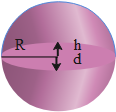
The acceleration due to the gravity of a body at some height on the surface of the earth is given by the formula as follows.
\[{{g}_{h}}=\dfrac{g{{R}^{2}}}{{{(R+h)}^{2}}}\]
The acceleration due to the gravity of a body at some depth below the surface of the earth, that is, depth is given by the formula as follows.
\[{{g}_{d}}=g\left( 1-\dfrac{d}{R} \right)\]
As the weight of the body equals at some height and the depth, so, we have,
\[{{g}_{d}}=g\left( 1-\dfrac{h}{R} \right)\]
As the value of the acceleration due to gravity should remain the same as the weight of the body is supposed to remain the same.
\[{{g}_{h}}={{g}_{d}}\]
Substitute the equations in the above formula
\[\dfrac{g{{R}^{2}}}{{{(R+h)}^{2}}}=g\left( 1-\dfrac{h}{R} \right)\]
Continue further computation.
\[\begin{align}
& \dfrac{{{R}^{2}}}{{{(R+h)}^{2}}}=\left( 1-\dfrac{h}{R} \right) \\
& \Rightarrow \dfrac{1}{{{R}^{2}}}{{(R+h)}^{2}}\left( 1-\dfrac{h}{R} \right)=1 \\
& \therefore \left( \dfrac{{{R}^{2}}+{{h}^{2}}+2hR}{{{R}^{2}}} \right)\left( 1-\dfrac{h}{R} \right)=1 \\
\end{align}\]
Cancel out common terms.
\[\begin{align}
& \left( \dfrac{{{R}^{2}}}{{{R}^{2}}}+\dfrac{{{h}^{2}}}{{{R}^{2}}}+\dfrac{2hR}{{{R}^{2}}} \right)\left( 1-\dfrac{h}{R} \right)=1 \\
& \therefore \left( 1+\dfrac{{{h}^{2}}}{{{R}^{2}}}+\dfrac{2h}{R} \right)\left( 1-\dfrac{h}{R} \right)=1 \\
\end{align}\]
Take out the brackets.
\[\begin{align}
& 1+\dfrac{{{h}^{2}}}{{{R}^{2}}}+\dfrac{2h}{R}-\dfrac{h}{R}-\dfrac{{{h}^{3}}}{{{R}^{3}}}-\dfrac{2{{h}^{2}}}{{{R}^{2}}}=1 \\
& \therefore -\dfrac{{{h}^{2}}}{{{R}^{2}}}-\dfrac{{{h}^{3}}}{{{R}^{3}}}+\dfrac{h}{R}=0 \\
\end{align}\]
Take out the common terms.
\[\begin{align}
& \left( -\dfrac{h}{R} \right)\left( \dfrac{{{h}^{2}}}{{{R}^{2}}}+\dfrac{h}{R}-1 \right)=0 \\
& \Rightarrow \left( \dfrac{{{h}^{2}}}{{{R}^{2}}}+\dfrac{h}{R}-1 \right)=0 \\
& \therefore {{h}^{2}}+hR-{{R}^{2}}=0 \\
\end{align}\]
Solve the above quadratic equation.
\[\begin{align}
& {{h}^{2}}+hR-{{R}^{2}}=0 \\
& \Rightarrow h=\dfrac{-R\pm \sqrt{{{R}^{2}}+4{{R}^{2}}}}{2\times 1} \\
& \therefore h=\dfrac{\sqrt{5}R-R}{2} \\
\end{align}\]
\[\therefore \] The height at which the weight will be the same as at the same depth from the surface of the earth is \[\dfrac{\sqrt{5}R-R}{2}\].
Thus, option (C) is correct.
Note:
As the options contain the parameter radius, thus, we need to obtain the expression for the height above the surface of the earth at which the weight equals the weight at some depth below the surface of the earth.
Formula used:
\[{{g}_{h}}=\dfrac{g{{R}^{2}}}{{{(R+h)}^{2}}}\]
\[{{g}_{d}}=g\left( 1-\dfrac{d}{R} \right)\]
Complete answer:
From the given information, we have the data as follows.
At some height, the weight will be the same as at the same depth from the surface of the earth.
The weight of a body can be represented as the product of the mass of the body and the acceleration due to gravity.
\[W=mg\]
The mass of the body remains constant irrespective of the place. Thus, the value of the acceleration due to gravity should remain the same as the weight of the body is supposed to remain the same.
The acceleration due to the gravity of a body at some height on the surface of the earth is given by the formula as follows.
\[{{g}_{h}}=\dfrac{g{{R}^{2}}}{{{(R+h)}^{2}}}\]
The acceleration due to the gravity of a body at some depth below the surface of the earth, that is, depth is given by the formula as follows.
\[{{g}_{d}}=g\left( 1-\dfrac{d}{R} \right)\]
As the weight of the body equals at some height and the depth, so, we have,
\[{{g}_{d}}=g\left( 1-\dfrac{h}{R} \right)\]
As the value of the acceleration due to gravity should remain the same as the weight of the body is supposed to remain the same.
\[{{g}_{h}}={{g}_{d}}\]
Substitute the equations in the above formula
\[\dfrac{g{{R}^{2}}}{{{(R+h)}^{2}}}=g\left( 1-\dfrac{h}{R} \right)\]
Continue further computation.
\[\begin{align}
& \dfrac{{{R}^{2}}}{{{(R+h)}^{2}}}=\left( 1-\dfrac{h}{R} \right) \\
& \Rightarrow \dfrac{1}{{{R}^{2}}}{{(R+h)}^{2}}\left( 1-\dfrac{h}{R} \right)=1 \\
& \therefore \left( \dfrac{{{R}^{2}}+{{h}^{2}}+2hR}{{{R}^{2}}} \right)\left( 1-\dfrac{h}{R} \right)=1 \\
\end{align}\]
Cancel out common terms.
\[\begin{align}
& \left( \dfrac{{{R}^{2}}}{{{R}^{2}}}+\dfrac{{{h}^{2}}}{{{R}^{2}}}+\dfrac{2hR}{{{R}^{2}}} \right)\left( 1-\dfrac{h}{R} \right)=1 \\
& \therefore \left( 1+\dfrac{{{h}^{2}}}{{{R}^{2}}}+\dfrac{2h}{R} \right)\left( 1-\dfrac{h}{R} \right)=1 \\
\end{align}\]
Take out the brackets.
\[\begin{align}
& 1+\dfrac{{{h}^{2}}}{{{R}^{2}}}+\dfrac{2h}{R}-\dfrac{h}{R}-\dfrac{{{h}^{3}}}{{{R}^{3}}}-\dfrac{2{{h}^{2}}}{{{R}^{2}}}=1 \\
& \therefore -\dfrac{{{h}^{2}}}{{{R}^{2}}}-\dfrac{{{h}^{3}}}{{{R}^{3}}}+\dfrac{h}{R}=0 \\
\end{align}\]
Take out the common terms.
\[\begin{align}
& \left( -\dfrac{h}{R} \right)\left( \dfrac{{{h}^{2}}}{{{R}^{2}}}+\dfrac{h}{R}-1 \right)=0 \\
& \Rightarrow \left( \dfrac{{{h}^{2}}}{{{R}^{2}}}+\dfrac{h}{R}-1 \right)=0 \\
& \therefore {{h}^{2}}+hR-{{R}^{2}}=0 \\
\end{align}\]
Solve the above quadratic equation.
\[\begin{align}
& {{h}^{2}}+hR-{{R}^{2}}=0 \\
& \Rightarrow h=\dfrac{-R\pm \sqrt{{{R}^{2}}+4{{R}^{2}}}}{2\times 1} \\
& \therefore h=\dfrac{\sqrt{5}R-R}{2} \\
\end{align}\]
\[\therefore \] The height at which the weight will be the same as at the same depth from the surface of the earth is \[\dfrac{\sqrt{5}R-R}{2}\].
Thus, option (C) is correct.
Note:
As the options contain the parameter radius, thus, we need to obtain the expression for the height above the surface of the earth at which the weight equals the weight at some depth below the surface of the earth.
Recently Updated Pages
Master Class 11 Social Science: Engaging Questions & Answers for Success

Master Class 11 Physics: Engaging Questions & Answers for Success
Master Class 11 Maths: Engaging Questions & Answers for Success
Master Class 11 Economics: Engaging Questions & Answers for Success
Master Class 11 Computer Science: Engaging Questions & Answers for Success
Master Class 11 Chemistry: Engaging Questions & Answers for Success
Trending doubts
One Metric ton is equal to kg A 10000 B 1000 C 100 class 11 physics CBSE
There are 720 permutations of the digits 1 2 3 4 5 class 11 maths CBSE
1 Quintal is equal to a 110 kg b 10 kg c 100kg d 1000 class 11 physics CBSE
State and prove Bernoullis theorem class 11 physics CBSE
Difference Between Prokaryotic Cells and Eukaryotic Cells
Which among the following are examples of coming together class 11 social science CBSE