




Find the general solution of the trigonometric equation:
$ \sqrt{16{{\cos }^{4}}x-8{{\cos }^{2}}x+1}+\sqrt{16{{\cos }^{4}}x-24{{\cos }^{2}}x+9}=2 $
Answer
 Verified
663k+ views
Hint: If you observe you will find that $ 16{{\cos }^{4}}x-24{{\cos }^{2}}x+9 $ is equal to $ {{\left( 4{{\cos }^{2}}x-3 \right)}^{2}} $ and $ 16{{\cos }^{4}}x-8{{\cos }^{2}}x+1 $ is equal to $ {{\left( 4{{\cos }^{2}}x-1 \right)}^{2}} $ . Put this and solve the equation to the form $ {{\cos }^{2}}x={{\cos }^{2}}y $ and use the general solution $ x=n\pi \pm y $ to get the answer.
Complete step-by-step answer:
Before moving to the solution, let us discuss the periodicity of sine and cosine function, which we would be using in the solution. All the trigonometric ratios, including sine and cosine, are periodic functions. We can better understand this using the graph of sine and cosine.
First, let us start with the graph of sinx.
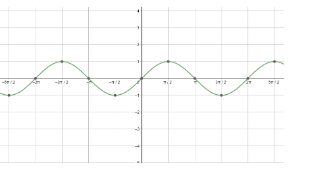
Next, let us see the graph of cosx.
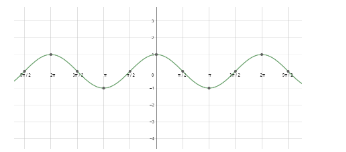
Looking at both the graphs, we can say that the graphs are repeating after a fixed period i.e. $ 2{{\pi }^{c}} $ . So, we can say that the fundamental period of the cosine function and the sine function is $ 2{{\pi }^{c}}=360{}^\circ $ .
Now, let us start the solving of the equation given in the question.
$ \sqrt{16{{\cos }^{4}}x-8{{\cos }^{2}}x+1}+\sqrt{16{{\cos }^{4}}x-24{{\cos }^{2}}x+9}=2 $
$ \Rightarrow \sqrt{{{\left( 4{{\cos }^{2}}x \right)}^{2}}-2\times 4{{\cos }^{2}}x\times 1+{{1}^{2}}}+\sqrt{\left( 4{{\cos }^{2}}x \right)-2\times 4{{\cos }^{2}}x\times 3+{{3}^{2}}}=2 $
Now, using the formula $ {{\left( a-b \right)}^{2}}={{a}^{2}}+{{b}^{2}}-2ab $ , we can say that $ 16{{\cos }^{4}}x-24{{\cos }^{2}}x+9 $ is equal to $ {{\left( 4{{\cos }^{2}}x-3 \right)}^{2}} $ and $ 16{{\cos }^{4}}x-8{{\cos }^{2}}x+1 $ is equal to $ {{\left( 4{{\cos }^{2}}x-1 \right)}^{2}} $ . So, our equation becomes:
$ \sqrt{{{\left( 4{{\cos }^{2}}x-1 \right)}^{2}}}+\sqrt{{{\left( 4{{\cos }^{2}}x-3 \right)}^{2}}}=2 $
Now, we know that $ \sqrt{{{k}^{2}}}=k $ . So, our equation becomes:
$ 4{{\cos }^{2}}x-1+4{{\cos }^{2}}x-3=2 $
$ \Rightarrow 8{{\cos }^{2}}x-4=2 $
$ \Rightarrow {{\cos }^{2}}x=\dfrac{6}{8}=\dfrac{3}{4} $
Now, we know that $ \cos \dfrac{\pi }{6}=\dfrac{\sqrt{3}}{2} $ . So, $ {{\cos }^{2}}\dfrac{\pi }{6}=\dfrac{3}{4} $ . If we put this in our equation, we get
$ {{\cos }^{2}}x={{\cos }^{2}}\dfrac{\pi }{6} $
Now, we know that, if $ {{\cos }^{2}}x={{\cos }^{2}}y $ , then the general solution is $ x=n\pi \pm y $ . So, for our equation, $ y=\dfrac{\pi }{6} $ . So, the general solution to our equation is $ x=n\pi \pm \dfrac{\pi }{6} $ , where n is an integer.
Note: Be careful about the calculation and the signs of the formulas you use as the signs in the formulas are very confusing and are very important for solving the problems. Also, $ x=n\pi \pm \dfrac{\pi }{6} $ represents all the solution to the equation given in the question, however the principal solutions are $ \dfrac{\pi }{6},\dfrac{5\pi }{6},\dfrac{7\pi }{6}\text{ and }\dfrac{11\pi }{6} $ .
Complete step-by-step answer:
Before moving to the solution, let us discuss the periodicity of sine and cosine function, which we would be using in the solution. All the trigonometric ratios, including sine and cosine, are periodic functions. We can better understand this using the graph of sine and cosine.
First, let us start with the graph of sinx.
Next, let us see the graph of cosx.
Looking at both the graphs, we can say that the graphs are repeating after a fixed period i.e. $ 2{{\pi }^{c}} $ . So, we can say that the fundamental period of the cosine function and the sine function is $ 2{{\pi }^{c}}=360{}^\circ $ .
Now, let us start the solving of the equation given in the question.
$ \sqrt{16{{\cos }^{4}}x-8{{\cos }^{2}}x+1}+\sqrt{16{{\cos }^{4}}x-24{{\cos }^{2}}x+9}=2 $
$ \Rightarrow \sqrt{{{\left( 4{{\cos }^{2}}x \right)}^{2}}-2\times 4{{\cos }^{2}}x\times 1+{{1}^{2}}}+\sqrt{\left( 4{{\cos }^{2}}x \right)-2\times 4{{\cos }^{2}}x\times 3+{{3}^{2}}}=2 $
Now, using the formula $ {{\left( a-b \right)}^{2}}={{a}^{2}}+{{b}^{2}}-2ab $ , we can say that $ 16{{\cos }^{4}}x-24{{\cos }^{2}}x+9 $ is equal to $ {{\left( 4{{\cos }^{2}}x-3 \right)}^{2}} $ and $ 16{{\cos }^{4}}x-8{{\cos }^{2}}x+1 $ is equal to $ {{\left( 4{{\cos }^{2}}x-1 \right)}^{2}} $ . So, our equation becomes:
$ \sqrt{{{\left( 4{{\cos }^{2}}x-1 \right)}^{2}}}+\sqrt{{{\left( 4{{\cos }^{2}}x-3 \right)}^{2}}}=2 $
Now, we know that $ \sqrt{{{k}^{2}}}=k $ . So, our equation becomes:
$ 4{{\cos }^{2}}x-1+4{{\cos }^{2}}x-3=2 $
$ \Rightarrow 8{{\cos }^{2}}x-4=2 $
$ \Rightarrow {{\cos }^{2}}x=\dfrac{6}{8}=\dfrac{3}{4} $
Now, we know that $ \cos \dfrac{\pi }{6}=\dfrac{\sqrt{3}}{2} $ . So, $ {{\cos }^{2}}\dfrac{\pi }{6}=\dfrac{3}{4} $ . If we put this in our equation, we get
$ {{\cos }^{2}}x={{\cos }^{2}}\dfrac{\pi }{6} $
Now, we know that, if $ {{\cos }^{2}}x={{\cos }^{2}}y $ , then the general solution is $ x=n\pi \pm y $ . So, for our equation, $ y=\dfrac{\pi }{6} $ . So, the general solution to our equation is $ x=n\pi \pm \dfrac{\pi }{6} $ , where n is an integer.
Note: Be careful about the calculation and the signs of the formulas you use as the signs in the formulas are very confusing and are very important for solving the problems. Also, $ x=n\pi \pm \dfrac{\pi }{6} $ represents all the solution to the equation given in the question, however the principal solutions are $ \dfrac{\pi }{6},\dfrac{5\pi }{6},\dfrac{7\pi }{6}\text{ and }\dfrac{11\pi }{6} $ .
Recently Updated Pages
Which of the following graphs shows the variation of class 12 physics CBSE

Draw a labelled diagram of the human male reproductive class 12 biology CBSE
Describe the experiment to compare the emf of two cells class 12 physics CBSE
What is standard hydrogen electrode
What is conventional current and electric current class 12 physics CBSE
2Bromopentane is treated with an alcoholic KOH solution class 12 chemistry CBSE
Trending doubts
Draw a labelled sketch of the human eye class 12 physics CBSE
Which are the Top 10 Largest Countries of the World?
Differentiate between homogeneous and heterogeneous class 12 chemistry CBSE
Draw ray diagrams each showing i myopic eye and ii class 12 physics CBSE
Which is the correct genotypic ratio of mendel dihybrid class 12 biology CBSE
What is the Full Form of PVC, PET, HDPE, LDPE, PP and PS ?