




How do you find the exact values of ${{\sin }^{-1}}\left( \dfrac{\sqrt{2}}{2} \right)$?
Answer
 Verified
616.5k+ views
Hint: In this problem, we have to find the value of the angle given. We will be using trigonometric ratios and some properties of inverse functions. Trigonometric functions will be applied on the right angled triangle with given sides and angles. Mainly we have to solve the whole question using Pythagoras theorem:
${{\left( hypotenuse \right)}^{2}}={{\left( base \right)}^{2}}+{{\left( perpendicular \right)}^{2}}$
Now, solve the problem and find its solution.
Complete step-by-step answer:
Here, the basic function of the trigonometry is used i.e. sine. Even some functions can be derived using this function. They are:
$\Rightarrow $cosec$\theta $ = $\dfrac{1}{\sin \theta }$
$\Rightarrow $sec$\theta $ = $\dfrac{1}{\cos \theta }$
$\Rightarrow $tan$\theta $ = $\dfrac{\sin \theta }{\cos \theta }$ = $\dfrac{1}{\cot \theta }$
$\Rightarrow $cot$\theta $ = $\dfrac{1}{\tan \theta }$ = $\dfrac{\cos \theta }{\sin \theta }$
Let’s see how we actually find the angle of a triangle using sine function.
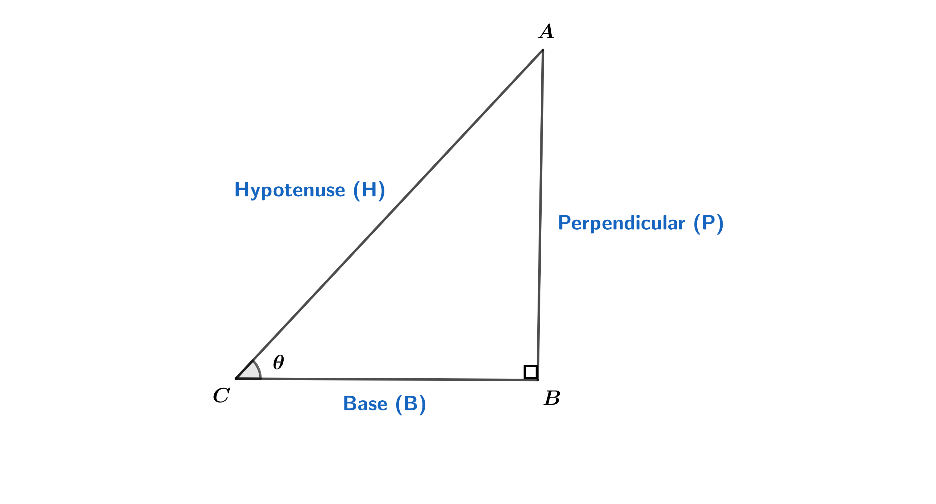
So, from figure, sin$\theta $ = $\dfrac{perpendicular(P)}{hypotenuse(H)}$
Let’s assume a triangle which is right angled at B. It’s sides are $\dfrac{\sqrt{2}}{2},\dfrac{\sqrt{2}}{2}$ and 1. Angles are: $\angle A=\dfrac{\pi }{4},\angle B=\dfrac{\pi }{2},\angle C=\dfrac{\pi }{4}$
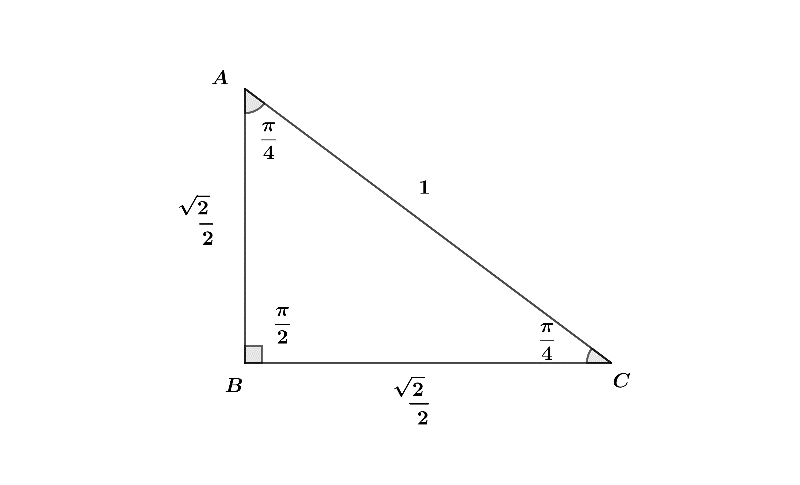
Let’s check whether the triangle satisfies Pythagoras theorem or not. According to Pythagoras theorem:
${{\left( hypotenuse \right)}^{2}}={{\left( base \right)}^{2}}+{{\left( perpendicular \right)}^{2}}$
$\Rightarrow {{\left( AC \right)}^{2}}={{\left( BC \right)}^{2}}+{{\left( AB \right)}^{2}}$
Now, put the values for base and perpendicular:
$\Rightarrow {{\left( AC \right)}^{2}}={{\left( \dfrac{\sqrt{2}}{2} \right)}^{2}}+{{\left( \dfrac{\sqrt{2}}{2} \right)}^{2}}$
Open the brackets and solve:
$\Rightarrow {{\left( AC \right)}^{2}}=\dfrac{2}{4}+\dfrac{2}{4}$
On adding, we get:
$\Rightarrow {{\left( AC \right)}^{2}}=\dfrac{4}{4}$
Cancel the like terms:
$\Rightarrow AC=\sqrt{1}$
$\therefore $AC = 1
Which proves that it satisfies Pythagoras theorem.
As we know that, sin$\theta $ = $\dfrac{perpendicular(P)}{hypotenuse(H)}$
According to the triangle,
$\Rightarrow \sin \left( \dfrac{\pi }{4} \right)=\dfrac{\sqrt{2}}{2}$
When we take to the other side, it will form an inverse function. So,
$\Rightarrow \dfrac{\pi }{4}={{\sin }^{-1}}\left( \dfrac{\sqrt{2}}{2} \right)$
So we get the value as $\dfrac{\pi }{4}$.
Note: Here, Pythagora's theorem is just used to check whether we have taken right sides and angles for right angled triangle or not. As we know that trigonometric functions work only on right angled triangles. Knowledge of basic trigonometric functions is very much necessary for solving such questions.
${{\left( hypotenuse \right)}^{2}}={{\left( base \right)}^{2}}+{{\left( perpendicular \right)}^{2}}$
Now, solve the problem and find its solution.
Complete step-by-step answer:
Here, the basic function of the trigonometry is used i.e. sine. Even some functions can be derived using this function. They are:
$\Rightarrow $cosec$\theta $ = $\dfrac{1}{\sin \theta }$
$\Rightarrow $sec$\theta $ = $\dfrac{1}{\cos \theta }$
$\Rightarrow $tan$\theta $ = $\dfrac{\sin \theta }{\cos \theta }$ = $\dfrac{1}{\cot \theta }$
$\Rightarrow $cot$\theta $ = $\dfrac{1}{\tan \theta }$ = $\dfrac{\cos \theta }{\sin \theta }$
Let’s see how we actually find the angle of a triangle using sine function.
So, from figure, sin$\theta $ = $\dfrac{perpendicular(P)}{hypotenuse(H)}$
Let’s assume a triangle which is right angled at B. It’s sides are $\dfrac{\sqrt{2}}{2},\dfrac{\sqrt{2}}{2}$ and 1. Angles are: $\angle A=\dfrac{\pi }{4},\angle B=\dfrac{\pi }{2},\angle C=\dfrac{\pi }{4}$
Let’s check whether the triangle satisfies Pythagoras theorem or not. According to Pythagoras theorem:
${{\left( hypotenuse \right)}^{2}}={{\left( base \right)}^{2}}+{{\left( perpendicular \right)}^{2}}$
$\Rightarrow {{\left( AC \right)}^{2}}={{\left( BC \right)}^{2}}+{{\left( AB \right)}^{2}}$
Now, put the values for base and perpendicular:
$\Rightarrow {{\left( AC \right)}^{2}}={{\left( \dfrac{\sqrt{2}}{2} \right)}^{2}}+{{\left( \dfrac{\sqrt{2}}{2} \right)}^{2}}$
Open the brackets and solve:
$\Rightarrow {{\left( AC \right)}^{2}}=\dfrac{2}{4}+\dfrac{2}{4}$
On adding, we get:
$\Rightarrow {{\left( AC \right)}^{2}}=\dfrac{4}{4}$
Cancel the like terms:
$\Rightarrow AC=\sqrt{1}$
$\therefore $AC = 1
Which proves that it satisfies Pythagoras theorem.
As we know that, sin$\theta $ = $\dfrac{perpendicular(P)}{hypotenuse(H)}$
According to the triangle,
$\Rightarrow \sin \left( \dfrac{\pi }{4} \right)=\dfrac{\sqrt{2}}{2}$
When we take to the other side, it will form an inverse function. So,
$\Rightarrow \dfrac{\pi }{4}={{\sin }^{-1}}\left( \dfrac{\sqrt{2}}{2} \right)$
So we get the value as $\dfrac{\pi }{4}$.
Note: Here, Pythagora's theorem is just used to check whether we have taken right sides and angles for right angled triangle or not. As we know that trigonometric functions work only on right angled triangles. Knowledge of basic trigonometric functions is very much necessary for solving such questions.
Recently Updated Pages
Which will be the least stable resonating structure class 11 chemistry CBSE

How many 5 digit telephone numbers can be construc-class-11-maths-CBSE
How do you find the angle of the resultant vector class 11 physics CBSE
Draw labelled diagram of the following i Gram seed class 11 biology CBSE
1 Quintal is equal to a 110 kg b 10 kg c 100kg d 1000 class 11 physics CBSE
What is the need and importance of classification class 11 biology CBSE
Trending doubts
One Metric ton is equal to kg A 10000 B 1000 C 100 class 11 physics CBSE
Find the value of the expression given below sin 30circ class 11 maths CBSE
Draw a diagram of nephron and explain its structur class 11 biology CBSE
10 examples of friction in our daily life
Proton was discovered by A Thomson B Rutherford C Chadwick class 11 chemistry CBSE
The teeth used for biting and cutting food are called class 11 biology CBSE