




How do you find the exact values of cotangent, cosecant and secant for $45$ degrees?
Answer
 Verified
502.2k+ views
Hint: The given question involves the basic concepts of trigonometric functions. The value of trigonometric ratios is always calculated in a right angled triangle. There are six main trigonometric ratios which are the ratios of different pairs of sides of a right angled triangle: base, altitude and hypotenuse. We first draw a right angled triangle and then calculate the trigonometric ratios accordingly.
Complete step-by-step answer:
The trigonometry is a Greek word whose meaning is derived as:
“Tri” means three while “Gon” means sides and “Metron” means measure. It helps in studying the relation between the three sides and three angles of the triangle.
The main values at which trigonometric ratios are given and easy to calculate are: ${0^ \circ }$, ${30^ \circ }$, ${45^ \circ }$, ${60^ \circ }$ and ${90^ \circ }$. The values of the six trigonometric ratios is easy to determine at multiples of the above given numbers.
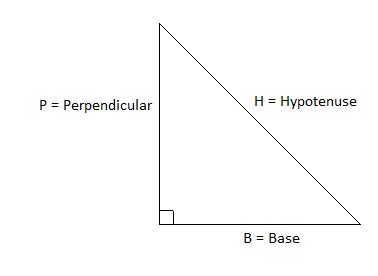
Trigonometric ratios in terms of sides of triangle are given as:
Sine of an angle is the ratio of perpendicular side to the angle to the hypotenuse of the triangle. So, $\sin \theta = \dfrac{{Perpendicular}}{{Hypotenuse}}$.
Cosine of an angle is the ratio of base side of the angle to the hypotenuse of the triangle. So, $\cos \theta = \dfrac{{Base}}{{Hypotenuse}}$.
Tangent of an angle is the ratio of perpendicular side to the angle to the base side of the angle. So, $\tan \theta = \dfrac{{Perpendicular}}{{Base}}$.
Now, cotangent, cosecant and secant are the reciprocal functions of tangent, sine and cosine functions respectively.
So, we get,
Cosecant of an angle is the ratio of hypotenuse of the triangle to the perpendicular side to the angle. So, $\cos ec\theta = \dfrac{{Hypotenuse}}{{Perpendicular}}$.
Secant of an angle is the ratio of hypotenuse of the triangle to the base side of the angle. So, $\sec \theta = \dfrac{{Hypotenuse}}{{Base}}$.
Cotangent of an angle is the ratio of base side of angle to the perpendicular side to the angle.
\[\cot \theta = \dfrac{{Base}}{{Perpendicular}}\]
Now, we know the values of cosine, sine and tangent for the angle $45$ degrees as:
$\sin {45^ \circ } = \dfrac{1}{{\sqrt 2 }}$ , $\tan {45^ \circ } = 1$and $\cos {45^ \circ } = \dfrac{1}{{\sqrt 2 }}$.
As we know that cosecant is the reciprocal of sine. So, we get, $\cos ec\left( {{{45}^ \circ }} \right) = \dfrac{1}{{\sin \left( {{{45}^ \circ }} \right)}}$.
Substituting the value of $\sin {45^ \circ }$,
$\cos ec\left( {{{45}^ \circ }} \right) = \dfrac{1}{{\left( {\dfrac{1}{{\sqrt 2 }}} \right)}}$
$ \Rightarrow \cos ec\left( {{{45}^ \circ }} \right) = \sqrt 2 $
We know that cotangent is the reciprocal of tangent. So, we get, $\cot \left( {{{45}^ \circ }} \right) = \dfrac{1}{{\tan \left( {{{45}^ \circ }} \right)}}$.
Substituting the value of $\tan {45^ \circ }$,
$ \Rightarrow \cot \left( {{{45}^ \circ }} \right) = \dfrac{1}{1} = 1$
We know that secant is the reciprocal of cosine. So, we get, $\sec \left( {{{45}^ \circ }} \right) = \dfrac{1}{{\cos \left( {{{45}^ \circ }} \right)}}$.
Substituting the value of $\cos {45^ \circ }$,
$sec\left( {{{45}^ \circ }} \right) = \dfrac{1}{{\left( {\dfrac{1}{{\sqrt 2 }}} \right)}}$
$ \Rightarrow \sec \left( {{{45}^ \circ }} \right) = \sqrt 2 $
The values of trigonometric ratios for angle ${45^ \circ }$ are given as:
$\cos ec\left( {{{45}^ \circ }} \right) = \sqrt 2 $
$\sec \left( {{{45}^ \circ }} \right) = \sqrt 2 $
$\tan \left( {{{45}^ \circ }} \right) = 1$
Note:
The value of trigonometric ratio of given angle remains the same and does not change according to change in sides of the triangle as the ratio of the sides of the triangle remains same. We must know the values of trigonometric functions for some standard angles in order to solve the given question such as: ${0^ \circ }$, ${30^ \circ }$, ${45^ \circ }$, ${60^ \circ }$ and ${90^ \circ }$ because the values of trigonometric functions for other angles can be derived from the values of trigonometric functions of these standard angles.
Complete step-by-step answer:
The trigonometry is a Greek word whose meaning is derived as:
“Tri” means three while “Gon” means sides and “Metron” means measure. It helps in studying the relation between the three sides and three angles of the triangle.
The main values at which trigonometric ratios are given and easy to calculate are: ${0^ \circ }$, ${30^ \circ }$, ${45^ \circ }$, ${60^ \circ }$ and ${90^ \circ }$. The values of the six trigonometric ratios is easy to determine at multiples of the above given numbers.
Trigonometric ratios in terms of sides of triangle are given as:
Sine of an angle is the ratio of perpendicular side to the angle to the hypotenuse of the triangle. So, $\sin \theta = \dfrac{{Perpendicular}}{{Hypotenuse}}$.
Cosine of an angle is the ratio of base side of the angle to the hypotenuse of the triangle. So, $\cos \theta = \dfrac{{Base}}{{Hypotenuse}}$.
Tangent of an angle is the ratio of perpendicular side to the angle to the base side of the angle. So, $\tan \theta = \dfrac{{Perpendicular}}{{Base}}$.
Now, cotangent, cosecant and secant are the reciprocal functions of tangent, sine and cosine functions respectively.
So, we get,
Cosecant of an angle is the ratio of hypotenuse of the triangle to the perpendicular side to the angle. So, $\cos ec\theta = \dfrac{{Hypotenuse}}{{Perpendicular}}$.
Secant of an angle is the ratio of hypotenuse of the triangle to the base side of the angle. So, $\sec \theta = \dfrac{{Hypotenuse}}{{Base}}$.
Cotangent of an angle is the ratio of base side of angle to the perpendicular side to the angle.
\[\cot \theta = \dfrac{{Base}}{{Perpendicular}}\]
Now, we know the values of cosine, sine and tangent for the angle $45$ degrees as:
$\sin {45^ \circ } = \dfrac{1}{{\sqrt 2 }}$ , $\tan {45^ \circ } = 1$and $\cos {45^ \circ } = \dfrac{1}{{\sqrt 2 }}$.
As we know that cosecant is the reciprocal of sine. So, we get, $\cos ec\left( {{{45}^ \circ }} \right) = \dfrac{1}{{\sin \left( {{{45}^ \circ }} \right)}}$.
Substituting the value of $\sin {45^ \circ }$,
$\cos ec\left( {{{45}^ \circ }} \right) = \dfrac{1}{{\left( {\dfrac{1}{{\sqrt 2 }}} \right)}}$
$ \Rightarrow \cos ec\left( {{{45}^ \circ }} \right) = \sqrt 2 $
We know that cotangent is the reciprocal of tangent. So, we get, $\cot \left( {{{45}^ \circ }} \right) = \dfrac{1}{{\tan \left( {{{45}^ \circ }} \right)}}$.
Substituting the value of $\tan {45^ \circ }$,
$ \Rightarrow \cot \left( {{{45}^ \circ }} \right) = \dfrac{1}{1} = 1$
We know that secant is the reciprocal of cosine. So, we get, $\sec \left( {{{45}^ \circ }} \right) = \dfrac{1}{{\cos \left( {{{45}^ \circ }} \right)}}$.
Substituting the value of $\cos {45^ \circ }$,
$sec\left( {{{45}^ \circ }} \right) = \dfrac{1}{{\left( {\dfrac{1}{{\sqrt 2 }}} \right)}}$
$ \Rightarrow \sec \left( {{{45}^ \circ }} \right) = \sqrt 2 $
The values of trigonometric ratios for angle ${45^ \circ }$ are given as:
$\cos ec\left( {{{45}^ \circ }} \right) = \sqrt 2 $
$\sec \left( {{{45}^ \circ }} \right) = \sqrt 2 $
$\tan \left( {{{45}^ \circ }} \right) = 1$
Note:
The value of trigonometric ratio of given angle remains the same and does not change according to change in sides of the triangle as the ratio of the sides of the triangle remains same. We must know the values of trigonometric functions for some standard angles in order to solve the given question such as: ${0^ \circ }$, ${30^ \circ }$, ${45^ \circ }$, ${60^ \circ }$ and ${90^ \circ }$ because the values of trigonometric functions for other angles can be derived from the values of trigonometric functions of these standard angles.
Recently Updated Pages
Master Class 12 Economics: Engaging Questions & Answers for Success

Master Class 12 English: Engaging Questions & Answers for Success
Master Class 12 Social Science: Engaging Questions & Answers for Success
Master Class 12 Maths: Engaging Questions & Answers for Success
Master Class 12 Physics: Engaging Questions & Answers for Success
Master Class 9 General Knowledge: Engaging Questions & Answers for Success
Trending doubts
One Metric ton is equal to kg A 10000 B 1000 C 100 class 11 physics CBSE
Difference Between Prokaryotic Cells and Eukaryotic Cells
Two of the body parts which do not appear in MRI are class 11 biology CBSE
Find the value of the expression given below sin 30circ class 11 maths CBSE
1 ton equals to A 100 kg B 1000 kg C 10 kg D 10000 class 11 physics CBSE
Draw a diagram of nephron and explain its structur class 11 biology CBSE