




How do you find the exact value of ${\sin ^{ - 1}}( - 1)$?
Answer
 Verified
591k+ views
Hint: The arcsin is the inverse of the trigonometric representation of sine. The range of arcsine is from negative of $\dfrac{\pi }{2}$ to positive of $\dfrac{\pi }{2}$. The domain of arcsin is from negative 1 to positive 1. It is a bijective function, which means it will be invertible. This property will be very useful in this question.
Complete step by step solution:
According to the question, we have to find the value of ${\sin ^{ - 1}}( - 1)$,
So, let ${\sin ^{ - 1}}( - 1)$=x
Now,
Let us draw a triangle with $\sin x$= $ - 1$
In this right-angled triangle,
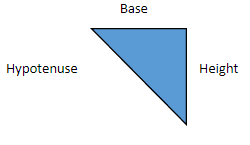
We have considered the angle between base and Hypotenuse as x.
The angle between the base and the height $= 90^{\circ}$
Now taking sine function both sides we will get,
$\sin ({\sin ^{ - 1}}( - 1)) = \sin (x)$
And as we know that $\sin ({\sin ^{ - 1}}\theta ) = \theta $, so in above equation $\theta = ( - 1)$
Hence, the equation changes to $\sin (x) = ( - 1)$
So, as we know the value of $\sin \theta $ for different values of $\theta $, we know that when $\theta $ = 270° or (-90°), $\sin \theta $ will give the value $ - 1$.
Hence now we know that for getting a result equal to a negative one, we must give input as $\theta $ = 270° or (-90°),
So, our answer $x = \dfrac{{3\pi }}{2}$ or $x = - \dfrac{\pi }{2}$.
Note:
The arcsin is the inverse of the tan trigonometric function. It is a bijective function, that is, it gives a unique value of every unique input and for every output one single input is considered. Bijective also means it is invertible, that is why we changed arsine to sin easily in our solution. This property is valid only for its respective domain, which is from a negative one to positive one.
Complete step by step solution:
According to the question, we have to find the value of ${\sin ^{ - 1}}( - 1)$,
So, let ${\sin ^{ - 1}}( - 1)$=x
Now,
Let us draw a triangle with $\sin x$= $ - 1$
In this right-angled triangle,
We have considered the angle between base and Hypotenuse as x.
The angle between the base and the height $= 90^{\circ}$
Now taking sine function both sides we will get,
$\sin ({\sin ^{ - 1}}( - 1)) = \sin (x)$
And as we know that $\sin ({\sin ^{ - 1}}\theta ) = \theta $, so in above equation $\theta = ( - 1)$
Hence, the equation changes to $\sin (x) = ( - 1)$
So, as we know the value of $\sin \theta $ for different values of $\theta $, we know that when $\theta $ = 270° or (-90°), $\sin \theta $ will give the value $ - 1$.
Hence now we know that for getting a result equal to a negative one, we must give input as $\theta $ = 270° or (-90°),
So, our answer $x = \dfrac{{3\pi }}{2}$ or $x = - \dfrac{\pi }{2}$.
Note:
The arcsin is the inverse of the tan trigonometric function. It is a bijective function, that is, it gives a unique value of every unique input and for every output one single input is considered. Bijective also means it is invertible, that is why we changed arsine to sin easily in our solution. This property is valid only for its respective domain, which is from a negative one to positive one.
Recently Updated Pages
Master Class 12 Economics: Engaging Questions & Answers for Success

Master Class 12 English: Engaging Questions & Answers for Success
Master Class 12 Social Science: Engaging Questions & Answers for Success
Master Class 12 Maths: Engaging Questions & Answers for Success
Master Class 12 Physics: Engaging Questions & Answers for Success
Master Class 11 Social Science: Engaging Questions & Answers for Success
Trending doubts
One Metric ton is equal to kg A 10000 B 1000 C 100 class 11 physics CBSE
Difference Between Prokaryotic Cells and Eukaryotic Cells
Find the value of the expression given below sin 30circ class 11 maths CBSE
Two of the body parts which do not appear in MRI are class 11 biology CBSE
Draw a diagram of nephron and explain its structur class 11 biology CBSE
10 examples of friction in our daily life