




How do you find the exact value of \[arctan1\text{ or }{{\tan }^{-1}}1\]?
Answer
 Verified
580.8k+ views
Hint:
tan\[x\] is the ratio of \[perpendicular\] to \[base\] in a right angled triangle and if this ratio is \[1\] that means the two sides are equal and using the property of an isosceles triangle their corresponding angles are also equal and that is \[45{}^\circ \] each by applying the angle sum property.
Complete step by step solution:
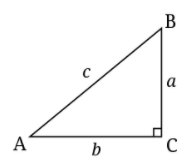
As we know that the \[tangent\] function for acute angles can be viewed as the ratio of the opposite to the adjacent side of the angle.
\[\Rightarrow \tan A=\dfrac{perpendicular}{base}=\dfrac{a}{b}\]
Let the given value \[{{\tan }^{-1}}1\] be \[x\]
\[\Rightarrow {{\tan }^{-1}}1=x\]
Now taking \[\tan \]both sides
\[\Rightarrow \tan \left( {{\tan }^{-1}}1 \right)=x\]
\[\Rightarrow 1=\tan x\]
If the ratio is 1, it means that the triangle is a right angle isosceles
Therefore, \[m\angle A=m\angle B--(1)\]
Now, using the angle sum property of the triangle
\[\Rightarrow \angle A+\angle B+\angle C=\angle 180{}^\circ --(2)\]
Since \[\angle C=90{}^\circ --(3)\]
From Equation \[(1),(2),(3)\]
\[\begin{align}
& \Rightarrow \angle A+\angle B=90{}^\circ \\
& \Rightarrow \angle A=\angle B=45{}^\circ \\
\end{align}\]
And therefore the corresponding angle is \[45{}^\circ \] degrees of \[\dfrac{\pi }{4}rad\].
Hence, \[\arctan 1=\dfrac{\pi }{4}\]
Note:
To find the exact value we will use the basic foundations of trigonometry. Normally for \[45{}^\circ \] or \[\dfrac{\pi}{4} radian\] and in general form \[(2n+1)\dfrac{\pi }{4}\] where \[n\in Z\] the length other two sides are equal and the domain of \[arctan1\text{ or }{{\tan }^{-1}}1\] is \[\left[ -1,1 \right]\] and the range is \[\left( -\dfrac{\pi }{2},\dfrac{\pi }{2} \right)\].
tan\[x\] is the ratio of \[perpendicular\] to \[base\] in a right angled triangle and if this ratio is \[1\] that means the two sides are equal and using the property of an isosceles triangle their corresponding angles are also equal and that is \[45{}^\circ \] each by applying the angle sum property.
Complete step by step solution:
As we know that the \[tangent\] function for acute angles can be viewed as the ratio of the opposite to the adjacent side of the angle.
\[\Rightarrow \tan A=\dfrac{perpendicular}{base}=\dfrac{a}{b}\]
Let the given value \[{{\tan }^{-1}}1\] be \[x\]
\[\Rightarrow {{\tan }^{-1}}1=x\]
Now taking \[\tan \]both sides
\[\Rightarrow \tan \left( {{\tan }^{-1}}1 \right)=x\]
\[\Rightarrow 1=\tan x\]
If the ratio is 1, it means that the triangle is a right angle isosceles
Therefore, \[m\angle A=m\angle B--(1)\]
Now, using the angle sum property of the triangle
\[\Rightarrow \angle A+\angle B+\angle C=\angle 180{}^\circ --(2)\]
Since \[\angle C=90{}^\circ --(3)\]
From Equation \[(1),(2),(3)\]
\[\begin{align}
& \Rightarrow \angle A+\angle B=90{}^\circ \\
& \Rightarrow \angle A=\angle B=45{}^\circ \\
\end{align}\]
And therefore the corresponding angle is \[45{}^\circ \] degrees of \[\dfrac{\pi }{4}rad\].
Hence, \[\arctan 1=\dfrac{\pi }{4}\]
Note:
To find the exact value we will use the basic foundations of trigonometry. Normally for \[45{}^\circ \] or \[\dfrac{\pi}{4} radian\] and in general form \[(2n+1)\dfrac{\pi }{4}\] where \[n\in Z\] the length other two sides are equal and the domain of \[arctan1\text{ or }{{\tan }^{-1}}1\] is \[\left[ -1,1 \right]\] and the range is \[\left( -\dfrac{\pi }{2},\dfrac{\pi }{2} \right)\].
Recently Updated Pages
Three beakers labelled as A B and C each containing 25 mL of water were taken A small amount of NaOH anhydrous CuSO4 and NaCl were added to the beakers A B and C respectively It was observed that there was an increase in the temperature of the solutions contained in beakers A and B whereas in case of beaker C the temperature of the solution falls Which one of the following statements isarecorrect i In beakers A and B exothermic process has occurred ii In beakers A and B endothermic process has occurred iii In beaker C exothermic process has occurred iv In beaker C endothermic process has occurred

Master Class 11 Social Science: Engaging Questions & Answers for Success
Master Class 11 Physics: Engaging Questions & Answers for Success
Master Class 11 Maths: Engaging Questions & Answers for Success
Master Class 11 Economics: Engaging Questions & Answers for Success
Master Class 11 Computer Science: Engaging Questions & Answers for Success
Three beakers labelled as A B and C each containing 25 mL of water were taken A small amount of NaOH anhydrous CuSO4 and NaCl were added to the beakers A B and C respectively It was observed that there was an increase in the temperature of the solutions contained in beakers A and B whereas in case of beaker C the temperature of the solution falls Which one of the following statements isarecorrect i In beakers A and B exothermic process has occurred ii In beakers A and B endothermic process has occurred iii In beaker C exothermic process has occurred iv In beaker C endothermic process has occurred
Master Class 11 Social Science: Engaging Questions & Answers for Success
Master Class 11 Physics: Engaging Questions & Answers for Success
Trending doubts
One Metric ton is equal to kg A 10000 B 1000 C 100 class 11 physics CBSE
There are 720 permutations of the digits 1 2 3 4 5 class 11 maths CBSE
State and prove Bernoullis theorem class 11 physics CBSE
Draw a diagram of a plant cell and label at least eight class 11 biology CBSE
Difference Between Prokaryotic Cells and Eukaryotic Cells
1 Quintal is equal to a 110 kg b 10 kg c 100kg d 1000 class 11 physics CBSE