




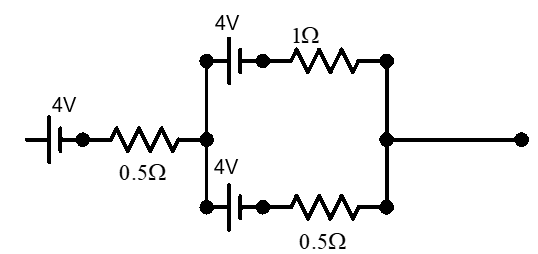
Find the equivalent emf of the three batteries as shown in the figure below.
Answer
 Verified
618.3k+ views
Hint: We can find the equivalent emf due to the combination of batteries by substituting in appropriate relations for series and parallel combinations. We have both the combination, so we have to find the equivalent emf through many steps starting from basic equations.
Complete answer:
Let us consider a combination of two batteries of emf \[{{\varepsilon }_{1}}\text{ and }{{\varepsilon }_{2}}\] connected in series with an internal resistance of r1 and r2 respectively.
We know that in a series combination the current remains a constant, that gives the following relation –
\[\begin{align}
& {{\varepsilon }_{1}}={{V}_{1}}-I{{r}_{1}} \\
& \Rightarrow {{V}_{1}}={{\varepsilon }_{1}}+I{{r}_{1}} \\
& \text{and, } \\
& {{\varepsilon }_{2}}={{V}_{2}}-I{{r}_{2}} \\
& \Rightarrow {{V}_{2}}={{\varepsilon }_{2}}+I{{r}_{2}} \\
& \Rightarrow V={{V}_{1}}+{{V}_{2}} \\
& \therefore V=({{\varepsilon }_{1}}+{{\varepsilon }_{2}})+I({{r}_{1}}+{{r}_{2}}) \\
& \Rightarrow {{\varepsilon }_{eq}}={{\varepsilon }_{1}}+{{\varepsilon }_{2}} \\
\end{align}\]
Similarly, if we connect the given batteries parallel we get –
\[\begin{align}
& {{\varepsilon }_{1}}=V-{{I}_{1}}{{r}_{1}} \\
& \Rightarrow {{I}_{1}}=\dfrac{{{\varepsilon }_{1}}-V}{{{r}_{1}}} \\
& \text{and, } \\
& {{\varepsilon }_{2}}=V-{{I}_{1}}{{r}_{2}} \\
& \Rightarrow {{I}_{2}}=\dfrac{{{\varepsilon }_{2}}-V}{{{r}_{2}}} \\
\end{align}\]
We know that in a parallel combination, the voltage is constant and the current is distributed among the two parallel cells according to their emf and internal resistance as -
\[\begin{align}
& \Rightarrow I={{I}_{1}}+{{I}_{2}} \\
& \therefore I=\dfrac{{{\varepsilon }_{1}}-V}{{{r}_{1}}}+\dfrac{{{\varepsilon }_{2}}-V}{{{r}_{2}}} \\
& I=\dfrac{{{\varepsilon }_{1}}}{{{r}_{1}}}+\dfrac{{{\varepsilon }_{2}}}{{{r}_{2}}}-V(\dfrac{1}{{{r}_{1}}}+\dfrac{1}{{{r}_{2}}}) \\
& \Rightarrow V=-[I-(\dfrac{{{\varepsilon }_{1}}}{{{r}_{1}}}+\dfrac{{{\varepsilon }_{2}}}{{{r}_{2}}})]\dfrac{{{r}_{1}}{{r}_{2}}}{{{r}_{1}}+{{r}_{2}}} \\
& V=(\dfrac{{{\varepsilon }_{1}}}{{{r}_{1}}}+\dfrac{{{\varepsilon }_{2}}}{{{r}_{2}}})(\dfrac{{{r}_{1}}{{r}_{2}}}{{{r}_{1}}+{{r}_{2}}})-I\dfrac{{{r}_{1}}{{r}_{2}}}{{{r}_{1}}+{{r}_{2}}} \\
& \Rightarrow {{\varepsilon }_{eq}}=\dfrac{{{\varepsilon }_{1}}{{r}_{2}}}{{{r}_{1}}+{{r}_{2}}}+\dfrac{{{\varepsilon }_{2}}{{r}_{1}}}{{{r}_{1}}+{{r}_{2}}} \\
\end{align}\]
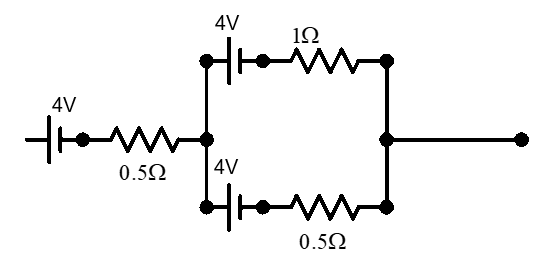
Now, let us consider the network given. Two of the batteries are connected parallel to each in series to the third. We can find the emf due to the parallel connections as –
\[\begin{align}
& {{\varepsilon }_{1}}={{\varepsilon }_{2}}=4V, \\
& {{r}_{1}}=1\Omega ,{{r}_{2}}=0.5\Omega \\
& {{\varepsilon }_{p}}=\dfrac{{{\varepsilon }_{1}}{{r}_{2}}}{{{r}_{1}}+{{r}_{2}}}+\dfrac{{{\varepsilon }_{2}}{{r}_{1}}}{{{r}_{1}}+{{r}_{2}}} \\
& \Rightarrow {{\varepsilon }_{p}}=\dfrac{(4\times 0.5)(4\times 1)}{0.5+1}=4V \\
\end{align}\]
Now, let us find the equivalent emf as –
\[\begin{align}
& {{\varepsilon }_{s}}={{\varepsilon }_{p}}=4V, \\
& {{r}_{1}}=0.5\Omega ,{{r}_{2}}=0.5\Omega \\
& {{\varepsilon }_{eq}}={{\varepsilon }_{1}}+{{\varepsilon }_{2}}=8V \\
\end{align}\]
So, the equivalent emf of the given circuit with a series-parallel combination of batteries is 8V.
Note:
The effective or equivalent resistance and emf should not be confused. The equivalent resistance of a network can be found easily if we can figure out the type of network involved. For the equivalent emf also, the type of network is understood initially to work out but with a more complex formula.
Complete answer:
Let us consider a combination of two batteries of emf \[{{\varepsilon }_{1}}\text{ and }{{\varepsilon }_{2}}\] connected in series with an internal resistance of r1 and r2 respectively.
We know that in a series combination the current remains a constant, that gives the following relation –
\[\begin{align}
& {{\varepsilon }_{1}}={{V}_{1}}-I{{r}_{1}} \\
& \Rightarrow {{V}_{1}}={{\varepsilon }_{1}}+I{{r}_{1}} \\
& \text{and, } \\
& {{\varepsilon }_{2}}={{V}_{2}}-I{{r}_{2}} \\
& \Rightarrow {{V}_{2}}={{\varepsilon }_{2}}+I{{r}_{2}} \\
& \Rightarrow V={{V}_{1}}+{{V}_{2}} \\
& \therefore V=({{\varepsilon }_{1}}+{{\varepsilon }_{2}})+I({{r}_{1}}+{{r}_{2}}) \\
& \Rightarrow {{\varepsilon }_{eq}}={{\varepsilon }_{1}}+{{\varepsilon }_{2}} \\
\end{align}\]
Similarly, if we connect the given batteries parallel we get –
\[\begin{align}
& {{\varepsilon }_{1}}=V-{{I}_{1}}{{r}_{1}} \\
& \Rightarrow {{I}_{1}}=\dfrac{{{\varepsilon }_{1}}-V}{{{r}_{1}}} \\
& \text{and, } \\
& {{\varepsilon }_{2}}=V-{{I}_{1}}{{r}_{2}} \\
& \Rightarrow {{I}_{2}}=\dfrac{{{\varepsilon }_{2}}-V}{{{r}_{2}}} \\
\end{align}\]
We know that in a parallel combination, the voltage is constant and the current is distributed among the two parallel cells according to their emf and internal resistance as -
\[\begin{align}
& \Rightarrow I={{I}_{1}}+{{I}_{2}} \\
& \therefore I=\dfrac{{{\varepsilon }_{1}}-V}{{{r}_{1}}}+\dfrac{{{\varepsilon }_{2}}-V}{{{r}_{2}}} \\
& I=\dfrac{{{\varepsilon }_{1}}}{{{r}_{1}}}+\dfrac{{{\varepsilon }_{2}}}{{{r}_{2}}}-V(\dfrac{1}{{{r}_{1}}}+\dfrac{1}{{{r}_{2}}}) \\
& \Rightarrow V=-[I-(\dfrac{{{\varepsilon }_{1}}}{{{r}_{1}}}+\dfrac{{{\varepsilon }_{2}}}{{{r}_{2}}})]\dfrac{{{r}_{1}}{{r}_{2}}}{{{r}_{1}}+{{r}_{2}}} \\
& V=(\dfrac{{{\varepsilon }_{1}}}{{{r}_{1}}}+\dfrac{{{\varepsilon }_{2}}}{{{r}_{2}}})(\dfrac{{{r}_{1}}{{r}_{2}}}{{{r}_{1}}+{{r}_{2}}})-I\dfrac{{{r}_{1}}{{r}_{2}}}{{{r}_{1}}+{{r}_{2}}} \\
& \Rightarrow {{\varepsilon }_{eq}}=\dfrac{{{\varepsilon }_{1}}{{r}_{2}}}{{{r}_{1}}+{{r}_{2}}}+\dfrac{{{\varepsilon }_{2}}{{r}_{1}}}{{{r}_{1}}+{{r}_{2}}} \\
\end{align}\]
Now, let us consider the network given. Two of the batteries are connected parallel to each in series to the third. We can find the emf due to the parallel connections as –
\[\begin{align}
& {{\varepsilon }_{1}}={{\varepsilon }_{2}}=4V, \\
& {{r}_{1}}=1\Omega ,{{r}_{2}}=0.5\Omega \\
& {{\varepsilon }_{p}}=\dfrac{{{\varepsilon }_{1}}{{r}_{2}}}{{{r}_{1}}+{{r}_{2}}}+\dfrac{{{\varepsilon }_{2}}{{r}_{1}}}{{{r}_{1}}+{{r}_{2}}} \\
& \Rightarrow {{\varepsilon }_{p}}=\dfrac{(4\times 0.5)(4\times 1)}{0.5+1}=4V \\
\end{align}\]
Now, let us find the equivalent emf as –
\[\begin{align}
& {{\varepsilon }_{s}}={{\varepsilon }_{p}}=4V, \\
& {{r}_{1}}=0.5\Omega ,{{r}_{2}}=0.5\Omega \\
& {{\varepsilon }_{eq}}={{\varepsilon }_{1}}+{{\varepsilon }_{2}}=8V \\
\end{align}\]
So, the equivalent emf of the given circuit with a series-parallel combination of batteries is 8V.
Note:
The effective or equivalent resistance and emf should not be confused. The equivalent resistance of a network can be found easily if we can figure out the type of network involved. For the equivalent emf also, the type of network is understood initially to work out but with a more complex formula.
Recently Updated Pages
Basicity of sulphurous acid and sulphuric acid are

Master Class 11 English: Engaging Questions & Answers for Success
Master Class 11 Physics: Engaging Questions & Answers for Success
Master Class 11 Computer Science: Engaging Questions & Answers for Success
Master Class 11 Chemistry: Engaging Questions & Answers for Success
Master Class 11 Social Science: Engaging Questions & Answers for Success
Trending doubts
Difference Between Prokaryotic Cells and Eukaryotic Cells
Two of the body parts which do not appear in MRI are class 11 biology CBSE
One Metric ton is equal to kg A 10000 B 1000 C 100 class 11 physics CBSE
10 examples of friction in our daily life
Draw a diagram of nephron and explain its structur class 11 biology CBSE
What will happen if the mucus is not secreted by the class 11 biology CBSE