




How do you find the equation of the line tangent to the graph of $f\left( x \right)={{x}^{2}}+5x$. at $x=4$?
Answer
 Verified
591.9k+ views
Hint: In this question we have to find the equation of a line which is tangent to the given graph. We will first substitute the value of $x=4$ in the given function to get the point $\left( {{x}_{1}},{{y}_{1}} \right)$. we will then find the slope $m$ of the tangent by using the limit function. we will then use the slope-intercept form $y-{{y}_{1}}=m\left( x-{{x}_{1}} \right)$ and rearrange to get the required equation of the tangent.
Complete step-by-step answer:
We have the function given to us $f\left( x \right)={{x}^{2}}+5x$.
On substituting $x=4$ in in the function, we get:
$\Rightarrow f\left( 4 \right)={{\left( 4 \right)}^{2}}+5\left( 4 \right)$
On simplifying, we get:
$\Rightarrow f\left( 4 \right)=16+20$
On adding the terms, we get:
$\Rightarrow f\left( 4 \right)=36$
Therefore, the point is $\left( {{x}_{1}},{{y}_{1}} \right)=\left( 4,36 \right)$.
Now we know that the slope of the tangent line to a graph of a given function $f$ at $x=a$ is given by the limit $\displaystyle \lim_{h \to 0}\dfrac{f\left( a+h \right)-f\left( a \right)}{h}$
So, in this question, we have $f\left( x \right)={{x}^{2}}+5x$ and $a=4$, so the slope of the tangent line can be calculated as:
$\Rightarrow \displaystyle \lim_{h \to 0}\dfrac{f\left( 4+h \right)-f\left( 4 \right)}{h}$
On substituting the function, we get:
$\Rightarrow \displaystyle \lim_{h \to 0}\dfrac{\left( {{\left( 4+h \right)}^{2}}+5\left( 4+h \right) \right)-\left( {{\left( 4 \right)}^{2}}+5\left( 4 \right) \right)}{h}$
On simplifying the terms, we get:
$\Rightarrow \displaystyle \lim_{h \to 0}\dfrac{16+8h+{{h}^{2}}+20+5h-\left( 16+20 \right)}{h}$
On simplifying the bracket, we get:
$\Rightarrow \displaystyle \lim_{h \to 0}\dfrac{16+8h+{{h}^{2}}+20+5h-16-20}{h}$
On simplifying, we get:
$\Rightarrow \displaystyle \lim_{h \to 0}\dfrac{8h+{{h}^{2}}+5h}{h}$
On adding the similar terms, we get:
$\Rightarrow \displaystyle \lim_{h \to 0}\dfrac{13h+{{h}^{2}}}{h}$
Now on taking $h$ common in the numerator, we get:
$\Rightarrow \displaystyle \lim_{h \to 0}\dfrac{h\left( 13+h \right)}{h}$
Now since $h \to 0$ and $h\ne 0$, on cancelling, we get:
$\Rightarrow \displaystyle \lim_{h \to 0}\left( 13+h \right)$
On putting the value of $h$, we get:
$\Rightarrow 13$, which is the slope of the tangent line therefore $m=13$.
Now to find the equation of the tangent, we will use the slope intercept form as:
$\Rightarrow y-{{y}_{1}}=m\left( x-{{x}_{1}} \right)$
On substituting $\left( {{x}_{1}},{{y}_{1}} \right)$ as $\left( 4,36 \right)$ and $m=13$, we get:
$\Rightarrow y-36=13\left( x-4 \right)$
On simplifying and rearranging the terms, we get:
$\Rightarrow y=13x-16$, which is the required equation for the tangent.
On drawing the function and the tangent on the graph, we get:
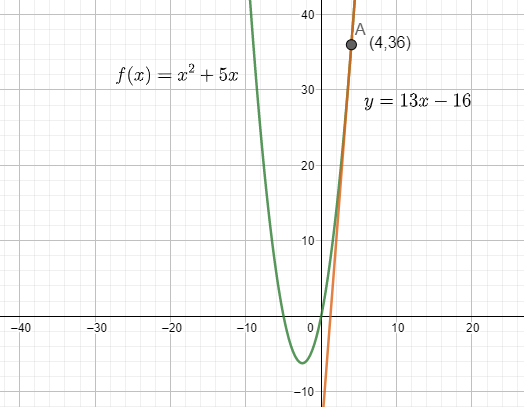
Which is the required solution.
Note: It is to be remembered that a tangent is a line segment which touches the given other curve on the graph through a point. The slope of the line $m$ tells us the steepness of the line. Slope of the line is also called the gradient of the line. It is to be remembered in limits that $h$ should not be substituted in the denominator such that $0$ is present in the denominator.
Complete step-by-step answer:
We have the function given to us $f\left( x \right)={{x}^{2}}+5x$.
On substituting $x=4$ in in the function, we get:
$\Rightarrow f\left( 4 \right)={{\left( 4 \right)}^{2}}+5\left( 4 \right)$
On simplifying, we get:
$\Rightarrow f\left( 4 \right)=16+20$
On adding the terms, we get:
$\Rightarrow f\left( 4 \right)=36$
Therefore, the point is $\left( {{x}_{1}},{{y}_{1}} \right)=\left( 4,36 \right)$.
Now we know that the slope of the tangent line to a graph of a given function $f$ at $x=a$ is given by the limit $\displaystyle \lim_{h \to 0}\dfrac{f\left( a+h \right)-f\left( a \right)}{h}$
So, in this question, we have $f\left( x \right)={{x}^{2}}+5x$ and $a=4$, so the slope of the tangent line can be calculated as:
$\Rightarrow \displaystyle \lim_{h \to 0}\dfrac{f\left( 4+h \right)-f\left( 4 \right)}{h}$
On substituting the function, we get:
$\Rightarrow \displaystyle \lim_{h \to 0}\dfrac{\left( {{\left( 4+h \right)}^{2}}+5\left( 4+h \right) \right)-\left( {{\left( 4 \right)}^{2}}+5\left( 4 \right) \right)}{h}$
On simplifying the terms, we get:
$\Rightarrow \displaystyle \lim_{h \to 0}\dfrac{16+8h+{{h}^{2}}+20+5h-\left( 16+20 \right)}{h}$
On simplifying the bracket, we get:
$\Rightarrow \displaystyle \lim_{h \to 0}\dfrac{16+8h+{{h}^{2}}+20+5h-16-20}{h}$
On simplifying, we get:
$\Rightarrow \displaystyle \lim_{h \to 0}\dfrac{8h+{{h}^{2}}+5h}{h}$
On adding the similar terms, we get:
$\Rightarrow \displaystyle \lim_{h \to 0}\dfrac{13h+{{h}^{2}}}{h}$
Now on taking $h$ common in the numerator, we get:
$\Rightarrow \displaystyle \lim_{h \to 0}\dfrac{h\left( 13+h \right)}{h}$
Now since $h \to 0$ and $h\ne 0$, on cancelling, we get:
$\Rightarrow \displaystyle \lim_{h \to 0}\left( 13+h \right)$
On putting the value of $h$, we get:
$\Rightarrow 13$, which is the slope of the tangent line therefore $m=13$.
Now to find the equation of the tangent, we will use the slope intercept form as:
$\Rightarrow y-{{y}_{1}}=m\left( x-{{x}_{1}} \right)$
On substituting $\left( {{x}_{1}},{{y}_{1}} \right)$ as $\left( 4,36 \right)$ and $m=13$, we get:
$\Rightarrow y-36=13\left( x-4 \right)$
On simplifying and rearranging the terms, we get:
$\Rightarrow y=13x-16$, which is the required equation for the tangent.
On drawing the function and the tangent on the graph, we get:
Which is the required solution.
Note: It is to be remembered that a tangent is a line segment which touches the given other curve on the graph through a point. The slope of the line $m$ tells us the steepness of the line. Slope of the line is also called the gradient of the line. It is to be remembered in limits that $h$ should not be substituted in the denominator such that $0$ is present in the denominator.
Recently Updated Pages
Master Class 11 English: Engaging Questions & Answers for Success

Master Class 11 Physics: Engaging Questions & Answers for Success
Master Class 11 Computer Science: Engaging Questions & Answers for Success
Master Class 11 Chemistry: Engaging Questions & Answers for Success
Master Class 11 Social Science: Engaging Questions & Answers for Success
Master Class 11 Accountancy: Engaging Questions & Answers for Success
Trending doubts
Difference Between Prokaryotic Cells and Eukaryotic Cells
Two of the body parts which do not appear in MRI are class 11 biology CBSE
One Metric ton is equal to kg A 10000 B 1000 C 100 class 11 physics CBSE
10 examples of friction in our daily life
Draw a diagram of nephron and explain its structur class 11 biology CBSE
Draw a diagram of a plant cell and label at least eight class 11 biology CBSE