




Find the equation of the hyperbola whose foci are $ (6,4) $ and $ ( - 4,4) $ and eccentricity is $ 2. $
Answer
 Verified
618.3k+ views
Hint: Hyperbola is two curves that are like infinite bows. Here, we need to find out the coordinates of the point through which the hyperbola passes. Also you will need a standard equation for hyperbola, to solve this numerical problem. So let’s get started.
Complete step-by-step answer:
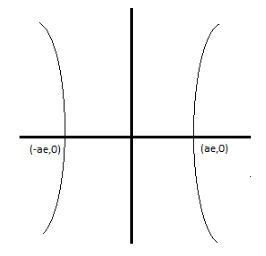
Here the foci of the hyperbola are given $ (6,4) $ and $ ( - 4,4) $ .
So, the centre of the hyperbola can be given as $ \left( {\dfrac{{6 - 4}}{2},\dfrac{{4 + 4}}{2}} \right) $
Simplify the above expression –
Centre $ (h,k) = \left( {\dfrac{2}{2},\dfrac{8}{2}} \right) $
Common factors from the numerator and the denominator cancel each other.
Centre $ (h,k) = \left( {1,4} \right) $ .... (A)
The distance between the two focus is $ = 2ae $
By using distance formula -
$ 2ae = \sqrt {{{(6 + 4)}^2} + {{(4 - 4)}^2}} $
Simplify the above equation. Like terms with the same value and opposite sign cancel each other.
$ 2ae = \sqrt {{{(10)}^2} + 0} $
When zero is added to any number the resultant is its original number itself.
$ \Rightarrow 2ae = \sqrt {{{(10)}^2}} $
Square and square-root cancel each other on the right hand side of the equation.
$ \Rightarrow 2ae = 10 $
Eccentricity, e is given, $ e = 2 $ place in the above equation –
$ \Rightarrow 2a2 = 10 $
Take all the terms on one side and make “a” the subject. When the term multiplicative on one side moves to the opposite side then it goes in the denominator.
$ \Rightarrow a = \dfrac{{10}}{{2 \times 2}} $
Common multiple from the numerator and the denominator cancel each other.
$ \Rightarrow a = \dfrac{5}{2} $
Squaring both the sides of the equation –
$ \Rightarrow {a^2} = \dfrac{{25}}{4} $ .... (B)
Now, we know the formula for the eccentricity for the hyperbola
$ {b^2} = {a^2}({e^2} - 1) $
Place the known values in the above equation-
$ \Rightarrow {b^2} = {\left( {\dfrac{5}{2}} \right)^2}({2^2} - 1) $
Simplify the above equation –
$
\Rightarrow {b^2} = \dfrac{{25}}{4}(4 - 1) \\
\Rightarrow {b^2} = \dfrac{{25}}{4}(3) \\
\Rightarrow {b^2} = \dfrac{{75}}{4}\;{\text{ }}.....{\text{ (C)}} \\
$
The equation of the hyperbola can be given as –
$ \dfrac{{{{(x - h)}^2}}}{{{a^2}}} - \dfrac{{{{(y - k)}^2}}}{{{b^2}}} = 1 $
Place values from the equation (A), (B) and (C)
$ \dfrac{{{{(x - 1)}^2}}}{{\dfrac{{25}}{4}}} - \dfrac{{{{(y - 4)}^2}}}{{\dfrac{{75}}{4}}} = 1 $
Denominator’s denominator goes to the numerator part.
$ \Rightarrow \dfrac{{4{{(x - 1)}^2}}}{{25}} - \dfrac{{4{{(y - 4)}^2}}}{{75}} = 1 $ is the required solution.
So, the correct answer is “ $ \dfrac{{4{{(x - 1)}^2}}}{{25}} - \dfrac{{4{{(y - 4)}^2}}}{{75}} = 1 $ ”.
Note: Be careful while simplifying. When you move any term multiplicative at one end to the opposite side then it goes to the denominator and there is no change in the sign of the term. Know the concepts of squares and square-root and apply accordingly.
Complete step-by-step answer:
Here the foci of the hyperbola are given $ (6,4) $ and $ ( - 4,4) $ .
So, the centre of the hyperbola can be given as $ \left( {\dfrac{{6 - 4}}{2},\dfrac{{4 + 4}}{2}} \right) $
Simplify the above expression –
Centre $ (h,k) = \left( {\dfrac{2}{2},\dfrac{8}{2}} \right) $
Common factors from the numerator and the denominator cancel each other.
Centre $ (h,k) = \left( {1,4} \right) $ .... (A)
The distance between the two focus is $ = 2ae $
By using distance formula -
$ 2ae = \sqrt {{{(6 + 4)}^2} + {{(4 - 4)}^2}} $
Simplify the above equation. Like terms with the same value and opposite sign cancel each other.
$ 2ae = \sqrt {{{(10)}^2} + 0} $
When zero is added to any number the resultant is its original number itself.
$ \Rightarrow 2ae = \sqrt {{{(10)}^2}} $
Square and square-root cancel each other on the right hand side of the equation.
$ \Rightarrow 2ae = 10 $
Eccentricity, e is given, $ e = 2 $ place in the above equation –
$ \Rightarrow 2a2 = 10 $
Take all the terms on one side and make “a” the subject. When the term multiplicative on one side moves to the opposite side then it goes in the denominator.
$ \Rightarrow a = \dfrac{{10}}{{2 \times 2}} $
Common multiple from the numerator and the denominator cancel each other.
$ \Rightarrow a = \dfrac{5}{2} $
Squaring both the sides of the equation –
$ \Rightarrow {a^2} = \dfrac{{25}}{4} $ .... (B)
Now, we know the formula for the eccentricity for the hyperbola
$ {b^2} = {a^2}({e^2} - 1) $
Place the known values in the above equation-
$ \Rightarrow {b^2} = {\left( {\dfrac{5}{2}} \right)^2}({2^2} - 1) $
Simplify the above equation –
$
\Rightarrow {b^2} = \dfrac{{25}}{4}(4 - 1) \\
\Rightarrow {b^2} = \dfrac{{25}}{4}(3) \\
\Rightarrow {b^2} = \dfrac{{75}}{4}\;{\text{ }}.....{\text{ (C)}} \\
$
The equation of the hyperbola can be given as –
$ \dfrac{{{{(x - h)}^2}}}{{{a^2}}} - \dfrac{{{{(y - k)}^2}}}{{{b^2}}} = 1 $
Place values from the equation (A), (B) and (C)
$ \dfrac{{{{(x - 1)}^2}}}{{\dfrac{{25}}{4}}} - \dfrac{{{{(y - 4)}^2}}}{{\dfrac{{75}}{4}}} = 1 $
Denominator’s denominator goes to the numerator part.
$ \Rightarrow \dfrac{{4{{(x - 1)}^2}}}{{25}} - \dfrac{{4{{(y - 4)}^2}}}{{75}} = 1 $ is the required solution.
So, the correct answer is “ $ \dfrac{{4{{(x - 1)}^2}}}{{25}} - \dfrac{{4{{(y - 4)}^2}}}{{75}} = 1 $ ”.
Note: Be careful while simplifying. When you move any term multiplicative at one end to the opposite side then it goes to the denominator and there is no change in the sign of the term. Know the concepts of squares and square-root and apply accordingly.
Recently Updated Pages
Basicity of sulphurous acid and sulphuric acid are

Master Class 11 English: Engaging Questions & Answers for Success
Master Class 11 Physics: Engaging Questions & Answers for Success
Master Class 11 Computer Science: Engaging Questions & Answers for Success
Master Class 11 Chemistry: Engaging Questions & Answers for Success
Master Class 11 Social Science: Engaging Questions & Answers for Success
Trending doubts
Difference Between Prokaryotic Cells and Eukaryotic Cells
Two of the body parts which do not appear in MRI are class 11 biology CBSE
One Metric ton is equal to kg A 10000 B 1000 C 100 class 11 physics CBSE
10 examples of friction in our daily life
Draw a diagram of nephron and explain its structur class 11 biology CBSE
What will happen if the mucus is not secreted by the class 11 biology CBSE