




How do you find the equation of the circle with centre at the origin and passing through \[\left( -6,2 \right)\]?
Answer
 Verified
563.1k+ views
Hint: In the above question we have to find the equation using the coordinates of two: one is the centre of the circle and the other is the point lying on the circle. Now the standard equation of the circle is \[{{(x-h)}^{2}}+{{(y-k)}^{2}}={{r}^{2}}\], here h and k are the centre of the circle and r is the radius of the given circle. Using the other point, we can find the radius of the circle using distance formula which is \[\sqrt{{{(x-{{x}_{1}})}^{2}}+{{(y-{{y}_{1}})}^{2}}}\] here \[x,{{x}_{1}}\] are x coordinates of the two point and \[y,{{y}_{1}}\] are the y coordinates of the two point.
Complete step by step answer:
In the above question the centre of the circle is given as the origin therefore, \[h=0,k=0\] as they coordinate of origin is \[(0,0)\].
Thus, the equation becomes \[{{(x-0)}^{2}}+{{(y-0)}^{2}}={{r}^{2}}\]
\[\Rightarrow {{x}^{2}}+{{y}^{2}}={{r}^{2}}\]
Also, \[\left( -6,2 \right)\] is the point through which the circle passes.
Now, to find the value of radius we will use the distance formula between the centre and the point through which the circle passes.
The values for the coordinates are
\[\begin{align}
& x=0,{{x}_{1}}=-6 \\
& y=0,{{y}_{1}}=2 \\
\end{align}\]
By applying distance formula
\[\begin{align}
& r=\sqrt{{{(x-{{x}_{1}})}^{2}}+{{(y-{{y}_{1}})}^{2}}} \\
& \Rightarrow r=\sqrt{{{(0-(-6))}^{2}}+{{(0-2)}^{2}}} \\
& \Rightarrow r=\sqrt{{{(6)}^{2}}+{{(-2)}^{2}}} \\
& \Rightarrow r=\sqrt{36+4} \\
& \Rightarrow r=\sqrt{40} \\
& \Rightarrow r=2\sqrt{10} \\
& \\
\end{align}\]
Thus, the value of radius is \[2\sqrt{10}\]
Now to find the equation of the circle we will substitute all the values in the general equation of the circle which is
\[{{(x-h)}^{2}}+{{(y-k)}^{2}}={{r}^{2}}\]
\[{{(x-0)}^{2}}+{{(y-0)}^{2}}={{r}^{2}}\]
\[\Rightarrow {{x}^{2}}+{{y}^{2}}={{r}^{2}}\]
Now substitute the value of r
\[\Rightarrow {{x}^{2}}+{{y}^{2}}={{(2\sqrt{10})}^{2}}\]
\[\Rightarrow {{x}^{2}}+{{y}^{2}}=40\]
Thus, the equation of the circle with centre at the origin and passing through\[\left( -6,2 \right)\] is \[{{x}^{2}}+{{y}^{2}}=40\]
Circle will look like
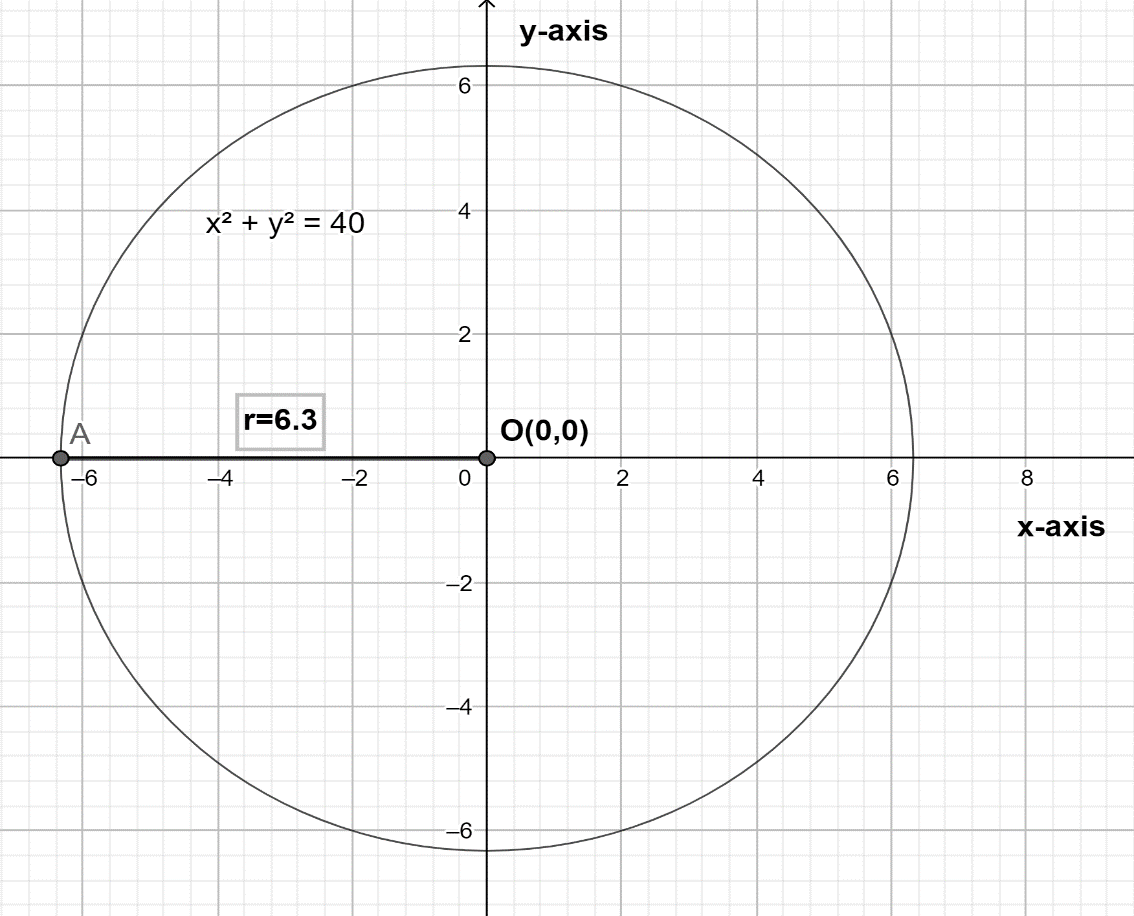
Note: Remember that \[{{x}^{2}}+{{y}^{2}}+2gx+2fy+c=0\] is the other general equation of a circle. We can solve the question using this equation also. It is very useful as it gives standard quantities of a circle in hand for example the radius of circle is \[\sqrt{{{g}^{2}}+{{f}^{2}}-c}\] and its centre is \[\left( -g,\text{ }-f \right)\]which is \[-\dfrac{1}{2}\] coefficient of x, \[-\dfrac{1}{2}\] coefficient of y. If the expression \[\sqrt{{{g}^{2}}+{{f}^{2}}-c}\] is equal to zero then the radius of circle is zero and the circle is known as point circle. If the expression is greater than zero then the circle is real and if the expression is less than zero then the circle is imaginary.
Complete step by step answer:
In the above question the centre of the circle is given as the origin therefore, \[h=0,k=0\] as they coordinate of origin is \[(0,0)\].
Thus, the equation becomes \[{{(x-0)}^{2}}+{{(y-0)}^{2}}={{r}^{2}}\]
\[\Rightarrow {{x}^{2}}+{{y}^{2}}={{r}^{2}}\]
Also, \[\left( -6,2 \right)\] is the point through which the circle passes.
Now, to find the value of radius we will use the distance formula between the centre and the point through which the circle passes.
The values for the coordinates are
\[\begin{align}
& x=0,{{x}_{1}}=-6 \\
& y=0,{{y}_{1}}=2 \\
\end{align}\]
By applying distance formula
\[\begin{align}
& r=\sqrt{{{(x-{{x}_{1}})}^{2}}+{{(y-{{y}_{1}})}^{2}}} \\
& \Rightarrow r=\sqrt{{{(0-(-6))}^{2}}+{{(0-2)}^{2}}} \\
& \Rightarrow r=\sqrt{{{(6)}^{2}}+{{(-2)}^{2}}} \\
& \Rightarrow r=\sqrt{36+4} \\
& \Rightarrow r=\sqrt{40} \\
& \Rightarrow r=2\sqrt{10} \\
& \\
\end{align}\]
Thus, the value of radius is \[2\sqrt{10}\]
Now to find the equation of the circle we will substitute all the values in the general equation of the circle which is
\[{{(x-h)}^{2}}+{{(y-k)}^{2}}={{r}^{2}}\]
\[{{(x-0)}^{2}}+{{(y-0)}^{2}}={{r}^{2}}\]
\[\Rightarrow {{x}^{2}}+{{y}^{2}}={{r}^{2}}\]
Now substitute the value of r
\[\Rightarrow {{x}^{2}}+{{y}^{2}}={{(2\sqrt{10})}^{2}}\]
\[\Rightarrow {{x}^{2}}+{{y}^{2}}=40\]
Thus, the equation of the circle with centre at the origin and passing through\[\left( -6,2 \right)\] is \[{{x}^{2}}+{{y}^{2}}=40\]
Circle will look like
Note: Remember that \[{{x}^{2}}+{{y}^{2}}+2gx+2fy+c=0\] is the other general equation of a circle. We can solve the question using this equation also. It is very useful as it gives standard quantities of a circle in hand for example the radius of circle is \[\sqrt{{{g}^{2}}+{{f}^{2}}-c}\] and its centre is \[\left( -g,\text{ }-f \right)\]which is \[-\dfrac{1}{2}\] coefficient of x, \[-\dfrac{1}{2}\] coefficient of y. If the expression \[\sqrt{{{g}^{2}}+{{f}^{2}}-c}\] is equal to zero then the radius of circle is zero and the circle is known as point circle. If the expression is greater than zero then the circle is real and if the expression is less than zero then the circle is imaginary.
Recently Updated Pages
Master Class 11 Social Science: Engaging Questions & Answers for Success

Master Class 11 Physics: Engaging Questions & Answers for Success
Master Class 11 Maths: Engaging Questions & Answers for Success
Master Class 11 Economics: Engaging Questions & Answers for Success
Master Class 11 Computer Science: Engaging Questions & Answers for Success
Master Class 11 Chemistry: Engaging Questions & Answers for Success
Trending doubts
One Metric ton is equal to kg A 10000 B 1000 C 100 class 11 physics CBSE
How many bones are in the spine class 11 biology CBSE
What is charge mass and charge to mass ratio of an class 11 chemistry CBSE
State and prove Bernoullis theorem class 11 physics CBSE
Difference Between Prokaryotic Cells and Eukaryotic Cells
1 Quintal is equal to a 110 kg b 10 kg c 100kg d 1000 class 11 physics CBSE